












































What Is Sentiment Analysis in Machine Learning?
Sentiment analysis in machine learning uses NLP and AI to analyze text, identify emotional tone, and classify opinions as truly positive, negative, or neutral.
What do users really express when they write reviews, post on social media, or share feedback about a product or service? Beyond ratings and numbers, they express emotions hidden in language. But how can machines understand whether that text is positive, negative, or neutral?
This is where Sentiment Analysis comes in — a technique that interprets emotional tone from written text and helps systems understand human opinions at scale. Before diving deeper, it is important first to understand what sentiment analysis actually is.
What Is Sentiment Analysis?
Sentiment analysis, sometimes called opinion mining, is a natural language processing (NLP) technique used to identify and extract the emotional tone of a piece of text. In simple terms, it teaches a machine to read a sentence and decide whether the writer feels positively, negatively, or neutrally about something.
A sentence like "The delivery was fast, but the packaging was damaged" is not straightforwardly positive or negative. It is mixed. Sentiment analysis helps a system parse that kind of nuance, flag the packaging issue, and attribute it to the right part of the customer experience.


At its core, sentiment analysis sits at the intersection of machine learning and linguistics. The model does not just scan for keywords — it learns the context, word order, and patterns that indicate meaning.
How Does Sentiment Analysis Work?
The process follows a few core steps to analyze and classify sentiment in text. They are:
1. Text Input: Raw text is collected from emails, reviews, social media, surveys, or transcripts.
2. Preprocessing: The text is cleaned, punctuation and stop words are removed, words are normalised to their root forms (called stemming or lemmatisation), and the text is converted into a numerical format that the model can work with.
3. Feature Extraction: The model identifies important signals in the text. This could include specific words, phrases, bigrams, or contextual embeddings, depending on the model type.
4. Classification: The model predicts a sentiment label, positive, negative, neutral, or assigns a sentiment score on a continuous scale.
5. Output: The result is delivered in a structured format that feeds into dashboards, alerts, CRM updates, or product feedback systems.
Modern approaches use deep learning models, particularly transformer architectures like BERT (Bidirectional Encoder Representations from Transformers), which understand context in both directions rather than reading text left to right only. This makes them far better at handling sarcasm, negation, and mixed-tone content.
Types of Sentiment Analysis in Machine Learning
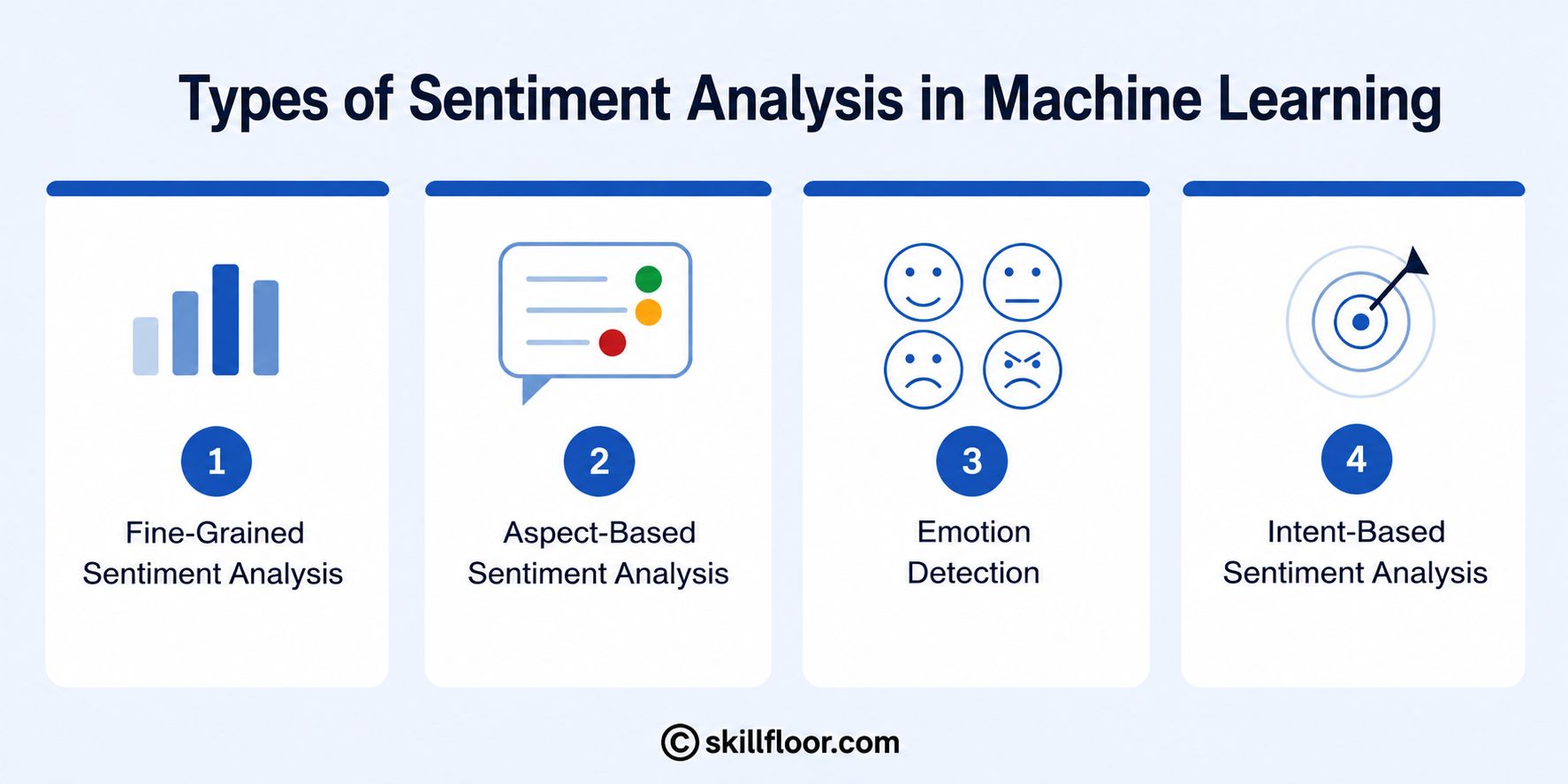
To understand opinions, emotions, and attitudes more accurately, different approaches are used based on the context and objective of sentiment analysis.
1. Fine-Grained Sentiment Analysis
Fine-grained sentiment analysis classifies text into multiple sentiment levels, such as very positive, positive, neutral, negative, and very negative. This approach provides a more detailed understanding of opinions than simple positive or negative classification. It is commonly used in product reviews and customer feedback systems where the intensity of sentiment matters.
2. Aspect-Based Sentiment Analysis
Aspect-based sentiment analysis focuses on specific features or aspects mentioned in a piece of text. Instead of analyzing the overall sentiment, it identifies opinions about individual elements. For example, in the review "The camera quality is excellent, but the battery life is poor," the sentiment is positive toward the camera and negative toward the battery.
3. Emotion Detection
Emotion detection goes beyond sentiment classification by identifying specific emotions such as happiness, anger, frustration, sadness, surprise, or excitement. This type of analysis helps provide a deeper understanding of how people feel and is often used in customer experience and social media monitoring.
4. Intent-Based Sentiment Analysis
Intent-based sentiment analysis aims to understand the purpose behind a statement in addition to its sentiment. It can identify whether a person is expressing interest, making a complaint, asking a question, or showing an intention to purchase. This helps organizations respond more effectively to customer needs and behaviors.
Common Techniques Used in Sentiment Analysis
There are three main technical approaches to building sentiment analysis systems, each offering unique advantages for sentiment classification.
|
Approach |
How It Works |
Best For |
Example Use Case |
|
Rule-Based |
Uses predefined dictionaries of positive and negative words to identify sentiment. |
Simple, domain-specific tasks. |
Customer helpdesk triage. |
|
Machine Learning |
Trains on labeled datasets to learn sentiment patterns and classify text automatically. |
Scalable and adaptable sentiment analysis. |
E-commerce product reviews. |
|
Deep Learning / NLP |
Uses advanced models such as BERT to understand context, relationships between words, and nuanced language. |
Complex and context-rich text analysis. |
Social media monitoring. |
For most real-world deployments today, deep learning models and transformer-based approaches are preferred because they handle linguistic complexity, negation, sarcasm, and informal language far better than earlier methods.
Real-World Applications of Sentiment Analysis
Sentiment analysis is widely used across industries to understand opinions and support faster, data-driven decisions.
|
Industry |
What Gets Analyzed |
Business Value |
|
E-Commerce |
Product reviews and return reasons |
Improve product listings and reduce returns |
|
Banking & Finance |
Customer feedback, social media mentions |
Identify dissatisfaction early, reduce churn |
|
Healthcare |
Patient feedback, online reviews |
Improve care quality and service delivery |
|
Media & Publishing |
Reader comments, content engagement |
Tune editorial tone and topic selection |
|
HR & Recruitment |
Employee surveys, exit interview notes |
Detect attrition risk, improve culture |
Beyond these sectors, sentiment analysis is embedded in recommendation engines, chatbot quality monitoring, political campaign analysis, and brand reputation management systems.
Common Tools and Libraries Used in Sentiment Analysis
If you are exploring sentiment analysis as a learner, these are some of the most commonly used NLP and sentiment analysis tools and libraries:
-
NLTK (Natural Language Toolkit) - a foundational Python library for NLP tasks
-
spaCy - a production-ready NLP library used widely in industry
-
Hugging Face Transformers - provides pre-trained models like BERT and RoBERTa for advanced sentiment tasks

-
TextBlob - beginner-friendly library for quick polarity and subjectivity analysis
-
VADER - rule-based model tuned specifically for social media language
-
AWS Comprehend, Google Cloud Natural Language API, and Azure Text Analytics - cloud-based sentiment services for enterprise use


For beginners, starting with NLTK or TextBlob gives you a working understanding of the fundamentals before moving into transformer-based models. If you are looking for structured guidance on this journey, Skillfloor offers beginner to advanced-level training that helps you build hands-on experience with these tools in real-world projects
Challenges and Limitations of Sentiment Analysis
No system is perfect. There are a few areas where sentiment analysis continues to struggle:
-
Understanding context: The same word can have different meanings depending on the sentence, making accurate sentiment detection difficult for models.
-
Sarcasm and irony: Sentences like “Great, another delay!” are hard to interpret because the literal meaning is opposite to the intended sentiment.
-
Mixed sentiments: A single sentence may contain both positive and negative opinions, such as “The product is good, but the service is poor.”
-
Slang and informal language: Social media language, abbreviations, and evolving slang make it difficult for models trained on standard text to stay accurate.
-
Language and cultural differences: Sentiment expression varies across languages and cultures, affecting model performance.
-
Data quality and bias: Poor or biased training data can lead to incorrect or inconsistent sentiment predictions.
Why Sentiment Analysis Is an Important Skill Today
Roles in data analytics, AI engineering, machine learning, and even product management increasingly require an understanding of NLP and text analytics. Sentiment analysis is one of the most practical starting points because:
-
It has immediate business relevance — companies can see the impact quickly
-
It bridges data science and business communication skills
-
It builds foundational NLP knowledge applicable to chatbots, recommendation systems, and AI assistants. It is used across sectors, so the skill transfers well
Whether you are targeting a role as a data analyst, ML engineer, or AI product specialist, being comfortable with NLP and sentiment analysis gives you an edge in a market that still has a shortage of people who can bridge language and data.
Frequently Asked Questions
1. Is sentiment analysis the same as NLP?
No. Sentiment analysis is a part of NLP that focuses on identifying emotions in text, while NLP encompasses broader tasks such as translation, summarization, and text generation.
2. Does sentiment analysis require programming knowledge?
Yes, basic programming (usually Python) is needed to work with tools and libraries like NLTK, spaCy, or Hugging Face, although concepts can be understood without coding.
3. How accurate is sentiment analysis?
Accuracy depends on the model and data. Advanced models perform well on clean data but may struggle with sarcasm, informal language, or multiple languages.
4. Is sentiment analysis supervised or unsupervised learning?
Most sentiment analysis models use supervised learning trained on labeled data, while unsupervised methods use lexicons but are less accurate for specific domains.
5. Which industries use sentiment analysis most?
Sentiment analysis is widely used in industries like retail, finance, healthcare, media, and customer support, wherever large amounts of text feedback need to be analyzed.
Sentiment analysis is a key technique in machine learning that helps transform unstructured text into meaningful emotional insights. It is widely used across industries to understand customer opinions, improve services, and support data-driven decision-making. From social media monitoring to product reviews, it plays a crucial role in modern business intelligence. Despite its challenges, like sarcasm and context understanding, continuous advancements in NLP are improving its accuracy. Overall, sentiment analysis remains an essential skill and technology in today’s AI-driven digital world.
Sources & references:
1. Learn More About Sentiment Analysis
https://en.wikipedia.org/wiki/Sentiment_analysis
2. Natural Language Toolkit (NLTK) Documentation
https://www.nltk.org/
3. Natural Language Processing
https://www.ibm.com/think/topics/natural-language-processing
Artificial Intelligence Course | Data Science Courses | Data Analytics Course | Digital Marketing Course
Digital Marketing Courses in Other Locations in India
Ahmedabad | Aurangabad | Bangalore | Bhilai | Bhopal | Bhubaneshwar | Chandigarh | Chennai | Cochin | Coimbatore | Dehra Dun | Delhi | Faridabad | Ghaziabad | Gorakhpur | Guntur | Gurgaon | Guwahati | Hyderabad | Jaipur | Kanpur | Khammam | Kolkata | Lucknow | Madurai | Mumbai | Mysore | Nagpur | Noida | Patna | Pondicherry | Pune | Ranchi | Shimoga | Surat | Thane | Thiruvananthapuram | Tiruchirappalli | Tirupati | Vadodara | Visakhapatnam | Warangal | Jalandhar | Jodhpur | Indore | Durgapur | Jamshedpur | Dhanbad | Kota | Karnal | Udaipur | Amritsar | calicut | Nashik | Ludhiana | varanasi | thrissur | Mangalore | Raipur |