




































How to Become a Performance Marketing Specialist in 2026
Learn how to become a Performance Marketing Specialist in 2026. Explore essential skills, tools, certifications, salary insights, and a practical career roadmap.
If you've ever searched for a product on Google or browsed Instagram and later seen ads that felt highly relevant, you've already experienced performance marketing in action. Businesses today invest heavily in paid advertising because every click, lead, and sale can be measured and optimised. As a result, companies are actively looking for Performance Marketing Specialists who can manage campaigns, analyse performance, and turn advertising budgets into real business growth.
Whether you're a student, recent graduate, working professional, or career switcher, performance marketing offers a career with strong demand and plenty of opportunities to grow. In this guide, you'll learn what a Performance Marketing Specialist does, the essential skills, tools, certifications, salary expectations in India, and the step-by-step roadmap to become job-ready in 2026.
What Is Performance Marketing?
Performance marketing is a digital marketing approach where advertisers pay only when a specific action is completed, such as a click, lead, sale, or app install. Unlike traditional advertising, which focuses on visibility, this model focuses on measurable results and ROI-driven outcomes. It allows marketers to track campaigns in real time and optimize strategies based on performance data.
Digital advertising spending is expected to reach $740 billion globally by 2026, with nearly 65–70% of marketing budgets shifting toward digital channels. Studies show that performance-based campaigns can improve conversion efficiency by up to 2x compared to traditional marketing methods, as every click and conversion is trackable. In India, digital ad spending is growing at around 15–20% annually, driven by e-commerce and SaaS growth. This rapid shift highlights the increasing demand for skilled professionals in this space.


What Does a Performance Marketing Specialist Actually Do?
A Performance Marketing Specialist manages paid advertising campaigns that help businesses achieve measurable goals such as generating leads, increasing online sales, driving app installs, and maximising return on ad spend (ROAS). Every campaign is continuously monitored, analysed, and optimised to improve performance and deliver better business results.
-
Launch and manage paid campaigns: Create and manage campaigns across platforms like Google Ads, Meta Ads, and LinkedIn Ads while aligning them with business objectives.
-
Target the right audience: Research customer segments, keywords, and audience behaviour to ensure ads reach the people most likely to convert.
-
Monitor and optimise performance: Track metrics such as CTR, CPC, CPA, Conversion Rate, and ROAS, and optimize bids, budgets, audience targeting, and ad creatives using the resulting performance data.
-
Run A/B tests: Experiment with different headlines, visuals, calls to action, and landing pages to identify what drives the highest conversions.
-
Measure and report results: Analyse campaign performance, prepare reports, and share actionable insights with clients or internal stakeholders to support business decisions.
Success in this role depends on balancing creativity with analytical thinking. While engaging ads help attract potential customers, data and performance marketing skills determine which campaigns to scale, refine, or stop to maximise marketing performance.
Is Performance Marketing the Right Career for You?
A career as a Performance Marketing Specialist is ideal for individuals who enjoy solving business challenges through data-driven decisions. If you like experimenting with campaigns, analysing performance, and turning insights into measurable results, performance marketing offers a dynamic and rewarding career path with strong long-term growth.
The role is well suited to people who enjoy continuous learning, adapting to evolving digital platforms, and improving campaigns through testing and optimisation. As more businesses invest in performance marketing, professionals with these skills continue to be in high demand across industries.
However, if you prefer roles that focus primarily on storytelling, content creation, or long-term brand building with less emphasis on campaign analysis and optimisation, other areas of digital marketing may be a better fit.
Ultimately, performance marketing is a career that combines creativity with analytical thinking to deliver measurable business outcomes. If you're looking for a role where your work directly contributes to business growth, becoming a Performance Marketing Specialist can be an excellent career choice.
Performance marketing is evolving rapidly with automation, AI-driven ad platforms, and advanced analytics shaping how campaigns are managed. Understanding where the industry is headed helps professionals stay updated and prepare for long-term growth in this field. Staying informed about the future of performance marketing careers is important for anyone planning to build a long-term career in this industry.
How Is a Performance Marketing Specialist Different from a General Digital Marketer?
Although both roles are part of digital marketing, they differ in their focus, responsibilities, and measures of success. A Performance Marketing Specialist specialises in paid advertising and campaign optimisation, while a General Digital Marketer manages multiple digital marketing channels to support overall business growth.
|
Aspect |
Performance Marketing Specialist |
General Digital Marketer |
|
Primary Focus |
Driving measurable results through paid advertising |
Managing multiple digital marketing channels and campaigns |
|
Marketing Channels |
Google Ads, Meta Ads, LinkedIn Ads, Programmatic, Affiliate Marketing |
SEO, Content Marketing, Social Media, Email Marketing, Paid Advertising |
|
Decision Making |
Based on campaign data, testing, and optimisation |
Balances data with content, branding, and customer engagement |
|
Success Metrics |
CPA, ROAS, Conversion Rate, Revenue, and Leads |
Traffic, Engagement, Brand Awareness, and Organic Growth |
|
Business Impact |
Directly contributes to revenue and marketing ROI |
Builds long-term brand visibility and supports overall marketing growth |
A Performance Marketing Specialist develops deeper expertise in paid advertising and campaign optimisation, while a General Digital Marketer builds skills across multiple digital marketing channels.
Skills You Need to Become a Performance Marketing Specialist
You don't need to master every skill before applying for your first role, but employers look for candidates who combine technical knowledge with analytical thinking and a willingness to learn. Building the following skills will help you become job-ready.
-
Paid Advertising Platforms: Learn to create, manage, and optimise campaigns on Google Ads, Meta Ads, and LinkedIn Ads while understanding bidding strategies, audience targeting, and campaign objectives.
-
Analytics and Reporting: Develop the ability to analyse campaign performance using Google Analytics 4 (GA4) and advertising dashboards to make informed, data-driven decisions.
-
Conversion Tracking: Understand how pixels, tags, and conversion events work so you can accurately measure campaign performance and user actions.
-
Budget Management: Learn how to allocate advertising budgets, optimise bids, and improve return on investment (ROI) without overspending.
-
A/B Testing: Test different ad creatives, headlines, audiences, and landing pages to identify what generates better engagement and conversions.
-
Copywriting and Creative Thinking: Write compelling ad copy, create effective calls-to-action, and understand what motivates users to take action.
-
Analytical and Problem-Solving Skills: Interpret campaign data, identify performance issues, and continuously optimise campaigns based on insights rather than assumptions.
Since digital advertising platforms evolve regularly, continuous learning and hands-on practice are just as important as technical skills.
Tools Every Performance Marketing Specialist Should Know
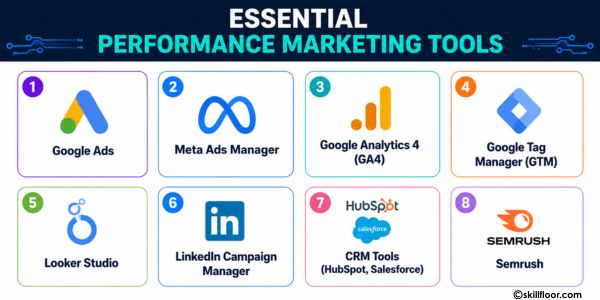
A Performance Marketing Specialist uses a combination of advertising, analytics, tracking, and reporting tools to execute and measure campaigns effectively. Understanding the most commonly used platforms helps improve campaign efficiency, optimisation, and decision-making. Familiarity with performance marketing tools also helps professionals streamline campaign management, monitor key metrics, and make data-driven optimisation decisions.
|
Tool |
Primary Use |
Why It Matters |
|
Google Ads |
Running Search, Display, Shopping, YouTube, and Performance Max campaigns |
Essential for driving paid traffic and conversions through Google's advertising network. |
|
Meta Ads Manager |
Creating and managing Facebook and Instagram ad campaigns |
Helps businesses reach highly targeted audiences and optimize social media advertising performance. |
|
Google Analytics 4 (GA4) |
Tracking website traffic, user behavior, and conversions |
Provides insights into campaign performance and customer journeys for data-driven decisions. |
|
Google Tag Manager (GTM) |
Managing tracking codes, pixels, and conversion events |
Simplifies website tracking without requiring frequent code changes. |
|
Looker Studio |
Building interactive dashboards and performance reports |
Combines marketing data into easy-to-understand visual reports for better analysis. |
|
LinkedIn Campaign Manager |
Running B2B advertising and lead generation campaigns |
Ideal for targeting professionals, decision-makers, and business audiences. |
|
CRM Tools (HubSpot, Salesforce) |
Managing leads, customer interactions, and sales pipelines |
Connects marketing campaigns with lead management and revenue tracking. |
|
Semrush |
Keyword research, competitor analysis, and PPC insights |
Helps improve campaign strategy by analyzing competitors and identifying high-performing keywords. |
Beginners should first master Google Ads, Meta Ads Manager, and Google Analytics 4 (GA4), as these are the core tools used in most performance marketing roles. As they gain experience, learning Google Tag Manager, Looker Studio, CRM platforms, LinkedIn Campaign Manager, and Semrush will help them improve campaign tracking, reporting, optimization, and overall marketing performance.
Step-by-Step Roadmap to Become a Performance Marketing Specialist in 2026
There is no single path to becoming a Performance Marketing Specialist, but following a structured roadmap can help you become job-ready faster. The key is to focus on fundamentals, gain hands-on experience, and build proof of work through real or simulated campaigns.


Step 1: Learn the Fundamentals of Digital Marketing
Start by understanding how the digital marketing ecosystem works. Learn the basics of SEO, social media marketing, content marketing, email marketing, paid advertising, and customer journey mapping. This helps you understand where performance marketing fits into the bigger picture.
Step 2: Master Google Ads and Meta Ads
Google Ads and Meta Ads Manager are the core platforms in performance marketing. Focus on campaign creation, audience targeting, bidding strategies, and budget management. Practice by running small test campaigns or working on live projects to understand real campaign behaviour.
Step 3: Learn Analytics and Conversion Tracking
Without tracking, performance marketing cannot exist. Learn Google Analytics 4 (GA4), Google Tag Manager, conversion events, pixels, UTM parameters, and attribution models. This helps you measure what happens after a user clicks an ad.
Step 4: Understand Campaign Optimisation
Learn how to improve campaign performance using data. Focus on reducing CPA, improving CTR, increasing ROAS, testing audiences, refining creatives, and adjusting bids. Optimisation is what separates beginners from professionals.
Step 5: Earn Relevant Certifications
Certifications help validate your platform knowledge, especially when you are starting out. They are not a replacement for experience but strengthen your resume and demonstrate foundational expertise.
Step 6: Build a Portfolio
Create proof of your work by running small campaigns for personal projects, friends’ businesses, NGOs, internships, or freelance clients. Document objectives, strategies, budgets, results, and learnings. Even small campaigns can demonstrate real skills if explained properly.
Step 7: Apply for Entry-Level Roles
Start applying for roles such as Performance Marketing Executive, PPC Executive, Paid Media Associate, or Growth Marketing Associate. These roles provide hands-on exposure to real campaigns and help you advance to more senior positions.
Once you understand the typical expectations of recruiters, it becomes easier to explore real Performance Marketing Specialist job roles to see how responsibilities vary across companies and experience levels.
Certifications That Actually Matter in 2026
Certifications can strengthen your resume and demonstrate your understanding of industry-standard platforms, but they are most valuable when combined with practical experience. Instead of collecting multiple certificates, focus on certifications that employers recognise and that align with the platforms used in performance marketing.
1. Google Skillshop (Google Ads Certifications)
Google Skillshop is one of the most recognised certifications for aspiring Performance Marketing Specialists. It covers campaign creation, bidding strategies, keyword planning, measurement, and optimisation across Google Ads, helping beginners build a strong foundation in paid advertising.
2. Meta Blueprint
Meta Blueprint validates your ability to create and optimise advertising campaigns across Facebook and Instagram. The certification focuses on audience targeting, campaign objectives, ad formats, budget management, and performance measurement using Meta Ads Manager.
3. Google Analytics 4 (GA4) Certification
GA4 certification demonstrates your understanding of user behaviour, event tracking, attribution, and conversion measurement. Since data analysis plays a major role in performance marketing, employers often value candidates who can confidently use analytics to improve campaign performance.
4. Skillfloor Digital Marketing Certification
Skillfloor provides a Digital Marketing Certification that combines theoretical concepts with practical learning through live projects, mentor guidance, and portfolio development. This helps learners gain hands-on experience while building the practical skills employers expect from entry-level performance marketers.
5. HubSpot Digital Marketing Certification
This certification provides a strong understanding of digital marketing fundamentals, including inbound marketing, content strategy, customer journeys, and lead generation. It is particularly useful for beginners looking to build broader marketing knowledge alongside performance marketing skills.
While certifications can strengthen your profile, employers are more likely to value candidates who can demonstrate their skills through live projects, internships, freelance work, or a well-documented campaign portfolio.
Performance Marketing Specialist Salary in India (2026)
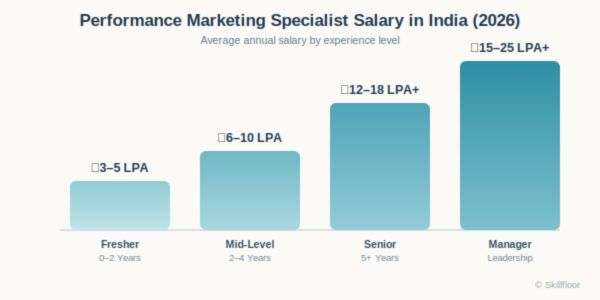
The salary of a Performance Marketing Specialist depends on factors such as experience, location, industry, company size, and the complexity of campaigns managed. While the figures below are indicative, they provide a realistic overview of the earning potential in India.
|
Experience Level |
Average Salary (Per Year) |
|
Fresher / Associate (0–2 Years) |
₹3–5 LPA |
|
Mid-Level (2–4 Years) |
₹6–10 LPA |
|
Senior Level (5+ Years) |
₹12–18 LPA+ |
|
Performance Marketing Manager |
₹15–25 LPA+ |
|
Freelance Performance Marketer |
Varies based on clients, projects, and ad spend managed |
Source: Salary ranges compiled using data from Glassdoor, AmbitionBox, Payscale, and current performance marketing job listings (2025–2026).
Professionals working with e-commerce brands, SaaS companies, digital marketing agencies, or international clients often earn higher salaries due to larger advertising budgets and greater campaign responsibilities. As you gain experience, build a strong portfolio, and consistently deliver measurable results, your earning potential can increase significantly.
Frequently Asked Questions
1. Is performance marketing a good career in 2026?
Yes. As businesses continue investing in digital advertising, performance marketing offers strong career opportunities and long-term growth.
2. Do I need a degree to become a Performance Marketing Specialist?
No. Most employers value practical skills, certifications, and hands-on experience more than a specific degree.
3. How long does it take to become job-ready?
With consistent learning and hands-on practice, many beginners can become job-ready within 3–6 months.
4. Which certification should I start with?
Start with the Google Skillshop Google Ads Search Certification, followed by Meta Blueprint and Google Analytics 4 (GA4).
5. Is coding required for performance marketing?
No. Basic knowledge of tracking tools is helpful, but programming skills are not required.
6. Can AI replace Performance Marketing Specialists?
No. AI can automate routine tasks, but strategic planning, campaign optimisation, and decision-making still require human expertise.
A career as a Performance Marketing Specialist offers excellent opportunities for individuals who enjoy combining creativity with data-driven decision-making to deliver measurable business results. As businesses continue to invest in digital advertising, the demand for professionals with expertise in paid advertising, analytics, and campaign optimisation is expected to remain strong. By gaining hands-on experience, earning industry-recognised certifications, and continuously adapting to evolving digital marketing trends, you can build a rewarding career in one of the fastest-growing specialisations in digital marketing.
Sources & references:
-
65–70% of marketing budgets are shifting toward digital channels
https://superstarsourcing.com/career-path/Performance-Marketing-Specialist -
Performance Marketing Specialist job roles
https://jobicy.com/careers/performance-marketing-specialist
Digital Marketing Course in Ahmedabad | Digital Marketing Course in Bangalore | Digital Marketing Course in Chennai | Digital Marketing Course in Coimbatore | Digital Marketing Course in Hyderabad | Digital Marketing Course in Pune | Digital Marketing Course in Delhi | Digital Marketing Course in Mumbai
Digital Marketing Courses in Other Locations in India
Ahmedabad | Aurangabad | Bangalore | Bhilai | Bhopal | Bhubaneshwar | Chandigarh | Chennai | Cochin | Coimbatore | Dehra Dun | Delhi | Faridabad | Ghaziabad | Gorakhpur | Guntur | Gurgaon | Guwahati | Hyderabad | Jaipur | Kanpur | Khammam | Kolkata | Lucknow | Madurai | Mumbai | Mysore | Nagpur | Noida | Patna | Pondicherry | Pune | Ranchi | Shimoga | Surat | Thane | Thiruvananthapuram | Tiruchirappalli | Tirupati | Vadodara | Visakhapatnam | Warangal | Jalandhar | Jodhpur | Indore | Durgapur | Jamshedpur | Dhanbad | Kota | Karnal | Udaipur | Amritsar | calicut | Nashik | Ludhiana | varanasi | thrissur | Mangalore | Raipur |