






































What Is Generative Engine Optimization (GEO)? A Complete Optimization Guide
Generative Engine Optimization (GEO) is the process of improving content so it appears in AI search results and increases online visibility in simple words now.
Search is changing faster than ever. Instead of browsing multiple websites, many users now ask questions directly to AI platforms like ChatGPT, Gemini, Perplexity, and Google AI Overviews and receive instant answers.
This shift is changing how content gets discovered online. It's no longer enough to rank well in traditional search results; content also needs to be clear, trustworthy, and structured in a way that AI systems can understand and reference.
That's where Generative Engine Optimization (GEO) comes in. GEO focuses on improving the visibility of content within AI-generated responses, helping brands, marketers, and creators stay discoverable as search behavior evolves.
In this guide, you'll learn what Generative Engine Optimization is, how it works, how it differs from traditional SEO, and why it is becoming an important skill for the future of digital marketing.


What Is Generative Engine Optimization (GEO)?
Generative Engine Optimization (GEO) is the process of creating content that AI platforms like ChatGPT, Gemini, Perplexity, and Google AI Overviews can understand, trust, and reference in their generated answers.
Unlike traditional SEO, GEO focuses on improving visibility in AI-generated responses by making content more structured, relevant, and reliable for conversational search experiences.
-
AI Visibility: GEO helps content appear in AI-generated answers, with adoption expected to grow as more searches shift toward generative experiences.
-
Content Structuring: GEO uses clear formats, expert insights, and accurate information to improve AI understanding and increase the chances of content selection.
-
Conversational Search: GEO optimizes content for natural language queries, supporting the rise in users asking AI-based questions instead of using traditional keywords.
-
Future Marketing Strategy: GEO prepares brands for AI-driven search trends, where trusted sources gain visibility across platforms like ChatGPT, Gemini, and Perplexity.
How Does GEO Actually Work?
Generative Engine Optimization (GEO) works by helping AI search systems find, understand, and reuse your content while generating accurate answers for users. It focuses on creating clear, trustworthy, and well-structured information that AI platforms can easily extract, summarize, and reference.
Key Elements That Make GEO Effective
-
Content Extraction: GEO improves AI readability by organizing information clearly, helping systems extract useful answers from content with better relevance.
-
Clear Information: AI models prefer direct definitions, statistics, and structured content, reducing confusion and improving chances of being referenced.
-
Authority Signals: GEO supports expert-driven content, as trusted sources receive higher visibility across AI-generated search experiences.
-
Structured Formatting: Headings, summaries, and concise sections help AI understand content faster and improve answer generation accuracy.
-
Data-Based Content: Pages with verified facts, research, and statistics are more likely to be selected by AI response engines.
-
User Intent Focus: GEO aligns content with conversational queries, helping brands answer specific questions across modern AI search platforms.
GEO vs Traditional SEO: What Actually Changes?
SEO and GEO both focus on improving online visibility, but they work differently based on how users search and consume information. Traditional SEO targets search rankings, while GEO focuses on getting content recognized and referenced by AI-generated answers.
|
Traditional SEO |
Generative Engine Optimization (GEO) |
|
Ranks content in search engine result pages |
Gets content featured in AI-generated responses |
|
Focuses on increasing clicks, rankings, and website traffic |
Focuses on AI visibility, mentions, and citations |
|
Improves titles, keywords, backlinks, and page performance |
Improves facts, definitions, data points, and content clarity |
|
Uses targeted keywords to match user searches |
Uses natural language and conversational questions |
|
Builds authority through backlinks and domain credibility |
Builds authority through citations, structured data, and expertise |
|
Helps users select from multiple search results |
Helps AI provide direct answers from trusted sources |
Why Should Students and Graduates Care About This Right Now?
Generative Engine Optimization (GEO) is becoming an important skill for students and graduates entering the digital marketing industry. Learning GEO early can help candidates stand out as AI-powered search continues to grow.
Key Reasons Why GEO Matters for Students and Graduates Today
-
Career Advantage: Learning GEO early helps students develop digital marketing skills before they become common among job applicants.
-
Industry Demand: Companies increasingly seek professionals who understand AI visibility, content optimization, and modern search behavior trends.
-
Interview Preparation: GEO knowledge helps graduates discuss AI search strategies confidently during digital marketing interviews and career opportunities.
-
Future Skills: Students who master GEO now gain exposure to future-focused marketing practices before training programs fully adapt.
-
Competitive Edge: Early GEO adoption helps candidates stand apart from larger applicant pools entering digital marketing roles.
-
Specialization Growth: GEO offers a new specialization area where learners can build expertise and explore advanced marketing careers.
The Core Pillars of Generative Engine Optimization
Core pillars of GEO define essential practices that help AI systems understand, trust, and accurately reuse structured and reliable content for generating precise, relevant, and context-aware responses.
Core Pillars of Generative Engine Optimization
-
Clarity and Structure: Clear headings, short paragraphs, and direct answers help AI quickly scan, understand, and accurately extract relevant content.
-
Definition Blocks: Precise one- to two-sentence definitions improve AI readability, enabling easy extraction and reuse in generated responses.

-
Data and Examples: Real statistics, case studies, and numbers increase trust and improve the likelihood of being cited by AI systems.
-
Authorship Signals: Visible authorship, credentials, and expertise improve credibility and help AI identify trustworthy, authoritative content sources.
-
Content Freshness: Regular updates ensure content stays relevant, improving chances of being selected over outdated information by AI engines.
-
External Authority: Mentions, citations, and backlinks from trusted platforms strengthen overall content credibility and AI trust signals.


Skills You Need to Build a Career in GEO
Building a career in Generative Engine Optimization (GEO) requires a mix of Fundamentals of Digital Marketing, SEO knowledge, AI-aware content writing, and data understanding. With AI-driven search growing swiftly, nearly 2–3% of search experiences are already influenced by generative engines, making GEO skills increasingly valuable for digital marketers.
1. AI-Optimized Content Writing Skills
Ability to create clear, structured, and factual content that AI systems can easily extract, summarize, and reuse in generated answers.
-
Writing concise definitions and structured content improves AI readability and increases the chances of better visibility in AI responses.
-
Using natural, intent-based writing instead of keyword stuffing improves trust and content selection by generative engines.
2. Structured Data & Schema Markup Skills
Knowledge of schema markup and structured formats helps AI systems understand content meaning, hierarchy, and relationships.
-
Implementing structured data can improve content interpretability by 2–3%, helping AI systems accurately categorize and retrieve information.
-
Using schema markup enhances search engine and AI understanding, increasing chances of content being cited in responses.
3. SEO & Search Intent Understanding Skills
Strong understanding of SEO fundamentals combined with user intent analysis to align content with what users actually ask.
-
Understanding search intent improves content relevance and can increase organic visibility in modern search systems.
-
Applying SEO basics like keywords, internal linking, and page structure supports better GEO performance.
4. Data Analysis & Performance Tracking Skills
Ability to track, measure, and analyze how content performs inside both search engines and AI-generated responses.
-
Monitoring AI mentions and engagement metrics helps identify optimization gaps and improve performance over time.
-
Using analytics tools like Google Analytics helps evaluate content visibility and user interaction trends.
5. AI Tools & Prompt Understanding Skills
Familiarity with AI tools like ChatGPT, Gemini, and Perplexity for content creation, optimization, and research.
-
Using AI tools for ideation and optimization improves content efficiency and output speed.
-
Understanding prompting techniques helps generate structured, high-quality content suitable for GEO strategies.
How to Start Learning GEO as a Student
Learning Generative Engine Optimization (GEO) as a student is best done through practical application rather than only theoretical study. By experimenting with AI tools, analyzing content structure, and practicing writing, students can quickly build real-world GEO skills for digital marketing careers.
Step-by-Step Guide to Start Learning GEO as a Student
-
Use AI Tools for Practice: Start by asking real questions on ChatGPT or Gemini and analyze which sources appear in generated answers.
-
Study Content Structure: Observe how top-ranking pages are organized with headings, clear definitions, and structured formatting for better AI readability.
-
Practice Definition Writing: Convert long paragraphs into short, precise two-line definitions that AI systems can easily extract and reuse.
-
Learn Schema Basics: Understand simple schema markup and structured data to improve how AI systems interpret and categorize content effectively.
-
Create GEO Content Portfolio: Write two to three blog posts using GEO principles to showcase practical skills during interviews and evaluations.
-
Apply Continuous Learning: Combine practice and feedback from experts to improve GEO understanding and develop strong AI-optimized content creation skills.
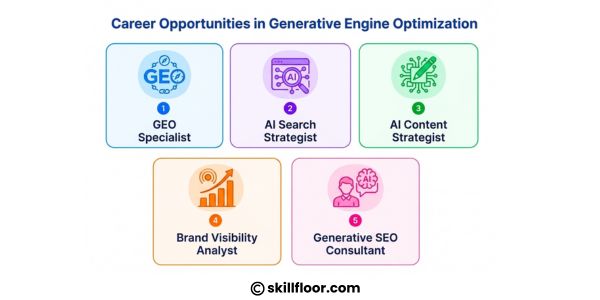
Career Opportunities in Generative Engine Optimization (GEO)
Career opportunities in Generative Engine Optimization (GEO) are growing quickly as AI-powered search is changing how brands appear in online results and content is discovered across platforms.
1. GEO Specialist
A GEO Specialist optimizes content so AI systems can easily extract, understand, and use it in generated responses.
Key Responsibilities
-
Optimizing content structure, headings, and definitions to improve AI readability and increase citation chances in generative search results.
-
Monitoring AI-generated responses and updating content strategies to improve brand visibility and accuracy across platforms.
Salary
-
Entry-level GEO Specialists earn ₹3–5 LPA in startups or agencies focusing on SEO and content optimization roles.
-
Mid-level professionals with AI content experience can earn ₹5–9 LPA depending on project complexity and industry demand.
2. AI Search Strategist
An AI Search Strategist builds advanced strategies to improve brand visibility across AI-powered search engines and conversational platforms.
Key Responsibilities
-
Creating AI-focused search strategies to enhance brand visibility and improve content inclusion in generative engine results.
-
Analyzing AI search behavior and optimizing content frameworks for better ranking and response accuracy in AI systems.
Salary
-
SEO Specialists typically earn ₹3.5–5.5 LPA at entry level, with salaries increasing significantly as professionals gain experience in agencies and tech companies.
-
Senior-level professionals earn ₹8–14 LPA working with tech companies, SaaS brands, and enterprise marketing teams.
3. AI Content Strategist
An AI Content Strategist develops structured, intent-based content optimized for both traditional SEO and AI-driven search engines.
Key Responsibilities
-
Writing structured, intent-based content optimized for AI summarization, search visibility, and improved user engagement results.
-
Developing content strategies that align with AI algorithms to enhance readability, trust, and generative engine performance.
Salary
-
Entry-level content strategists earn ₹3–6 LPA in content agencies, blogging platforms, and marketing startups.
-
Experienced professionals earn ₹6–11 LPA in high-growth companies focusing on AI content automation and SEO strategy.
4. Brand Visibility Analyst
A Brand Visibility Analyst tracks and improves how frequently and accurately a brand appears in AI-generated responses.
Key Responsibilities
-
Monitoring brand mentions across AI platforms like ChatGPT, Gemini, and Perplexity to evaluate visibility performance.
-
Identifying gaps in AI-generated responses and suggesting improvements to strengthen brand authority and content reach.
Salary
-
Entry-level analysts earn ₹3–5 LPA in analytics or digital marketing jobs in small- to mid-sized agencies.
-
Experienced analysts earn ₹5–8 LPA in performance marketing teams focusing on data-driven brand visibility insights.
5. Generative SEO Consultant
A Generative SEO Consultant helps businesses optimize content and strategies for AI-driven search engines and generative platforms.
Key Responsibilities
-
Auditing websites and improving structured content, schema markup, and AI readability for better generative engine visibility.
-
Advising businesses on GEO strategies to improve AI rankings, brand authority, and content discoverability across platforms.
Salary
-
Entry-level consultants earn ₹5–8 LPA working with small businesses and digital marketing agencies on SEO projects.
-
Experienced consultants earn ₹10–18 LPA handling enterprise clients, audits, and advanced AI search optimization strategies.
How Skillfloor's Digital Marketing Course Prepares You for GEO
Skillfloor’s Digital Marketing Course is designed to bridge the gap between traditional digital marketing and modern AI-driven strategies like Generative Engine Optimization (GEO). It combines core concepts with practical AI tools and real-world training to make learners job-ready for developing industry demands.
-
AI-Integrated Learning: Combines SEO, content marketing, and analytics with AI-driven techniques to help students understand and apply GEO concepts from the beginning.
-
Practical Experience: Focuses on live projects and real campaigns, helping learners apply GEO strategies in real marketing scenarios.
-
Industry Mentorship: Provides guidance from experienced professionals who actively work with developing AI and digital marketing trends.
-
Career Support: Offers certification, internships, and placement assistance to help students build a strong GEO-ready portfolio for employers.
-
Structured Curriculum: Follows a step-by-step learning path that blends foundational marketing skills with advanced AI and GEO-focused practices.
-
Portfolio Development: Helps learners create real project-based portfolios that demonstrate GEO skills and improve job readiness in interviews.
The Future of Generative Engine Optimization (GEO)
Generative Engine Optimization (GEO) is becoming more important as search behavior shifts toward AI-driven answers. Search interactions increasingly involve generative responses, and this trend is expected to grow steadily in the coming years.
Key Trends Shaping the Future of GEO
-
Rising AI Search Usage: Around a growing number of searches now show AI-generated answers, and this trend is increasing each year across digital platforms.
-
Early Skill Advantage: Students learning GEO now are entering a field where demand is growing faster than trained professionals are available.
-
Content Visibility Shift: Studies suggest users are less likely to click links when direct answers appear, increasing the importance of structured content.
-
Future Job Growth: Digital marketing roles are expanding, with GEO-related skills becoming part of SEO and content job descriptions.
-
Competitive Timing: Early learners gain an advantage before GEO becomes a standard requirement in most marketing and content roles.
FAQs
1. What is Generative Engine Optimization (GEO)?
GEO is optimizing content so AI systems like ChatGPT, Gemini, and Perplexity can understand and use it in generated answers.
2. Is GEO replacing SEO?
No. GEO works alongside SEO and depends on strong SEO basics like structure, speed, and quality content.
3. Do I need coding for GEO?
No. GEO mainly focuses on content writing, structure, and understanding how AI systems interpret information.
4. Can students build a career in GEO?
Yes. GEO is an emerging field, giving students early opportunities with less competition and growing demand.
5. Where should beginners start?
Start by analyzing AI answers and practicing clear, structured, fact-based content writing through hands-on learning.
GEO is not replacing SEO; it is expanding the way visibility works. As AI systems become a primary source of information for millions of users, marketers who understand how content gets selected, cited, and summarized will have a significant advantage. Learning GEO today is similar to learning SEO a decade ago; those who start early are often the ones who benefit most when adoption becomes mainstream.
Sources:
-
₹3.5–5.5 LPA at entry level—https://futurense.com/blog/is-digital-marketing-a-good-career
Digital Marketing Course in Ahmedabad | Digital Marketing Course in Bangalore | Digital Marketing Course in Chennai | Digital Marketing Course in Coimbatore | Digital Marketing Course in Hyderabad | Digital Marketing Course in Pune | Digital Marketing Course in Delhi | Digital Marketing Course in Mumbai
Digital Marketing Courses in Other Locations in India
Ahmedabad | Aurangabad | Bangalore | Bhilai | Bhopal | Bhubaneshwar | Chandigarh | Chennai | Cochin | Coimbatore | Dehra Dun | Delhi | Faridabad | Ghaziabad | Gorakhpur | Guntur | Gurgaon | Guwahati | Hyderabad | Jaipur | Kanpur | Khammam | Kolkata | Lucknow | Madurai | Mumbai | Mysore | Nagpur | Noida | Patna | Pondicherry | Pune | Ranchi | Shimoga | Surat | Thane | Thiruvananthapuram | Tiruchirappalli | Tirupati | Vadodara | Visakhapatnam | Warangal | Jalandhar | Jodhpur | Indore | Durgapur | Jamshedpur | Dhanbad | Kota | Karnal | Udaipur | Amritsar | calicut | Nashik | Ludhiana | varanasi | thrissur | Mangalore | Raipur |