

































15 Generative AI Tools for Digital Marketers in 2026
Explore 15 generative AI tools for digital marketing in 2026, covering content writing, SEO, design, video, voice, and marketing automation.

Digital marketers use generative AI tools to write content, research keywords, create images, edit videos, and automate daily tasks. But with so many tools available, choosing the right ones can be difficult.
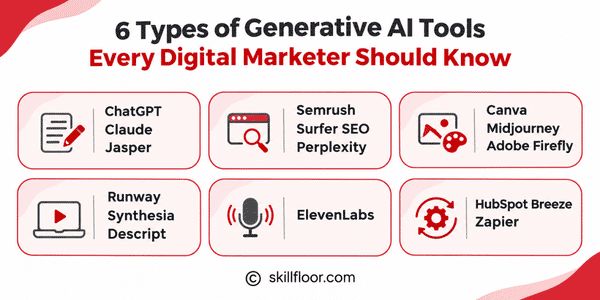
This guide covers 15 generative AI tools for digital marketing in 2026. They fall into six groups: content writing, SEO and AI search, image design, video creation, voice generation, and marketing automation.
Each tool has a short explanation of what it does and who should use it. A practical guide to building your AI marketing toolkit follows the list.
Quick Answer: Best Generative AI Tools for Digital Marketing in 2026
Digital marketers should know these generative AI tools in 2026: ChatGPT, Claude, Jasper, Surfer SEO, Semrush, Perplexity, Midjourney, Canva, Adobe Firefly, Synthesia, Runway, Descript, ElevenLabs, HubSpot Breeze, and Zapier.


ChatGPT and Claude help with writing. Surfer SEO and Semrush support search marketing. Canva and Midjourney help create visuals. Synthesia and Runway work with video, while Zapier and HubSpot Breeze support marketing automation.
Most marketers do not need every tool. A small set that matches their daily tasks is a better starting point.
Key Takeaways
-
Generative AI tools support content writing, SEO, design, video, voice, and automation.
-
ChatGPT, Claude, and Jasper help marketers create and edit content.
-
Semrush, Surfer SEO, and Perplexity support search research and content planning.
-
Canva, Midjourney, and Adobe Firefly help create marketing visuals.
-
Human editing, fact-checking, and performance tracking are still necessary.
What Are Generative AI Tools in Digital Marketing?
Generative AI tools are software applications that create text, images, video, audio, and other content from user instructions.
Digital marketers use these tools to complete tasks such as writing social media captions, preparing advertisements, creating campaign images, and producing video scripts.
For example, a marketer running a Facebook campaign might use ChatGPT to draft ad copy, Canva to design a creative, and ElevenLabs to produce a voiceover.
Each tool handles a different part of the campaign.
Generative AI can speed up production, but marketers must still review the content for accuracy, brand voice, and relevance.
Why Digital Marketers Need Generative AI Tools
Marketing teams manage websites, social media, advertisements, email campaigns, and customer communication. Creating content for every channel takes time.
Generative AI tools help with repetitive work and give marketers more time for planning and reviewing campaign performance.
According to HubSpot's 2026 research cited in the source material, 71% of marketers say AI helps them produce more content; however, 53% struggle to make their content stand out.
This shows why producing more content is not enough.
Marketers still need original ideas, accurate information, and a clear understanding of their audience.
Generative AI Tools at a Glance
The following table groups 15 tools by their main marketing use.
|
Tool |
Category |
Best For |
|
ChatGPT |
Content writing |
Ideas, drafts, social media copy |
|
Claude |
Content writing |
Long-form content and brand voice |
|
Jasper |
Content writing |
Marketing campaigns and team content |
|
Surfer SEO |
SEO |
On-page content optimisation |
|
Semrush |
SEO and AI search |
Keywords, competitors, AI visibility |
|
Perplexity |
Research |
Research with cited sources |
|
Midjourney |
Image generation |
Creative marketing images |
|
Canva |
Design |
Social graphics and ad creatives |
|
Adobe Firefly |
Image generation |
AI visuals within Adobe workflows |
|
Synthesia |
Video |
AI avatar videos |
|
Runway |
Video |
AI video generation and editing |
|
Descript |
Video and audio |
Transcript-based editing |
|
ElevenLabs |
Voice |
AI voiceovers |
|
HubSpot Breeze |
Marketing automation |
CRM tasks and reporting |
|
Zapier |
Workflow automation |
Connecting marketing tools |
List 1: Best AI Tools for Content Writing and Ideation
Content is part of almost every digital marketing campaign. AI writing tools help marketers prepare outlines, social media posts, advertisements, emails, and blog drafts.
1. ChatGPT
ChatGPT is an AI assistant developed by OpenAI. Digital marketers use it for brainstorming, content writing, campaign planning, and editing.
It can turn a single marketing idea into multiple content formats.
For example, a marketer can prepare a blog outline and then create Instagram captions, LinkedIn posts, and email copy around the same topic.
-
Type: AI writing and research assistant.
-
Main use: Writing, brainstorming, and content editing.
-
Digital marketing focus: Blogs, advertisements, captions, and campaign ideas.
-
Best for: Students, freelancers, content writers, and digital marketing teams.



2. Claude
Claude is an AI assistant developed by Anthropic. It is useful for working with long documents and preparing detailed content.
Marketers can use Claude to review articles, rewrite content, and maintain a consistent writing style across longer drafts.
It is particularly useful when a project requires several sections to follow the same brand guidelines.
-
Type: AI writing assistant.
-
Main use: Long-form writing and document analysis.
-
Digital marketing focus: Articles, content editing, and brand communication.
-
Best for: Content writers and teams handling long-form content.
3. Jasper
Jasper is an AI writing platform built for marketing teams.
It provides features for creating campaign content, following brand guidelines, and preparing marketing messages across channels.
Teams producing regular email campaigns, social media content, and advertisements can use Jasper to keep their messaging consistent.
-
Type: AI marketing content platform.
-
Main use: Campaign writing and brand-controlled content.
-
Digital marketing focus: Advertising, email marketing, and campaign content.
-
Best for: Marketing teams managing multiple campaigns.
List 2: Best AI Tools for SEO, GEO, and AI Search
Search marketing now covers traditional search results and AI-generated answers.
SEO tools help marketers research keywords, review competitors, improve website content, and understand search visibility.
4. Surfer SEO
Surfer SEO is a content optimisation platform.
It helps marketers review content structure, topic coverage, and on-page SEO elements based on search results.
A content writer can use Surfer SEO while preparing a blog to identify relevant topics and improve page structure.
Its recommendations should support the content rather than replace original research.
-
Type: SEO content optimisation platform.
-
Main use: On-page content analysis.
-
Digital marketing focus: Blog optimisation and content structure.
-
Best for: SEO specialists and content writers.
5. Semrush
Semrush is a digital marketing platform used for keyword research, competitor analysis, and SEO performance tracking.
It also offers AI search visibility features that help marketers study how brands appear in AI-generated answers.
Marketers can use Semrush to identify keyword opportunities, review competing websites, and monitor search performance.
-
Type: SEO and digital marketing platform.
-
Main use: Keyword research and competitor analysis.
-
Digital marketing focus: SEO planning, rankings, and AI visibility.
-
Best for: SEO professionals and digital marketing agencies.
6. Perplexity
Perplexity is an AI-powered answer and research tool.
It provides answers to research questions and displays supporting source links.
Digital marketers can use it to explore topics, find reference material, and review sources before writing.
Its citations should still be checked against the original pages before publication.
-
Type: AI answer and research tool.
-
Main use: Research with cited sources.
-
Digital marketing focus: Topic research and source discovery.
-
Best for: Content researchers, SEO writers, and marketing students.
List 3: Best Generative AI Tools for Images and Design
Visual content is used in social media posts, digital advertisements, blog thumbnails, and marketing campaigns.
AI design tools help marketers create and edit visuals without starting every design from scratch.
7. Midjourney
Midjourney generates images from text instructions.
Marketers can describe an image concept and generate visual options for a campaign.
It is useful for producing stylised creative concepts, illustrations, and promotional visuals.
-
Type: AI image generation tool.
-
Main use: Creating images from prompts.
-
Digital marketing focus: Campaign visuals and creative concepts.
-
Best for: Creative marketers and designers.
8. Canva
Canva is a design platform with AI-powered image generation and editing features.
Marketers use Canva to prepare social media posts, presentations, advertisements, and promotional graphics.
Its templates and editing tools make it useful for people with limited design experience.
-
Type: Design and AI editing platform.
-
Main use: Creating and editing marketing graphics.
-
Digital marketing focus: Social media posts, advertisements, and presentations.
-
Best for: Beginners, small businesses, and social media marketers.
9. Adobe Firefly
Adobe Firefly is a generative AI tool for creating and editing visual content.
It works with Adobe's creative applications and supports image generation and editing.
Marketing teams already using Adobe software can include Firefly in their existing design process.
-
Type: Generative AI image platform.
-
Main use: Image generation and editing.
-
Digital marketing focus: Marketing graphics and creative production.
-
Best for: Graphic designers and creative teams using Adobe applications.
List 4: Best AI Tools for Video Marketing
Video is widely used for Instagram Reels, YouTube Shorts, advertisements, product demonstrations, and training content.
AI video tools help marketers prepare videos from scripts, edit footage, and reduce repetitive editing work.
10. Synthesia
Synthesia creates videos using AI avatars.
Users can prepare a script and turn it into a presenter-led video without recording a person on camera.
Marketers can use Synthesia for product explanations, educational content, and training videos.
-
Type: AI avatar video platform.
-
Main use: Script-to-video creation.
-
Digital marketing focus: Explainer videos and training content.
-
Best for: Trainers, marketing teams, and businesses producing educational videos.
11. Runway
Runway provides AI tools for video generation and editing.
Marketers can create video clips from text or images and use AI features during editing.
It is useful for testing creative video ideas and producing short visual content.
-
Type: AI video generation platform.
-
Main use: Video creation and editing.
-
Digital marketing focus: Short videos and promotional visuals.
-
Best for: Video creators and social media marketers.
12. Descript
Descript is a video and audio editing platform.
It allows users to edit recorded content through its transcript.
For example, a marketer editing an interview can remove unwanted spoken sections by editing the corresponding text.
Descript also provides tools for improving audio quality.
-
Type: Video and audio editing platform.
-
Main use: Transcript-based editing.
-
Digital marketing focus: Interviews, podcasts, and talking-head videos.
-
Best for: Content creators, podcast teams, and video marketers.
List 5: Best AI Tool for Voice and Audio
Audio is used in video advertisements, explainers, tutorials, and local-language marketing campaigns.
13. ElevenLabs
ElevenLabs is an AI voice generation platform.
It creates voiceovers in different languages and accents from written text.
Digital marketers can use it for video narration, advertising voiceovers, and multilingual content.
-
Type: AI voice generation platform.
-
Main use: Text-to-speech and voiceovers.
-
Digital marketing focus: Video narration and audio content.
-
Best for: Video marketers and teams creating multilingual content.
List 6: Best AI Tools for Marketing Automation
Marketing teams repeat tasks such as updating customer records, preparing follow-ups, organising leads, and reviewing reports.
Automation tools help connect these tasks across different systems.
14. HubSpot Breeze
HubSpot Breeze brings AI features into HubSpot's customer relationship management platform.
It supports marketing and customer-related workflows, including content, follow-ups, and reporting.
Teams using HubSpot can apply AI within their existing customer management process.
-
Type: CRM AI platform.
-
Main use: AI-supported CRM tasks.
-
Digital marketing focus: Customer communication and reporting.
-
Best for: Marketing and sales teams using HubSpot.
15. Zapier
Zapier connects applications and automates workflows between them.
Marketers can use it to move information between tools and reduce manual data entry.
For example, a workflow can collect new form submissions, organise lead details, and prepare follow-up tasks.
Zapier also supports AI steps within automated workflows.
-
Type: Workflow automation platform.
-
Main use: Connecting applications and automating tasks.
-
Digital marketing focus: Lead management and repetitive workflows.
-
Best for: Digital marketers managing several platforms.
How to Choose the Right Generative AI Tools for Digital Marketing
The best AI toolkit depends on your daily marketing work.
You do not need to subscribe to every platform. Start with the tasks that take the most time.
You are a digital marketing beginner
Start with ChatGPT and Canva.
Use ChatGPT to practise writing captions, blogs, and advertisements. Use Canva to create social media graphics.
These tools help you understand how AI fits into common marketing tasks.
You work in SEO and content marketing
Consider ChatGPT, Perplexity, Surfer SEO, and Semrush.
Use AI writing tools for outlines and drafts. Use research and SEO tools to study search topics, keywords, and content performance.
Check facts and search data before publishing.
You create social media videos
Look at Runway, Descript, and ElevenLabs.
Runway supports visual creation, Descript helps edit recorded content, and ElevenLabs produces voiceovers.
Choose based on whether you need to generate new visuals, edit existing footage, or add narration.
You manage several marketing campaigns
Consider Jasper, HubSpot Breeze, and Zapier.
Jasper supports campaign content, while HubSpot Breeze and Zapier can help with CRM and repeated workflow tasks.
Start with one process before adding more automation.
Free and Paid Generative AI Tools for Digital Marketing
Some AI tools offer free plans, while others require paid access or provide limited trials.
The following table summarises the access options listed in the source material.
|
AI Tool |
Access Option |
|
ChatGPT |
Free tier |
|
Claude |
Free tier |
|
Jasper |
Trial |
|
Surfer SEO |
Paid |
|
Semrush |
Limited free access |
|
Perplexity |
Free tier |
|
Midjourney |
Paid |
|
Canva |
Free tier |
|
Synthesia |
Demo |
|
ElevenLabs |
Free tier |
Plan availability, features, and usage limits can change. Check the official tool websites before choosing a subscription.
Beginners can start with free tools to practise basic marketing tasks.
Paid plans may become useful when teams need higher usage limits, brand controls, collaboration features, or more advanced functions.
Five Steps to Build Your AI Marketing Toolkit
1. Identify your main marketing tasks
List the activities you complete every week, such as writing content, designing images, editing videos, or reviewing campaigns.
2. Choose one tool for each task
Start with a small number of tools. Learn their features before adding alternatives.
3. Review AI-generated content
Check the language, brand voice, accuracy, and relevance of every draft.
4. Prepare content for search
Use clear headings, direct answers, and useful tables. Support important claims with reliable sources.
5. Track marketing performance
Measure website visits, rankings, leads, conversions, and other results. Continue using the tools that help you complete useful work.
Responsible Use of Generative AI in Digital Marketing
AI-generated content can contain incorrect information, repeated ideas, or wording that does not match a brand.
Marketers should follow three basic practices:
-
Verify information: Check statistics, product details, and claims against reliable sources.
-
Maintain brand consistency: Edit generated content to match the brand's tone and audience.
-
Follow usage rules: Check copyright, privacy, disclosure, and platform requirements before publishing AI-generated material.
AI tools can support marketing work, but people remain responsible for the final output.
Frequently Asked Questions
1. What is the best generative AI tool for digital marketing?
There is no single best tool. ChatGPT is useful for writing and ideas, Canva for design, Semrush for SEO research, and Runway for video. The right choice depends on your work.
2. Which AI tools should digital marketing beginners learn first?
ChatGPT and Canva are useful starting points. Beginners can practise content writing, social media design, and basic campaign planning before learning specialised tools.
3. Can generative AI tools help with SEO?
Yes. Tools such as Surfer SEO and Semrush support content optimisation, keyword research, and competitor analysis. AI writing tools can also help prepare outlines and drafts.
4. Which AI tools are useful for social media marketing?
ChatGPT helps prepare captions and campaign ideas. Canva supports graphic design, while Runway and Descript help with video content.
5. Are free AI tools enough for digital marketing?
Free plans can support basic tasks such as writing, brainstorming, research, and graphic design. Paid plans may be useful for higher usage limits and advanced features.
6. Can AI tools create Facebook and Instagram advertisements?
AI tools can help write ad copy and create images or videos for campaigns. Marketers still need to choose the right audience, set budgets, review creative quality, and monitor performance.
7. Will generative AI replace digital marketers?
Generative AI can complete some repetitive production tasks. However, campaign strategy, customer understanding, creative decisions, and performance evaluation still require human judgment.
8. Do digital marketers need coding skills to use AI tools?
Many generative AI tools work through simple text instructions and visual interfaces. Coding is not required for common tasks such as content writing, image design, and basic automation.
9. How can digital marketers learn to use AI tools?
Start by practising one marketing task with one tool. Learn how the output fits into a full campaign, then study SEO, advertising, social media, and analytics to understand how marketing results are measured.
Next Steps: Learn Digital Marketing Beyond AI Tools
Generative AI tools can help marketers write faster, create visuals, edit videos, and automate routine tasks. But using the tools is only one part of digital marketing.
You also need to understand how campaigns work, how customers search, and how marketing performance is measured.
Skillfloor's Certified Digital Marketing Professional course covers SEO, paid social media, content marketing, and analytics through practical learning.
Build your marketing skills, practise with relevant tools, and learn how different marketing channels work together.
Explore Skillfloor's Digital Marketing Course and Book a Free Demo.
Digital Marketing Courses in Other Locations in India
Ahmedabad | Aurangabad | Bangalore | Bhilai | Bhopal | Bhubaneshwar | Chandigarh | Chennai | Cochin | Coimbatore | Dehra Dun | Delhi | Faridabad | Ghaziabad | Gorakhpur | Guntur | Gurgaon | Guwahati | Hyderabad | Jaipur | Kanpur | Khammam | Kolkata | Lucknow | Madurai | Mumbai | Mysore | Nagpur | Noida | Patna | Pondicherry | Pune | Ranchi | Shimoga | Surat | Thane | Thiruvananthapuram | Tiruchirappalli | Tirupati | Vadodara | Visakhapatnam | Warangal | Jalandhar | Jodhpur | Indore | Durgapur | Jamshedpur | Dhanbad | Kota | Karnal | Udaipur | Amritsar | calicut | Nashik | Ludhiana | varanasi | thrissur | Mangalore | Raipur |