




































Do You Need a Degree to Get a Job in AI?
Wondering if a degree is required to break into AI? Discover practical new paths, real fun stories, and actionable steps to land an AI job without a diploma.

The need for AI jobs is predicted to increase by 97 million positions worldwide by 2025, highlighting the rapid expansion of the AI job market growth. Businesses are struggling to find qualified personnel for everything from self-driving cars to personalized healthcare. This real shortage presents enormous opportunities for individuals ready to learn and take immediate action.
You're not the only one who has ever said, "I want to work in AI, but I don't have a degree." Many skilled and driven people feel stuck every day because they think getting a degree is the only way to get started.
The short answer: not necessarily. A degree can be helpful, but it's not the only way to succeed in artificial intelligence. AI careers can open up quickly, often sooner than you might think, if you're prepared to learn, practice, and show off your skills.
Why the “Degree Barrier” Feels Real
Degrees are important. They convey formal education, authority, and commitment. However, the field of artificial intelligence is changing more quickly than academics can keep up.


-
High cost & time commitment: A degree in computer science or data science might cost tens of thousands of dollars and take 3 to 6 years to complete. That's not something that everyone can afford.
-
Industry evolution: AI frameworks, libraries, and technologies are developing quickly. Before the next big thing happens, universities frequently struggle to teach the newest tools.
-
Skill gaps vs. credentials: Your skills are becoming more important to employers than your official education. A transcript is frequently not as powerful as a portfolio of projects.
-
Practical experience matters more: In order to accomplish the purpose of artificial intelligence in practical applications, many AI positions necessitate practical knowledge with real datasets, code, and ML models.
-
Flexible learning paths exist: Cutting-edge skills can be learned more quickly through online courses, boot camps, and self-taught projects than through a multi-year degree program.
-
Networking & visibility: Building a presence in AI communities, contributing to open-source projects, or sharing projects publicly can sometimes outweigh a formal degree in the eyes of recruiters.
Consider this: according to LinkedIn’s 2024 Emerging Jobs report, AI-related roles grew 37% year-over-year, yet many hiring managers emphasize practical experience and demonstrable skills over formal education.
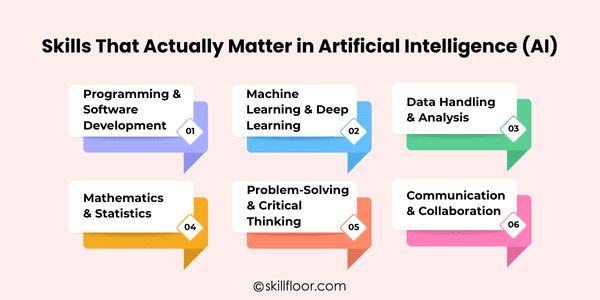
Skills That Actually Matter in AI
Whether you have a degree or not, AI is primarily a skills-driven field. Here are six essential skill areas to focus on:
1. Programming & Software Development
-
Proficiency in languages such as SQL, R, or Python is essential.
-
It is essential to use AI libraries like TensorFlow, PyTorch, or scikit-learn and write clear, effective code.
2. Machine Learning & Deep Learning
-
Comprehending fundamental machine learning principles like supervised, unsupervised, and reinforcement learning.
-
The capacity to use deep learning models for NLP and image recognition tasks.
3. Data Handling & Analysis
-
Data cleaning, preprocessing, and visualization skills are essential.
-
Smooth model training is ensured by familiarity with databases, SQL queries, and data pipelines.
4. Mathematics & Statistics
-
Strong command of probability, statistics, linear algebra, and calculus to comprehend the inner workings of models.
-
This helps in improving prediction accuracy, model performance evaluation, and algorithm tuning.
5. Problem-Solving & Critical Thinking
-
Incomplete or unclear data is frequently used in AI research.
-
It is really useful to be able to deconstruct complicated issues, come up with answers, and use reasoning.
6. Communication & Collaboration
-
Just as crucial as coding is providing stakeholders with clear explanations of technical results.

-
For cross-functional teams, team projects, and the practical use of AI, collaboration skills are essential.


A formal degree is frequently outweighed by a good project portfolio. Employers look for evidence that you can develop and implement AI solutions, and practical artificial intelligence courses give you the opportunity to demonstrate your abilities via real experience.
Non-Degree Paths to AI Jobs
The good news? You don't need a degree to work in AI if you concentrate on real-world experience:
-
Online Courses: Platforms like Coursera, edX, and Udemy provide practical AI learning, while Skillfloor offers focused training for hands-on project experience.
-
Bootcamps & Workshops: AI skills are learned in-depth in short-term immersive programs, which enable you to swiftly grasp industrial applications and develop practical projects.
-
Competitions & Challenges: Engaging in coding challenges or Kaggle contests enhances practical AI skills and shows employers that you can solve problems.
-
Open-Source Projects: Making contributions to AI forums or GitHub repositories demonstrates initiative, teamwork, and the capacity to apply machine learning solutions.
-
Certifications: Without requiring a formal university degree, AI certificates enhance your profile, confirm your knowledge, and supplement real-world experience.
-
Self-Directed Projects: Developing individual AI initiatives that address business issues demonstrates inventiveness, technical expertise, and preparedness for practical AI positions.
Challenges You Might Face Without a Degree
There are challenges in breaking into AI without a degree. You could run into a number of difficulties, such as:
-
Limited Initial Credibility: If you don't have a degree or official qualifications, employers can be hesitant to trust your skills.
-
Competitive Job Market: Since many candidates have degrees, it is more difficult to stand out without experience or completed projects.
-
Learning Curve Pressure: Self-taught learners must quickly study a wide range of subjects, including the foundations of AI, machine learning, and coding.
-
Networking Difficulties: Finding mentors, career referrals, or industry advice can be more difficult if you don't have educational connections.
-
Salary Negotiation Hurdles: Candidates without formal schooling or recognized credentials may initially earn less in entry-level AI jobs.
-
Access To Advanced Roles: Formal degrees or certifications may still be necessary for some research or specialist AI positions.
The Hidden Advantage of Starting Without a Degree
The wonderful part is that you can advance your career in unexpected ways by skipping a formal degree.
-
Faster Career Pivot: You don't need to wait for semesters or admissions cycles to transition into tech or AI roles.
-
Learn Practical Skills: Employers value practical skills more than theoretical knowledge or textbooks, therefore concentrate on developing these skills.
-
Build A Portfolio: Working on actual projects shows that you can solve issues and use information efficiently.
-
Stand Out to Employers: Results-driven, flexible talent that can learn on their own and have a quantifiable impact is valued by employers.
-
Demonstrate Resilience: Self-learning shows dedication, resolve, and the capacity to overcome obstacles without official direction.
-
Access Opportunities Early: Compared to typical degree pathways, you can begin internships, freelancing, or entry-level jobs more quickly.
Doers are rewarded more in the AI world than with paper qualifications. Your abilities and projects can speak louder than any diploma if you complete practical AI courses.
Practical Steps to Break into AI Without a Degree
If you want to succeed in AI without a degree, focus on these six key steps:
1. Build A Strong Foundation
-
Learn TensorFlow, PyTorch, NumPy, Pandas, and other fundamental machine learning tools in Python.
-
Learn the fundamentals of probability, linear algebra, and statistics in order to solve AI problems.
-
Utilize online resources and AI courses such as MIT Open Courseware, fast.ai, and Coursera.
2. Work On Real Projects
-
Develop modest AI projects that address issues you are enthusiastic about, such as chatbots or picture recognition.
-
Use a personal portfolio or GitHub to record your work to demonstrate your practical abilities.
-
Experiment with datasets to comprehend how algorithms and models are used in practical situations.
3. Participate In Competitions
-
Participate in Kaggle competitions to test your abilities against others and obtain practical experience.
-
Attend hackathons or AI challenges to tackle real-world problems under time limitations.
-
Participate in open-source AI initiatives to increase your visibility and reputation within the community.
4. Gain Practical Experience
-
Take on freelancing work or internships, no matter how tiny, to get experience with AI in the real world.
-
Work together with research laboratories or startups to comprehend workplace procedures and expectations.
-
Participate in online professional communities to gain knowledge from seasoned AI practitioners.
5. Showcase Results, Not Credentials
-
Publicly display projects with thorough case studies that emphasize impact and problem-solving.
-
Calculate your accomplishments, such as an X% increase in prediction accuracy or a decrease in processing time.
-
To draw in recruiters for artificial intelligence jobs, emphasize your GitHub links and portfolio on resumes.
6. Keep Learning and Adapting
-
Keep up with the most recent AI tools, frameworks, and methods—AI is changing quickly.
-
To learn more, follow AI research publications, go to conferences, and take part in webinars.
-
To gain credibility and awareness, learn in public by posting tutorials or blogging about projects.
Common Fears, Debunked
Without a degree, many people are afraid to study AI, yet the majority of their concerns are unfounded. Let's examine them in detail:
1. Fear: “I’ll never compete with degree holders.”
Reality: Your ability to build is more important to employers than your educational background. A strong portfolio has the potential to surpass a diploma.
2. Fear: “Without a degree, I’ll earn less.”
In actuality, AI salaries are frequently skill-based. Graduates of boot camps or talented self-taught professionals can make just as much, if not more, than those with degrees.
3. Fear: “I’m too late to enter AI.”
In actuality, AI is rapidly expanding worldwide. Opportunities are expanding more quickly than ever since 97 million new jobs could be generated by 2025.
4. Fear: “I won’t understand complex concepts.”
Reality: Even without a formal education, acquiring useful AI concepts is possible because of online courses, tutorials, and community help.
5. Fear: “I’ll miss networking opportunities.”
Reality: To meet experts and mentors, you can participate in open-source projects, LinkedIn groups, hackathons, and AI forums.
6. Fear: “I won’t get recognition.”
Reality: You can get attention from recruiters and the industry by sharing case studies, publishing projects openly, and contributing to open-source work.
FAQs About Breaking into AI Without a Degree
Q1: Can I get a high-paying AI job without a degree?
A: Yes. Many companies prioritize skills and results. With strong projects or real-world experience, self-taught professionals can earn competitive salaries.
Q2: Which AI roles are easiest to enter without formal education?
A: Roles like machine learning engineer, AI developer, data analyst, or AI consultant often value practical experience more than a degree.
Q3: How do employers view self-taught AI candidates?
A: Employers increasingly value hands-on experience, portfolios, and problem-solving skills. Demonstrated results often matter more than formal education.
Q4: Will not having a degree limit career growth in AI?
A: Not necessarily. Continuous learning, real projects, and networking can help you reach advanced positions, especially in applied AI roles.
Q5: How can I stay competitive in AI without a degree?
A: Keep building projects, participate in competitions, contribute to open-source, and follow trends in AI technologies and tools.
Q6: Are certifications or Skillfloor programs enough to get noticed by recruiters?
A: Certifications and programs like Skillfloor can strengthen credibility, but combining them with projects and portfolios makes you stand out even more.
The path to a Job in AI is open even without a degree if you're prepared to take action. Concentrate on developing abilities, completing tasks, and demonstrating outcomes. You get closer to your first Job in AI with each modest step, such as finishing an online course or adding to a portfolio. Recall that perseverance is more important than paperwork. You can get a job in AI more quickly than you think with commitment, real-world experience, and curiosity. Your Ideal Job in AI may become a reality sooner than you think if you start now.
Digital Marketing Courses in Other Locations in India
Ahmedabad | Aurangabad | Bangalore | Bhilai | Bhopal | Bhubaneshwar | Chandigarh | Chennai | Cochin | Coimbatore | Dehra Dun | Delhi | Faridabad | Ghaziabad | Gorakhpur | Guntur | Gurgaon | Guwahati | Hyderabad | Jaipur | Kanpur | Khammam | Kolkata | Lucknow | Madurai | Mumbai | Mysore | Nagpur | Noida | Patna | Pondicherry | Pune | Ranchi | Shimoga | Surat | Thane | Thiruvananthapuram | Tiruchirappalli | Tirupati | Vadodara | Visakhapatnam | Warangal | Jalandhar | Jodhpur | Indore | Durgapur | Jamshedpur | Dhanbad | Kota | Karnal | Udaipur | Amritsar | calicut | Nashik | Ludhiana | varanasi | thrissur | Mangalore | Raipur |