







































What is Social Media Analytics? Metrics & KPIs
Learn what social media analytics is, how it tracks engagement, audience insights, sentiment, and metrics to improve content strategy and marketing decisions.
Social media has become one of the most effective channels for businesses to connect with their audience, build brand awareness, and drive meaningful engagement. Every interaction, whether it's a like, comment, share, click, or follow, creates valuable data that reflects how users respond to your content and marketing efforts.
However, collecting data alone isn't enough. Businesses need to analyze this information to understand what's working and where improvements are needed. This is where social media analytics becomes essential. By tracking important metrics and Key Performance Indicators (KPIs), marketers can evaluate campaign performance, optimize their strategies, and make data-informed decisions that support long-term business growth.
Before exploring the key metrics and KPIs, let's understand what social media analytics is and why it plays a crucial role in measuring marketing success.
What is Social Media Analytics?
Social Media Analytics is the process of collecting, measuring, and analyzing data from social media platforms to understand how your content, campaigns, and audience are performing. It helps businesses track important metrics such as reach, engagement, clicks, conversions, and follower growth to evaluate the effectiveness of their social media efforts.
Why is Social Media Analytics Important?
Social media analytics helps businesses understand how their content and campaigns are performing across different platforms. By analyzing key performance data, marketers can improve their strategies, engage the right audience, and achieve better business outcomes.


Here's what it specifically helps you do:
-
Understand Your Audience: Learn about your audience's demographics, interests, and online behavior to create more relevant content.
-
Improve Content Strategy: Identify which posts and content formats perform best to optimize future campaigns.
-
Measure Campaign Performance: Evaluate the effectiveness of your social media campaigns using key metrics like engagement, reach, and conversions.
-
Track Business Results: Measure how social media contributes to website traffic, lead generation, and overall business objectives.
-
Make Better Marketing Decisions: Use performance insights to refine your digital marketing strategies, allocate resources effectively, and improve future campaign performance.
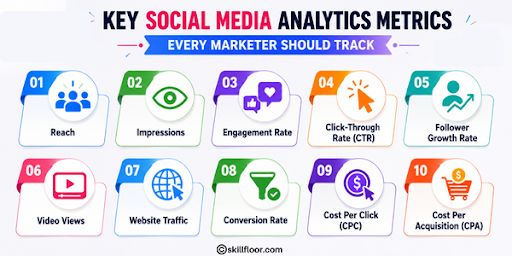
Key Social Media Analytics Metrics Every Marketer Should Track
The following social media analytics metrics provide valuable insights into the effectiveness of your content, campaigns, and overall social media performance.
-
Reach: Measures the number of unique users who have seen your content.
-
Impressions: Indicates the total number of times your content has been displayed.
-
Engagement Rate: Measures how actively users interact with your content through likes, comments, shares, and clicks.
-
Click-Through Rate (CTR): Shows the percentage of users who clicked on a link after viewing your content.
-
Follower Growth Rate: Tracks how quickly your social media audience is growing over time.
-
Video Views: Measures the number of times your videos have been viewed on social media platforms.
-
Website Traffic: Tracks the number of visitors driven to your website from social media channels.
-
Conversion Rate: Measures the percentage of users who complete a desired action after interacting with your content.
-
Cost Per Click (CPC): Calculates the average cost paid for each click on a social media advertisement.
-
Cost Per Acquisition (CPA): Measures the average cost of acquiring a customer or generating a lead through social media campaigns.
Social Media KPIs vs Metrics: What's the Difference?
When analyzing social media performance, the terms metrics and KPIs (Key Performance Indicators) are often used interchangeably. However, they serve different purposes. Knowing the difference helps marketers focus on the data that truly reflects business success rather than simply tracking every available number.
Social media metrics are the individual data points collected from your social media platforms. They help you measure content performance, audience engagement, and campaign activity. Examples include reach, impressions, likes, comments, shares, video views, and follower growth. While these metrics provide valuable insights, they don't always indicate whether you're achieving your marketing objectives.
Social media KPIs are the specific metrics selected to measure progress toward a defined business goal. A KPI is chosen because it directly reflects the success of a campaign or strategy. For example, if your objective is to generate leads, KPIs such as conversion rate, click-through rate (CTR), cost per acquisition (CPA), and website traffic from social media become more meaningful than simply tracking likes or impressions.
A simple way to understand it: All KPIs are metrics, but not all metrics are KPIs.
Example:
-
Metric: A Facebook post receives 5,000 impressions and 350 likes.
-
KPI: The campaign achieves a 6% conversion rate, helping generate qualified leads for the business.
Here's a quick comparison:


|
Aspect |
Social Media Metrics |
Social Media KPIs |
|
Definition |
Individual data points that measure social media performance. |
Selected metrics that measure progress toward specific business goals. |
|
Purpose |
Monitor content and campaign performance. |
Evaluate whether marketing objectives are being achieved. |
|
Examples |
Reach, Impressions, Likes, Shares, Video Views. |
Engagement Rate, Conversion Rate, CTR, CPA, ROI. |
|
Focus |
Overall performance tracking. |
Goal-oriented performance measurement. |
|
Business Value |
Provides insights into audience behavior. |
Demonstrates the effectiveness of marketing efforts in achieving business outcomes. |
How to Measure Social Media Performance Effectively
Tracking metrics is only useful if you're measuring the right things, the right way. Here's how to do it effectively:
1. Define Clear Goals First
Before tracking anything, identify what you actually want to achieve - brand awareness, lead generation, community engagement, or sales. Your goals determine which metrics and KPIs matter.
2. Choose Platform-Specific Metrics
Each platform serves a different purpose, so performance should be measured differently. Instagram might focus on engagement and reach, while LinkedIn might prioritize lead generation and click-throughs.
3. Use the Right Analytics Tools
Native platform insights (Instagram Insights, Facebook Analytics, LinkedIn Analytics) are a good starting point, but third-party tools like Hootsuite, Buffer, Sprout Social, or Google Analytics give you deeper, cross-platform visibility.
4. Track Performance Over Time, Not Just Snapshots
A single day's numbers don't tell the full story. Look at trends over weeks or months to understand what's genuinely working versus what's a temporary spike.
5. Segment Your Audience Data
Break down performance by demographics, location, or device to understand who's really engaging with your content. This helps you refine targeting and messaging.
6. Benchmark Against Competitors and Industry Standards
Compare your performance to competitors or industry averages to understand whether your numbers are actually good, or just good for you.
7. Connect Social Metrics to Business Outcomes
Tie social media performance back to real results, website traffic, leads, or sales using UTM tracking and conversion data, so you can prove actual ROI.
8. Review and Adjust Regularly
Set a consistent schedule (weekly, monthly, quarterly) to review performance and adjust your strategy based on what the data is telling you.
Best Social Media Analytics Tools
The right analytics tools simplify performance tracking, audience analysis, and campaign reporting, enabling marketers to improve their social media results.
|
Tool |
Key Features |
Best For |
|
Meta Business Suite |
Tracks reach, engagement, audience demographics, and ad performance for Facebook and Instagram. |
Facebook & Instagram analytics |
|
Google Analytics 4 (GA4) |
Measures website traffic, user behavior, conversions, and campaign performance from social media. |
Website and conversion tracking |
|
LinkedIn Analytics |
Provides insights into post performance, follower growth, audience demographics, and engagement. |
B2B marketing analytics |
|
YouTube Studio Analytics |
Monitors video views, watch time, audience retention, subscriber growth, and traffic sources. |
YouTube channel performance |
|
X Analytics |
Tracks impressions, engagement, profile visits, link clicks, and follower activity. |
X (Twitter) performance analysis |
|
Hootsuite Analytics |
Offers cross-platform reporting, campaign tracking, scheduling insights, and custom dashboards. |
Multi-platform social media management |
|
Sprout Social |
Provides advanced analytics, competitor benchmarking, social listening, and detailed performance reports. |
Enterprise social media analytics |
|
Buffer Analyze |
Tracks engagement, audience growth, and content performance with easy-to-read reports. |
Content performance analysis |
|
SocialPilot |
Combines post scheduling with analytics, audience insights, and customizable reporting. |
Small businesses and agencies |
Common Mistakes to Avoid When Analyzing Social Media Data
Analyzing social media data can help improve marketing performance, but only when the insights are interpreted correctly. Avoiding these common mistakes ensures you make better decisions and achieve more meaningful results.
-
Focusing Only on Vanity Metrics: High likes or follower counts may look impressive, but they don't always indicate meaningful engagement or business success.
-
Ignoring Business Goals: Tracking every metric without linking it to your marketing objectives can make it difficult to evaluate campaign success.
-
Not Monitoring Performance Regularly: Reviewing analytics only occasionally may cause you to miss important trends or opportunities for improvement.
-
Overlooking Audience Insights: Ignoring audience demographics, interests, and behavior can lead to content that doesn't resonate with your target audience.
-
Comparing Metrics Across Different Platforms: Each social media marketing platform measures performance differently, so avoid making direct comparisons without accounting for platform-specific factors.
-
Failing to Act on Insights: Analytics are valuable only when the findings are used to improve content, campaigns, and overall marketing strategies.
Emerging Trends in Social Media Analytics
Social media analytics continues to evolve as businesses adopt new technologies and consumer behaviors change. Keeping up with these emerging trends helps marketers gain deeper insights, improve campaign performance, and make more informed marketing decisions.
-
AI-Powered Analytics: Artificial intelligence helps analyze large volumes of social media data, identify patterns, automate reporting, and provide recommendations for improving content and campaigns.
-
Predictive Analytics: By analyzing historical data and user behavior, predictive analytics helps businesses forecast future trends, audience preferences, and campaign outcomes.
-
Cross-Platform Reporting: Marketers are increasingly using unified dashboards to monitor performance across multiple social media platforms, making it easier to compare results and manage campaigns efficiently.
-
Social Listening: Businesses use social listening tools to monitor online conversations, customer feedback, brand mentions, and industry trends, helping them understand audience sentiment and respond more effectively.
-
Privacy-First Analytics: As data privacy regulations continue to evolve, marketers are relying more on first-party data and privacy-focused analytics solutions to measure campaign performance while respecting user privacy.
Keeping pace with these evolving trends enables businesses to maximize the value of social media analytics and build more effective marketing strategies.
If you're looking to strengthen your social media marketing skills, Skillfloor's Certified Social Media Specialist program offers hands-on training in analytics, campaign management, and the use of industry-standard tools to prepare you for real-world roles.
Students can get useful skills in SEO, content marketing, social media, analytics, and online advertising for effective campaigns by enrolling in a digital marketing course.
In order to assist students in developing successful careers in marketing jobs, Skillfloor offers digital marketing training with industry-focused learning, hands-on projects, and professional mentoring.
FAQ’s:
1. What is the difference between social media metrics and KPIs?
Social media metrics are measurable data points like reach, impressions, and clicks, while KPIs are the specific metrics selected to measure progress toward defined business goals.
2. What are the most important social media metrics to track?
The most important social media metrics vary by marketing goals, but typically include reach, impressions, engagement rate, CTR, follower growth rate, website traffic, conversion rate, CPC, and CPA.
3. Which tools are best for social media analytics?
Popular tools include Hootsuite Analytics, Sprout Social, Google Analytics, Buffer Analytics, and native platform insights like Instagram Insights and LinkedIn Analytics, depending on your needs and budget.
4. How often should I analyze social media data?
It's best to review performance weekly for quick adjustments and monthly or quarterly for deeper strategic insights, rather than waiting too long between reviews.
5. Can social media analytics improve ROI?
Yes, social media analytics can improve ROI by identifying what works, optimizing campaigns, and helping businesses allocate their marketing budget more effectively.
Social media analytics plays a vital role in helping businesses understand audience behavior, evaluate campaign performance, and measure the impact of their marketing efforts. By tracking the right metrics and focusing on meaningful KPIs, marketers can make informed decisions, improve content strategies, and achieve better business outcomes. As social media continues to evolve, regularly analyzing performance data will remain essential for building stronger customer relationships and driving long-term marketing success.
Digital Marketing Course in Ahmedabad | Digital Marketing Course in Bangalore | Digital Marketing Course in Chennai | Digital Marketing Course in Coimbatore | Digital Marketing Course in Hyderabad | Digital Marketing Course in Pune | Digital Marketing Course in Delhi | Digital Marketing Course in Mumbai
Digital Marketing Courses in Other Locations in India
Ahmedabad | Aurangabad | Bangalore | Bhilai | Bhopal | Bhubaneshwar | Chandigarh | Chennai | Cochin | Coimbatore | Dehra Dun | Delhi | Faridabad | Ghaziabad | Gorakhpur | Guntur | Gurgaon | Guwahati | Hyderabad | Jaipur | Kanpur | Khammam | Kolkata | Lucknow | Madurai | Mumbai | Mysore | Nagpur | Noida | Patna | Pondicherry | Pune | Ranchi | Shimoga | Surat | Thane | Thiruvananthapuram | Tiruchirappalli | Tirupati | Vadodara | Visakhapatnam | Warangal | Jalandhar | Jodhpur | Indore | Durgapur | Jamshedpur | Dhanbad | Kota | Karnal | Udaipur | Amritsar | calicut | Nashik | Ludhiana | varanasi | thrissur | Mangalore | Raipur |