











































Display Advertising in Digital Marketing: The Complete Guide for Beginners (2026)
Get a clear understanding of display advertising in digital marketing with this beginner guide. Explore types, benefits, strategies, and display ads in 2026.
Display advertising is a digital marketing tactic that helps companies reach potential clients beyond search results by using visual advertisements to promote brands on websites, mobile applications, videos, and online platforms.
Display advertising is a potent branding channel since, according to Google, the Google Display Network reaches over 90% of all internet users worldwide across millions of websites, videos, and apps.
Display ads, as opposed to search advertising, help audiences recognize businesses by introducing them to them while they browse. Repeated brand exposure increases recall and has a positive impact on future purchasing decisions, according to multiple studies.
In 2026, companies will be able to optimize campaigns in real time, increase return on investment (ROI), and provide more relevant consumer experiences thanks to AI-powered bidding, responsive display ads, and privacy-first targeting.


What is Display Advertising?
Display advertising promotes goods and services through the use of banners, pictures, videos, and animations. It assists companies in reaching specific audiences through websites and applications in digital marketing.
Display advertising, as opposed to search ads, shows up when people read online content. This digital marketing approach increases brand recognition, draws attention, and promotes future client interaction.
Key Characteristics of Display Advertising
-
Uses visual creatives instead of plain text.
-
Appears across websites, apps, and online platforms.
-
Target audiences based on demographics, interests, behavior, or browsing activity.
-
Supports multiple campaign goals, including brand awareness, website traffic, lead generation, and sales.
-
Offers detailed performance tracking and campaign optimization.
Display Advertising vs Other Digital Advertising Channels
|
Feature |
Display Advertising |
Search Advertising |
Social Media Advertising |
|
Primary Goal |
Build brand awareness and remarketing |
Generate leads and conversions |
Increase engagement and brand awareness |
|
Where Ads Appear |
Websites, apps, and display networks |
Search engine results pages |
Social media platforms and feeds |
|
Ad Format |
Banner, image, and responsive ads |
Text-based ads |
Image, carousel, story, and video ads |
|
User Intent |
Reaches users while browsing online |
Targets users actively searching |
Engages users while using social media |
|
Targeting Options |
Demographics, interests, contextual, and remarketing |
Keywords, location, and audience signals |
Demographics, interests, behaviors, and custom audiences |
|
Best For |
Brand awareness, remarketing, and website traffic |
High-intent leads and sales |
Community engagement, audience growth, and conversions |
Key Takeaway: Display advertising is ideal for building brand awareness and remarketing, while search advertising targets users with high purchase intent, and social media advertising focuses on engagement and audience interaction.
Why Display Advertising Matters in Digital Marketing
Display advertising is an essential component of a complete digital marketing program. Display advertising helps companies create demand by introducing their brand to potential customers before they actively search for a product or service, whereas search advertisements capture existing demand.
Here are some key reasons why display advertising is important:
1. Builds Brand Awareness
Using frequent exposures, display ads help viewers recognize, recall, and trust your company by increasing brand presence across websites and applications.
2. Reaches the Right Audience
By reaching people based on their demographics, interests, activity, location, and purpose, advanced targeting increases the effectiveness of advertising campaigns.
3. Customer Journey Support
From raising awareness to promoting return visits and generating profitable conversions, display advertising engages prospects at every stage of the purchasing process.
4. Increases Website Traffic and Conversions
In addition to increasing website traffic and attracting qualified visitors, compelling display ads motivate users to take significant actions that lead to business expansion.
5. Delivers Measurable Results
Monitor impressions, clicks, conversions, CTR, and ROAS to assess campaign effectiveness and optimize advertising return on investment.
Benefits and Limitations of Display Advertising in Digital Marketing
Businesses may reach targeted audiences, boost brand awareness, and increase conversions with the aid of display advertising. Like any marketing technique, it has some drawbacks in addition to its many benefits.
Benefits of Display Advertising
Display advertising offers several benefits for businesses of all sizes.
-
Broad Audience Reach: Display ads can appear across millions of websites, mobile apps, and online platforms, allowing businesses to reach a diverse audience.
-
Strong Brand Awareness: Visual ads help people remember your brand through repeated exposure, even if they don't click immediately.
-
Advanced Audience Targeting: Advertisers can target users based on demographics, interests, browsing behavior, purchase intent, and previous website interactions.

-
Effective Remarketing: Display advertising makes it easy to reconnect with users who previously visited your website but didn't convert.


Limitations of Display Advertising
While display advertising offers many advantages, it's important to understand its limitations.
-
Lower Click-Through Rates: Compared to search advertising, display ads generally receive fewer clicks because users are not actively searching for products.
-
Banner Blindness: Frequent internet users may subconsciously ignore banner advertisements over time.
-
Ad Blockers: Some users install ad-blocking software, preventing display ads from appearing.
-
Creative Fatigue: Showing the same ad repeatedly can reduce engagement and lower campaign performance.
How Display Advertising Works
Breaking down the display advertising process into manageable parts makes it much easier to understand.
Step 1: Set a Campaign Goal
The advertiser first determines what they hope to accomplish, such as raising brand recognition, increasing online sales, driving website traffic, or gathering leads.
Step 2: Create the Ad
The marketer then creates visual creatives, such as headlines, photos, logos, videos, descriptions, and an attention-grabbing call to action (CTA).
Step 3: Define the Target Audience
Based on demographics, interests, browsing patterns, keywords, placements, or remarketing lists, the campaign is set up to target a certain audience.
Step 4: Choose an Advertising Platform
To distribute the adverts across pertinent websites and applications, the advertiser chooses a platform, such as the Google Display Network or another display advertising network.
Step 5: Ads Are Displayed
The software automatically evaluates whether visitors who visit websites or apps within the advertising network meet the campaign's targeting parameters. If they do, the advertisement is displayed.
Step 6: User Interaction
Users who are interested can click the advertisement, go to the landing page, buy something, subscribe to a newsletter, or perform another desired activity.
Step 7: Campaign Optimization
In order to enhance performance and optimize return on investment (ROI), marketers track important indicators and optimize bidding, targeting, creatives, and placements after the campaign runs.
Where Do Display Ads Appear?
The wide reach of display advertising is one of its greatest benefits. On a wide range of digital sites where people spend their time online, display adverts may show up. As explained in any effective digital marketing guide, understanding these placements helps businesses maximize their online visibility.
Common placements include:
-
News websites where readers consume the latest updates.
-
Blogs covering topics such as travel, technology, health, finance, and education.
-
eCommerce websites promoting products and special offers.
-
Mobile applications including productivity, entertainment, and utility apps.
-
Video platforms where users watch tutorials, reviews, and entertainment content.
-
Gaming apps that display rewarded or interstitial advertisements.
Display advertising is one of the most adaptable digital marketing platforms available because of this vast network, which enables firms to reach potential customers wherever they browse, read, watch, or interact online.
Types of Display Advertising
Display advertising is available in several formats, each intended to accomplish particular marketing objectives. The target demographic, the platform you're employing, and the goal of your campaign all influence which type is best.
1. Banner Ads
The most popular kind of display advertisement is the banner ad. These are picture-based advertisements that appear on the sides, top, or bottom of websites.
These ads typically include:
-
A compelling headline
-
An eye-catching image
-
Brand logo
-
Call-to-action (CTA)
Best for: Brand awareness, website traffic, and product promotions.
2. Responsive Display Ads
Responsive display ads adjust their format, size, and appearance dynamically based on available ad space. Advertisers provide various headlines, descriptions, photos, and logos, which AI combines to create optimized ads.
Benefits
-
Fits almost any website placement
-
Saves design time
-
Better reach across devices
-
AI-powered optimization
Best for: Beginners and businesses wanting maximum reach with minimal manual effort.
3. Native Display Ads
Compared to typical banner advertisements, native ads feel less obtrusive because they mix in seamlessly with a website's content.
They blend in with the surrounding content's layout and appearance rather than appearing like ads.
Best for:
-
Content marketing
-
Brand storytelling
-
Higher engagement
-
Building audience trust
4. Rich Media Ads
Interactive features like animations, expandable sections, films, games, and quizzes are all part of Rich Media Ads.
Before clicking, these advertisements invite users to engage.
Examples include:
-
Expandable banners
-
Hover animations
-
Interactive product showcases
-
Mini-games
Best for: Increasing user engagement and brand recall.
5. Video Display Ads
Short videos are used in video display adverts to captivate viewers, improve brand recall, and convey powerful messages on websites, apps, and streaming services.
What you'll commonly find:
-
Short promotional videos
-
Product demonstrations
-
Customer testimonials
-
Brand storytelling
Best for: Brand awareness, product demonstrations, customer engagement, and video marketing campaigns.
6. Interstitial Ads
Full-screen adverts known as "interstitial ads" are shown in between webpages or app displays to grab consumers' attention before they continue to browse online content.
Key characteristics:
-
Full-screen format
-
High-visibility placement
-
Skippable or timed display
-
Clear conversion-focused CTA
Best for: Mobile app promotions, limited-time offers, app installs, and lead generation.
7. Dynamic Display Ads
Dynamic display advertisements increase relevance, engagement, and conversion prospects by automatically tailoring offers, messages, and products based on user behavior.
Automatically personalized with:
-
Recently viewed products
-
Personalized recommendations
-
Real-time pricing and offers
-
Dynamic product catalog
Best for: Remarketing, eCommerce stores, personalized shopping experiences, and increasing online sales.
8. Gmail Ads
Gmail advertisements show up in users' inboxes as promotional emails, promoting interaction with tailored content, eye-catching images, and strong calls to action.
Inside a Gmail ad, you'll see:
-
Email-style subject line
-
Preview text
-
Expandable promotional content
-
Clickable links and CTA buttons
Best for: Email marketing, product launches, newsletter promotions, lead generation, and customer acquisition.
Popular Display Advertising Platforms
The reach and outcomes of your campaign can be greatly impacted by your choice of advertising platform.
In 2026, the following are some of the most popular platforms for display advertising:
1. Google Display Network (GDN)
Reaching millions of websites, mobile apps, and Google-owned domains, Google Display Network is one of the biggest display advertising networks.
Best for:
-
Beginners
-
Brand awareness
-
Remarketing
2. Microsoft Audience Network
Businesses can place display adverts on partner websites and throughout Microsoft's ecosystem through the company's advertising network.
Ideal for:
-
B2B campaigns
-
Professional audiences
-
Alternative traffic sources
3. Meta Audience Network
By displaying advertisements on third-party mobile apps and websites, Meta expands advertising beyond Facebook and Instagram.
Best for:
-
Mobile advertising
-
App promotion
-
Audience expansion
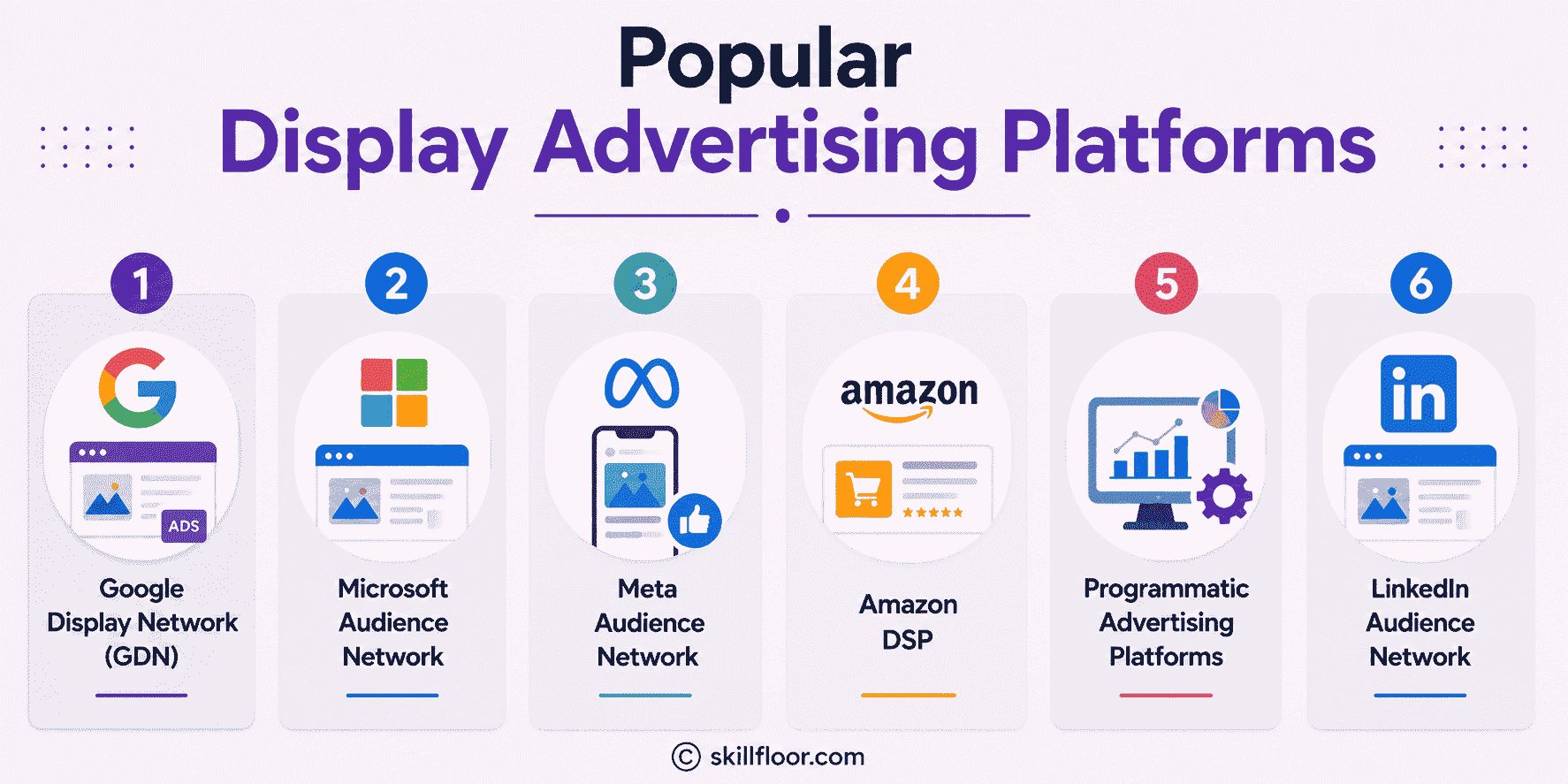
4. Amazon DSP
Advertisers can target customers based on their buying intent and purchase behavior with Amazon DSP.
Ideal for:
-
eCommerce businesses
-
Consumer products
-
Retail brands
5. Programmatic Advertising Platforms
Programmatic platforms automatically buy ad inventory and maximize campaign success using real-time bidding and artificial intelligence.
Benefits include:
-
Smarter audience targeting
-
Automated bidding
-
Improved campaign efficiency
6. LinkedIn Audience Network
LinkedIn Audience Network helps organizations efficiently reach professionals, decision-makers, and high-value B2B audiences by extending LinkedIn ads to reliable third-party websites and apps.
Best for:
-
B2B lead generation
-
Reaching professionals and executives
-
Recruitment and employer branding
Display Ad Targeting Options
The advanced targeting features of display advertising are among its greatest advantages. It aids in reaching target audiences, enhancing campaign effectiveness, cutting down on unnecessary advertising expenditures, and optimizing return on investment.
1. Demographic Targeting
Demographic targeting allows advertisers to reach users based on characteristics such as:
-
Age
-
Gender
-
Household income
-
Parental status
-
Education level (available on some platforms)
Example: A university promoting MBA programs can target users aged 21–35 who are likely to pursue higher education.
2. Geographic Targeting
Businesses can display ads to users in specific:
-
Countries
-
States
-
Cities
-
ZIP/postal codes
-
Radius around a physical location
This is especially useful for local businesses, restaurants, clinics, or service providers.
3. Interest-Based Targeting
Interest targeting helps advertisers reach users based on their long-term interests and online activities.
Examples include:
-
Fitness enthusiasts
-
Travel lovers
-
Technology enthusiasts
-
Food lovers
-
Business professionals
4. Contextual Targeting
Contextual targeting places ads on web pages related to your products or services.
Example: A sports shoe brand displaying ads on fitness blogs or marathon training websites.
This approach ensures your ads appear in a relevant context.
5. Placement Targeting
Placement targeting gives advertisers complete control over where their ads appear.
You can manually choose:
-
Specific websites
-
Mobile apps
-
YouTube channels
-
Individual web pages
Remarketing is one of the most effective display advertising strategies.
It targets users who have already interacted with your business by:
-
Visiting your website
-
Viewing products
-
Adding items to the cart
-
Downloading a guide
-
Signing up for a newsletter
These users are already familiar with your brand, making them more likely to convert.
Standard Display Ad Sizes
Display ads are available in multiple sizes to fit different placements across websites and mobile apps.
Here are some of the most widely used display ad dimensions:
|
Ad Size |
Common Name |
Best Placement |
|
300 × 250 |
Medium Rectangle |
Inside articles, sidebars |
|
336 × 280 |
Large Rectangle |
Content sections |
|
728 × 90 |
Leaderboard |
Top of webpages |
|
970 × 250 |
Billboard |
Premium website headers |
|
160 × 600 |
Wide Skyscraper |
Website sidebars |
|
300 × 600 |
Half Page Ad |
High-visibility placements |
|
Responsive |
Responsive Display Ad |
Automatically adjusts to available space |
Tip: Responsive Display Ads are often the best choice for beginners because they automatically adapt to different screen sizes and placements.
Pricing Models in Display Advertising
Understanding how advertisers are charged is essential before launching your first campaign. Different pricing models align with different campaign goals.
1. Cost Per Click (CPC)
With CPC, you pay only when someone clicks your ad.
Best for:
-
Website traffic
-
Lead generation
-
Sales campaigns
2. Cost Per Thousand Impressions (CPM)
CPM charges advertisers for every 1,000 ad impressions, regardless of clicks.
Best for:
-
Brand awareness
-
Product launches
-
Large-scale visibility
3. Cost Per Acquisition (CPA)
Under the CPA model, advertisers pay only when a user completes a specific action, such as:
-
Making a purchase
-
Filling out a form
-
Downloading an app
This model is commonly used in performance-focused campaigns.
4. Smart Bidding
Many advertising platforms now use AI-powered Smart Bidding strategies to optimize campaigns automatically.
Popular bidding strategies include:
-
Maximize Clicks
-
Maximize Conversions
-
Target ROAS
Smart Bidding analyzes real-time signals—such as device, location, time of day, and user behavior—to improve campaign performance while reducing manual effort.
How to Create a Display Advertising Campaign (Step-by-Step)
There is more to starting a successful display advertising campaign than merely creating a visually appealing advertisement. You get greater results when you adhere to an organized procedure.
Step 1: Define Your Campaign Objective
Establish a specific marketing objective first, such as raising brand awareness, increasing website traffic, producing leads, increasing online sales, or encouraging app installs. Every choice is guided by a specific goal.
Step 2: Choose the Right Advertising Platform
Choose a platform that aligns with your target market and marketing objectives. While other platforms are better suited for social, eCommerce, or B2B advertising, novices frequently favor Google Display Network.
Step 3: Identify Your Target Audience
To make sure your advertising reaches people who are most likely to interact, define your ideal audience using demographics, interests, browsing habits, purchase intent, location, and remarketing lists.
Step 4: Set Your Budget and Bidding Strategy
Choose a suitable bidding technique, such as CPC, CPM, or CPA, based on your campaign's goals and anticipated results after determining your daily or lifetime budget.
Step 5: Design Engaging Ad Creatives
Make eye-catching ads with excellent photos, compelling headlines, succinct writing, recognizable branding, and a compelling call to action that motivates viewers to proceed.
Step 6: Create a Relevant Landing Page
Make sure your landing site conveys the same message as the advertisement, loads fast, functions effectively on mobile devices, and offers a smooth experience that entices users to convert.
Step 7: Launch and Monitor the Campaign
To assess campaign effectiveness and pinpoint areas for improvement, track key metrics like impressions, clicks, CTR, conversions, CPC, and ROAS after launch.
Step 8: Optimize Continuously
Test various bidding methods, landing sites, audience segments, headlines, and creatives on a regular basis. Over time, continuous improvement maximizes advertising ROI, boosts conversions, and enhances performance.
Best Practices for Display Advertising in Digital Marketing
By using these best practices, you can maximize your return on investment (ROI), boost engagement, and enhance ad performance.
1. Use High-Quality Visuals
Make use of crisp, polished, eye-catching photos that grab attention fast. Good images make a good first impression and entice people to interact with your advertisements.
2. Keep Your Message Simple
Concentrate on a single call to action and a single, concise message. Simple advertisements are more effective and easier to read, so avoid packing your ad with too much material.
3. Write Compelling Headlines
Make attention-grabbing headlines that convey value right away. A compelling headline draws readers in, piques their interest, and motivates them to click on your advertisement.
4. Use Strong Calls-to-Action
Use terms like "Shop Now," "Learn More," or "Get Started" that are unambiguous and action-oriented. Users are given clear instructions on what to do next by an engaging call to action.
5. Target the Right Audience
To make sure your advertisements reach the individuals who are most likely to interact and convert, use audience targeting based on demographics, interests, location, or remarketing.
6. Test and Optimize Regularly
Track the effectiveness of your campaigns and keep experimenting with new headlines, images, calls to action, and audience groups. Optimizing on a regular basis maximizes your advertising spend and yields better outcomes.
Common Display Advertising Mistakes to Avoid
Even well-planned campaigns may perform badly if typical errors are ignored. Ad performance may be enhanced, wasteful spending can be decreased, and conversions can be raised by avoiding these mistakes.
1. Targeting Everyone
By reaching visitors who are unlikely to interact, click, or become customers, broad targeting squanders advertising funds.
2. Using Low-Quality Images
Visuals that are blurry, out-of-date, or badly created diminish trustworthiness, lower engagement, and harm the professional image of your brand.
3. Weak or Missing CTAs
Users are confused by a poor or absent call to action, which also lowers the possibility of clicks, leads, and conversions.
4. Ignoring Mobile Optimization
Poor user experiences and a marked increase in bounce rates are caused by ads and landing pages that are not mobile-friendly.
5. Sending Traffic to the Homepage
To enhance user experience and conversions, send visitors to a pertinent landing page rather than the homepage.
6. Not Tracking Conversions
You cannot properly optimize your advertising budget, find areas for improvement, or analyze campaign performance without conversion tracking.
Key Display Advertising Metrics You Should Track
Starting a display advertising campaign is just the first step. You can measure performance, find areas for improvement, and optimize campaigns for better outcomes by keeping track of the appropriate indicators.
1. Impressions
Impressions, a measure of overall visibility and brand awareness, are the number of times your display ad displays on consumers' screens.
Ad relevancy and engagement are measured by CTR, which is the proportion of users who click on your advertisement after viewing it.
Formula: CTR = (Clicks ÷ Impressions) × 100
3. Cost Per Click (CPC)
You can keep an eye on expenses and budget effectiveness by using CPC, which is the average price paid for each ad click.
4. Conversion Rate
The percentage of users that complete desired actions is known as the conversion rate, and it shows how well your adverts produce significant outcomes.
Formula: Conversion Rate = (Conversions ÷ Clicks) × 100
5. Cost Per Acquisition (CPA)
CPA calculates the typical cost of obtaining a single lead or client from your display advertising campaign.
Formula: CPA = Total Advertising Cost ÷ Total Conversions
6. Return on Ad Spend (ROAS)
In order to assess campaign profitability and overall marketing success, ROAS calculates the income gained for each dollar spent on advertising.
Formula: ROAS = Revenue Generated ÷ Advertising Cost
Real-World Examples of Display Advertising in Digital Marketing
Beginners can better understand how display advertising serves distinct company goals across different industries by comprehending real-world examples.
1. E-commerce Store
Banner and remarketing advertising are used by an online fashion company to highlight products and entice past customers to finish their purchases.
Goal: Increase product sales and recover abandoned shopping carts.
2. SaaS Company
A software startup targets professionals with responsive display advertisements on business and technology-related websites to advertise its free trial.
Goal: Generate qualified leads and increase software sign-ups.
3. Travel Agency
On travel websites, a travel agency posts eye-catching advertisements for vacation packages, encouraging customers to research and reserve vacation spots.
Goal: Increase travel bookings and brand awareness.
4. Educational Platform
A platform for online education promotes certification programs, such as those offered by Skillfloor, to professionals and students who want to advance their careers and skill sets.
Goal: Increase travel bookings and brand awareness.
Display Advertising Trends in 2026
Display advertising continues to evolve with advances in technology and changing consumer expectations. Staying updated with current trends helps businesses remain competitive.
-
AI-Powered Ad Creation: Artificial intelligence now assists advertisers in generating headlines, visuals, and responsive creatives, making campaign creation faster and more effective.
-
Privacy-First Advertising: As third-party cookies continue to decline, advertisers are increasingly relying on first-party data, contextual targeting, and privacy-focused audience strategies.
-
Interactive Ad Experiences: Interactive formats such as quizzes, polls, product previews, and augmented reality (AR) experiences are becoming more popular for increasing engagement.
-
Video-First Display Advertising: Short-form videos and animated creatives continue to outperform static image ads in many industries, helping brands capture user attention more effectively.
-
Smarter Automation: Machine learning is improving campaign optimization by automatically adjusting bids, placements, and audience targeting based on real-time performance.
Frequently Asked Questions (FAQs)
1. What is display advertising in digital marketing?
Display advertising is a form of online advertising that uses visual elements such as images, banners, videos, and interactive creatives to promote products or services across websites, mobile apps, and online platforms.
2. Is display advertising suitable for beginners?
Yes. Modern advertising platforms provide user-friendly campaign setup, automated bidding, and responsive ad formats, making display advertising accessible for beginners.
3. What is the difference between display advertising and search advertising?
Display advertising targets users while they browse websites and apps, whereas search advertising targets users who are actively searching for products or services on search engines.
4. Which industries benefit from display advertising?
Display advertising is effective for industries such as eCommerce, education, healthcare, travel, finance, real estate, SaaS, and local businesses.
5. How much does display advertising cost?
The cost varies depending on your targeting, bidding strategy, competition, and campaign objectives. Businesses can start with relatively small budgets and scale as they achieve positive results.
Display advertising remains one of the most effective digital marketing strategies for building brand awareness, reaching new audiences, and driving measurable business growth. Display advertising provides adaptable targeting, eye-catching formats, and potent optimization tools to assist your marketing objectives, whether you're promoting an online store, software product, local business, or educational platform.
Success in 2026 will depend on your ability to comprehend your target audience, develop effective ad creatives, choose appropriate targeting tactics, and continuously optimize your campaigns based on performance data.
If you're just getting started, start with a specific goal, test out responsive display advertisements, keep an eye on your important data, and gradually improve your campaigns. Display advertising can be a useful tool for expanding your clientele, boosting conversions, and growing your company with regular testing and adjustment.
Digital Marketing Course in Ahmedabad | Digital Marketing Course in Bangalore | Digital Marketing Course in Chennai | Digital Marketing Course in Coimbatore | Digital Marketing Course in Hyderabad | Digital Marketing Course in Pune | Digital Marketing Course in Delhi | Digital Marketing Course in Mumbai
Digital Marketing Courses in Other Locations in India
Ahmedabad | Aurangabad | Bangalore | Bhilai | Bhopal | Bhubaneshwar | Chandigarh | Chennai | Cochin | Coimbatore | Dehra Dun | Delhi | Faridabad | Ghaziabad | Gorakhpur | Guntur | Gurgaon | Guwahati | Hyderabad | Jaipur | Kanpur | Khammam | Kolkata | Lucknow | Madurai | Mumbai | Mysore | Nagpur | Noida | Patna | Pondicherry | Pune | Ranchi | Shimoga | Surat | Thane | Thiruvananthapuram | Tiruchirappalli | Tirupati | Vadodara | Visakhapatnam | Warangal | Jalandhar | Jodhpur | Indore | Durgapur | Jamshedpur | Dhanbad | Kota | Karnal | Udaipur | Amritsar | calicut | Nashik | Ludhiana | varanasi | thrissur | Mangalore | Raipur |