











































Essential SEO Skills Every Digital Marketer Needs
Discover essential SEO skills for digital marketers. Learn how to optimize content, find keywords, and build links to improve your online presence.

Millions of people use Google every day to locate goods, services, and information. My experience with SEO and digital marketing has shown me that the majority of people click on the top results; therefore, search presence is crucial for drawing in targeted website visitors.
SEO is more than just improving search engine rankings. It enhances online exposure by combining keyword research, content marketing, user intent analysis, and website optimization, assisting companies in gaining credibility and drawing in natural visitors.
Working with a variety of companies, I've witnessed several struggles even though they provide top-notch goods or services. On-page SEO, technical SEO, and content optimization are examples of effective SEO techniques that frequently increase search rankings and client reach.
Since search engine algorithms are always changing, SEO and digital marketing are lifelong learning processes. Once-effective strategies may lose their effectiveness, necessitating campaign refinement, adaptation, and adherence to current SEO best practices.


Gaining SEO expertise helps boost organic traffic, enhance lead generation, and improve digital marketing effectiveness, regardless of experience level. To achieve long-term growth for your online business, you still need to understand SEO.
What Are SEO Skills in Digital Marketing?
In digital marketing, the ability to enhance websites, content, and technological elements to boost search visibility is known as SEO skills. These skills encompass keyword research, content optimization, and understanding user intent, all aimed at helping businesses increase organic traffic and improve their online performance.
SEO competencies include technical SEO, analytics, and link-building strategies. Digital marketers leverage these skills to improve search rankings, monitor performance, and optimize website structure. Strong SEO skills enhance user experiences, increase engagement, and effectively support long-term growth in digital marketing.
Why SEO Skills Are Important for Digital Marketers
Without depending only on paid advertising, SEO assists companies in achieving long-term online presence. SEO continues to generate organic traffic over time, in contrast to PPC efforts that cease to generate traffic when the budget is exhausted.
For digital marketers, SEO skills offer several benefits:
-
Increase website traffic organically
-
Improve lead generation and conversions
-
Enhance brand visibility and authority
-
Reduce customer acquisition costs
-
Support content marketing strategies
-
Create long-term business growth
Additionally, SEO helps businesses comprehend consumer behavior and search trends. They may provide content that satisfies user needs while enhancing website performance and search visibility by utilizing insights from keyword research, analytics, and a well-thought-out digital marketing strategy.
Marketers who are familiar with SEO can develop strategies that meet search engine standards and user expectations as search engines grow more intelligent. In the digital sphere, this aids companies in maintaining their competitiveness, raising their ranks, and achieving long-term growth.
Challenges Digital Marketers Face in SEO
Before learning the fundamentals, it's critical to comprehend the common challenges related to SEO.
1. Frequent Algorithm Updates
Google makes frequent changes to its search algorithms to enhance the quality of its results. Website rankings may be impacted by these changes, so it's critical for marketers to keep informed and modify their tactics.
2. Growing Competition
Basically, there are millions of websites fighting for the same keywords. High-quality content, strategic planning, and ongoing optimization are necessary to stand out in competitive search results.
3. Technical Complexity
Technical SEO encompasses mobile optimization, crawlability, indexing, page speed, and website architecture. For beginners, it can be difficult to understand these technical features.
4. Content Saturation
It is no longer sufficient to only publish reputable content. In order to truly assist users, marketers must create original, valuable, and authoritative content.
5. Data Analysis
Google Analytics and Google Search Console are two examples of the tools used by Search engine optimization to produce vast volumes of data. Analytical skills are needed to interpret this data and transform it into insights that can be put into practice.
6. Changing User Search Intent
As consumer preferences, technology, and trends change, so does user search behavior. Over time, keywords that once generated traffic may become less effective. To remain relevant and satisfy user expectations, digital marketers must frequently assess search intent and change content.


Essential SEO Skills Every Digital Marketer Needs
1. Keyword Research
The process of identifying the words and phrases that people use while searching on Google is known as keyword research. It assists digital marketers in comprehending the desires of their target audience and producing content that corresponds with their queries.
A good keyword research strategy helps you:
-
Discover what customers are searching for
-
Find low-competition keyword opportunities
-
Understand user intent
-
Improve organic traffic
Ahrefs, Ubersuggest, Semrush, and Google Keyword Planner are popular tools for keyword research. Marketers may increase their chances of appearing higher in search results and draw in relevant visitors by targeting the right keywords.
2. On-Page SEO Optimization
The goal of on-page SEO is to improve each web page's search engine ranking. It enhances the user experience while assisting Google in comprehending your content.
Important on-page SEO elements include:
-
SEO-friendly title tags
-
Meta descriptions
-
Header tags (H1, H2, H3)
-
Internal linking
-
Image optimization
-
Keyword placement
Pages that are effectively optimized improve exposure, rankings, and overall website performance by making them easier for users to navigate and aiding search engines in better understanding information.
3. Content Creation
One of the most crucial aspects of SEO is content. Websites that offer users relevant, valuable, and helpful information are given priority by search engines.
Effective content creation involves:
-
Writing informative blog posts
-
Creating engaging guides and tutorials
-
Answering user questions
-
Updating outdated content
-
Providing unique insights
In addition to raising your website's rankings, high-quality content builds audience trust and entices users to stay on it longer.
4. Technical SEO
Technical SEO ensures that your website is easy for search engines to crawl, index, and comprehend. If search engines are unable to effectively access content due to technical challenges, even the best content may find it difficult to rank.
Key areas of technical SEO include:
-
Website speed optimization
-
Mobile responsiveness
-
XML sitemaps
-
Robots.txt management
-
Secure HTTPS websites
By loading more quickly, operating seamlessly across all platforms, and assisting search engines in more efficiently crawling, indexing, and ranking content, a technically optimized website enhances user experience.
5. Link Building
The process of obtaining backlinks from other websites is called link building. These backlinks serve as trust signals that assist search engines in assessing the legitimacy and authority of your website.
Benefits of quality backlinks include:
-
Higher search rankings
-
Increased website authority
-
More referral traffic
-
Better online visibility
Digital PR, resource sites, guest blogging, and producing informative material that people want to share are all effective link-building techniques.
6. SEO Analytics
Marketers may assess performance and determine whether their tactics are working with SEO analytics. It is challenging to find areas that could use improvement without data.
Important metrics to track include:
-
Organic traffic
-
Keyword rankings
-
Click-through rate (CTR)
-
Bounce rate
-
Conversion rate
Google Analytics and Google Search Console are two examples of tools that offer insightful data to assist marketers in making wise choices.
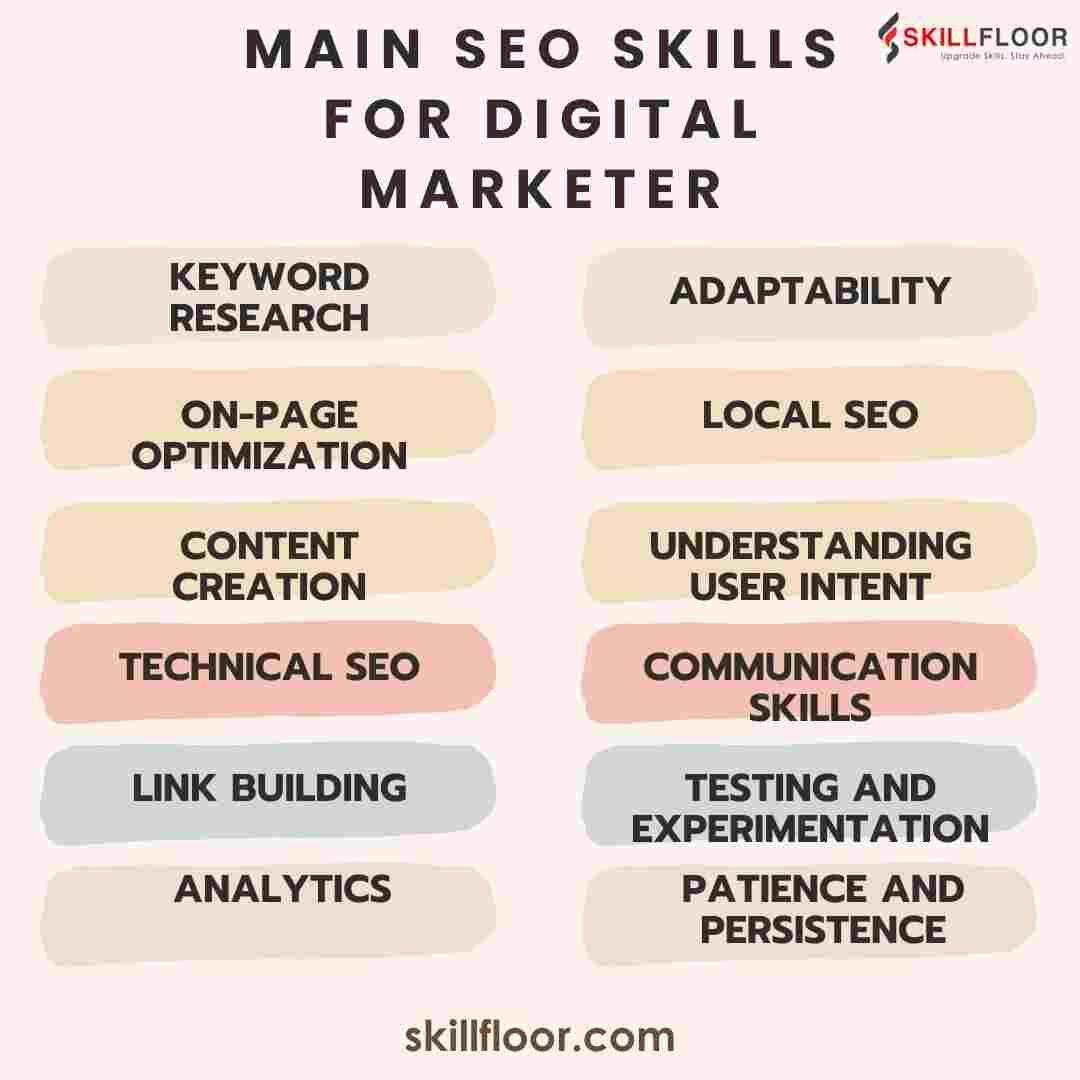
7. Local SEO
Businesses can appear in location-based searches and draw in local clients with the aid of local SEO. It is particularly crucial for companies that operate in particular areas or cities.
Local SEO activities include:
-
Optimizing Google Business Profile
-
Managing customer reviews
-
Building local citations
-
Creating local content
-
Using location-based keywords
Good local SEO makes companies more visible in Google Maps and local search results, which facilitates local clients' ability to locate, get in touch with, and visit them.
8. Understanding User Intent
The purpose of a search query is referred to as user intent. Knowing what consumers desire enables marketers to produce content that meets their demands.
The main types of search intent are:
-
Informational
-
Navigational
-
Commercial
-
Transactional
Content is more likely to meet user needs, boost engagement, raise ranks, and generate relevant website traffic when it aligns with the user's search intent.
9. Adaptability
New technology, changing user behavior, and algorithm modifications all contribute to the ongoing evolution of SEO. To stay competitive, digital marketers need to be open to learning and change.
Adaptability helps marketers:
-
Respond to Google updates
-
Implement new SEO strategies
-
Stay ahead of competitors
-
Improve long-term results
In an ever-changing digital ecosystem, digital marketers can stay up to date on SEO trends, adjust to algorithm changes, enhance their methods, and retain excellent search positions with the support of continuous learning.
10. Communication Skills
SEO specialists frequently collaborate with marketing teams, developers, business owners, and content creators. They can effectively communicate thoughts, explain tactics, and display results when they have strong communication skills.
Good communication helps marketers:
-
Present SEO reports clearly
-
Explain technical concepts simply
-
Collaborate with teams
-
Gain stakeholder support
Digital marketers can better align tactics, enhance teamwork, and accomplish overall business objectives by being able to accurately explain SEO advice.
11. Testing and Experimentation
SEO takes time and effort. In order to determine which tactics, content formats, and optimization methods are most effective for their target audience and sector, successful digital marketers constantly experiment.
Common SEO tests include:
-
Title tag optimization
-
Meta description improvements
-
Content updates
-
Internal linking strategies
-
Landing page optimization
Over time, consistent testing helps raise organic traffic, enhance search results, and increase conversions.
12. Patience and Persistence
Investing in SEO takes time. SEO results typically take time to appear, in contrast to paid advertisements. Marketers need to use best practices regularly and with patience.
Patience and persistence help marketers:
-
Handle ranking fluctuations
-
Stay focused on long-term growth
-
Continue optimizing content
-
Achieve sustainable results
Stronger and longer-lasting organic growth is frequently experienced by companies that dedicate themselves to SEO over time.
SEO Tools Every Digital Marketer Should Know
SEO tools are essential because they help digital marketers research keywords, track performance, fix technical issues, and improve rankings faster with data-driven decisions. Instead of guessing what works, these tools show exactly what to improve.
1. Keyword Research Tools
Using information from tools like Ahrefs and Google Keyword Planner, keyword research tools assist identifying low-competition, high-traffic keywords, comprehend search intent, and develop SEO content.
2. Analytics Tools
Using data from Google Analytics and Search Console, analytics tools monitor website traffic, user behavior, and conversions, assisting marketers in assessing SEO success and refining tactics.
3. Technical SEO Tools
Technical SEO tools make sure search engines can appropriately index and rank pages by identifying problems with websites such as sluggish performance, crawl errors, broken links, and mobile issues.
4. Content Optimization Tools
By matching search intent and offering real-time optimization recommendations, content optimization tools help content rank higher by enhancing readability, keyword placement, and SEO structure.
5. Backlink Analysis Tools
In order to efficiently increase domain authority and search rankings, backlink tools examine link profiles, find high-quality backlinks, identify toxic connections, and reveal competition link schemes.
6. Competitor Analysis Tools
Competitor analysis tools assist marketers develop more effective SEO strategies to surpass rivals online by analyzing competitor websites, tracking keywords, comparing traffic, and identifying content gaps.
How to Improve Your SEO Skills
If you're new to SEO or want to become more proficient, practice digital marketing tactics, pursue regular education, and use SEO tactics through practical optimization projects.
-
Practice on your own website or blog
-
Follow industry-leading SEO experts
-
Learn Google Search Console and Analytics
-
Stay updated on algorithm changes
-
Conduct regular SEO audits
-
Experiment with content optimization techniques
SEO is a skill that develops with regular practice, ongoing education, and keeping abreast of developments in digital marketing. Regularly using SEO strategies enables you to comprehend search behavior and gradually enhance website performance.
Gaining practical experience is crucial to becoming an SEO expert. Strategies can be improved by working on actual projects, testing with keywords, tweaking content, and evaluating outcomes. Stronger SEO abilities and long-term confidence are developed via consistent digital marketing effort.
Common SEO Mistakes to Avoid
SEO errors can have a detrimental effect on a website's performance and search exposure, even for experienced digital marketers. Building a solid and successful SEO strategy requires avoiding these mistakes.
1. Keyword Stuffing
Overuse of keywords lowers readability, creates artificial content, and has a detrimental effect on search rankings and overall, SEO performance.
2. Ignoring Search Intent
Unmatched user intent content struggles to rank well in search engines and fails to satisfy inquiries.
3. Thin Content
Low-value content does poorly in search engine rankings and engagement metrics and provides users with little valuable information.
4. Duplicate Content
Duplicate pages seriously impair a website's overall authority and organic visibility, confuse search engines, and lower ranking potential.
5. Poor Internal Linking
Inadequate internal linking hinders search engine crawling and indexing effectiveness and makes navigation challenging for users.
6. Neglecting Technical SEO
Website performance and rankings can be significantly impacted by ignoring technical SEO issues like speed, mobile optimization, and indexing issues.
The Future of SEO
As search engines become more advanced, intelligent, and user-focused, SEO practices are continually evolving. Today, the planning and implementation of optimization techniques are influenced by emerging technologies such as voice search, AI-driven search experiences, semantic search, and increased user experience signals.
Algorithm changes will not impact digital marketers who are adaptable, stay informed about new SEO trends, and prioritize delivering genuine value to users. Success in the competitive realm of digital marketing in the long term will depend on emphasizing useful content, relevance, and user satisfaction.
In the years ahead, predictive user behavior analysis, personalized search results, and artificial intelligence will play an increasingly significant role in SEO. Marketers who understand these changes and adopt data-driven digital marketing strategies will be better positioned to maintain strong visibility and achieve steady organic growth.
FAQs
1. Do I need coding skills to learn SEO?
No, basic SEO does not require coding skills. However, understanding HTML and website structure can help improve technical SEO and communication with developers.
2. How long does it take to see SEO results?
SEO results usually take 3 to 6 months, depending on competition, website quality, and consistency of optimization efforts and content updates.
3. Can SEO work without content marketing?
No, content is essential for SEO. Without quality content, it becomes difficult to rank, attract users, and target relevant keywords effectively.
4. Is SEO better than paid advertising?
SEO and paid ads serve different purposes. SEO provides long-term organic growth, while paid ads deliver quick but temporary traffic results.
5. Do social media signals affect SEO rankings?
Social media signals do not directly impact rankings, but they help increase visibility, traffic, and content reach, which indirectly supports SEO performance.
6. Can beginners learn SEO without experience?
Yes, beginners can learn SEO through online resources, practice, and experimentation. Continuous learning and real project experience help build strong SEO skills over time.
Digital marketers may increase their visibility, draw in the correct audience, and gradually establish a strong online presence with the aid of SEO. Anyone may gradually enhance their SEO skills with the correct combination of technical knowledge, content production, keyword research, and ongoing education. It is about constant effort and gradual improvement rather than fast results. You may remain ahead of the curve by staying informed and practicing frequently as search patterns change. Regardless of your level of experience, developing your SEO abilities will help any online business succeed in the long run, provide new opportunities, and fortify your digital marketing journey.
Digital Marketing Course in Ahmedabad | Digital Marketing Course in Bangalore | Digital Marketing Course in Chennai | Digital Marketing Course in Coimbatore | Digital Marketing Course in Hyderabad | Digital Marketing Course in Pune | Digital Marketing Course in Delhi | Digital Marketing Course in Mumbai
Digital Marketing Courses in Other Locations in India
Ahmedabad | Aurangabad | Bangalore | Bhilai | Bhopal | Bhubaneshwar | Chandigarh | Chennai | Cochin | Coimbatore | Dehra Dun | Delhi | Faridabad | Ghaziabad | Gorakhpur | Guntur | Gurgaon | Guwahati | Hyderabad | Jaipur | Kanpur | Khammam | Kolkata | Lucknow | Madurai | Mumbai | Mysore | Nagpur | Noida | Patna | Pondicherry | Pune | Ranchi | Shimoga | Surat | Thane | Thiruvananthapuram | Tiruchirappalli | Tirupati | Vadodara | Visakhapatnam | Warangal | Jalandhar | Jodhpur | Indore | Durgapur | Jamshedpur | Dhanbad | Kota | Karnal | Udaipur | Amritsar | calicut | Nashik | Ludhiana | varanasi | thrissur | Mangalore | Raipur |