







































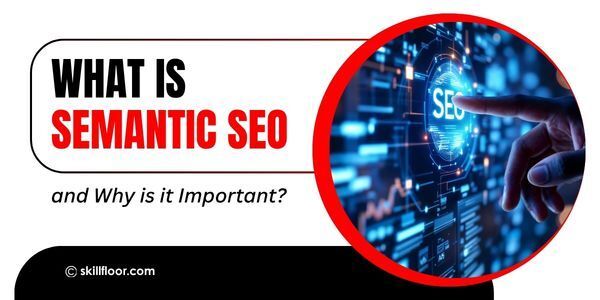
What is Semantic SEO and Why is it Important?
Semantic SEO builds meaning into content by focusing on topics, user intent, and related entities to help search engines and LLMs rank pages higher in SERPs !
Search engines today no longer rely only on exact keyword matching; they focus on understanding the meaning, context, and intent behind a search query. According to Exploding Topics, Google processes more than 8 billion searches per day, and many of these queries are interpreted using advanced AI systems that understand meaning, context, and user intent rather than exact keyword matches.
With this shift, Semantic SEO has become essential because it helps content align with how search engines actually understand information through topics, relationships, and user intent rather than isolated keywords.
With Google becoming more advanced through systems like BERT and MUM, aligning content with semantic search has a direct impact on visibility and rankings.
What is Semantic SEO?
Semantic SEO is a method of optimizing content based on meaning, context, and user intent rather than keyword repetition. It helps search engines understand what a page is about and whether it fully satisfies a user's query. Instead of targeting a single keyword repeatedly, Semantic SEO encourages comprehensive topic coverage by including related concepts, entities, and questions that users are likely to search for.


For example, a page targeting Digital Marketing should naturally cover related subtopics such as Search Engine Optimization (SEO), PPC Advertising, Content Marketing, Social Media Marketing, Email Marketing, Analytics, and Lead Generation. Covering these connected concepts provides a more complete understanding of the subject and helps search engines recognize the content's relevance and depth.
Powered by technologies such as Natural Language Processing (NLP), Entity Recognition, and Google's Knowledge Graph, Semantic SEO enables search engines to interpret content based on meaning rather than keyword frequency. This approach closely aligns with Semantic Search, where search engines focus on understanding the meaning and context behind queries rather than relying solely on exact keyword matches.
Key Takeaway: Semantic SEO focuses on topics, context, entities, and user intent rather than keyword frequency alone.
How Have Search Engines Moved Beyond Keywords?
Earlier search engines relied heavily on keyword matching to determine which pages should appear in search results. Content is often ranked based on how closely it matches a query rather than how effectively it answers a user's question. As a result, SEO strategies were largely focused on optimizing pages around specific keywords.
This change forced search engines to evolve their ranking systems. Users began searching with complete questions, conversational phrases, and highly specific information needs. To deliver better results, search engines started analysing relationships between concepts, entities, and user intent rather than relying solely on keyword matching.
Today, rankings are influenced by how well a page addresses a topic rather than how many times it uses a particular phrase. Search engines can connect related concepts, interpret different ways of expressing the same idea, and surface content that best satisfies user intent. According to Google's Search Ranking Systems documentation, modern ranking systems evaluate numerous signals to understand relevance and deliver useful results.
Why is Semantic SEO Important?
Semantic SEO improves both search engine understanding and user experience. Focusing on topics rather than isolated keywords helps content achieve broader visibility and greater relevance across related searches.
-
Better Search Visibility: A semantically optimized page in a digital marketing strategy can rank for hundreds of related search queries because it covers a topic in depth rather than targeting a single keyword. This increases overall organic reach without needing separate pages for every variation.
-
Stronger Topical Authority: When a website consistently covers related subtopics in detail, search engines start recognizing it as an authority in that subject area. This improves trust and increases the chances of ranking for competitive queries.
-
Improved User Experience: Users can find answers to multiple related questions within a single page instead of visiting multiple sources. This improves engagement and makes the content more useful and complete.
-
Better Performance in Modern Search Systems: As search engines evolve toward AI-driven and answer-based systems, content that clearly explains topics and connects related ideas is more likely to be selected and displayed in search results.
-
Long-Term SEO Stability: Content built on relevance, depth, and user intent is less affected by algorithm updates than content that relies solely on keyword optimization.
What Are the Core Concepts Behind Semantic SEO?
Semantic SEO is built on a set of core concepts that help search engines understand meaning, context, and relationships instead of relying only on keywords.
-
Search Intent refers to the purpose behind a user’s query. It explains what the user actually wants — information, comparison, or action. Content performs well when it directly matches this intent. When search intent is satisfied, users are more likely to engage with the content and find the answers they need.
-
Topical Authority is achieved when a website consistently publishes in-depth content around a specific subject. Over time, this signals expertise and trust in that topic area. Websites with strong topical authority are often considered more reliable sources for related searches.
During SEO audits, one of the most common issues we encounter is websites creating dozens of keyword-focused pages without building topical relationships between them. While these pages may target individual keywords, they often fail to establish the broader topical authority that modern search engines look for.
-
Entities are real-world concepts such as people, brands, tools, and ideas. Search engines use entities to understand what content is about and how different concepts are connected. This helps search engines interpret content more accurately, even when exact keywords are not used.
-
Topic Clusters organize content around a central pillar page supported by related subtopics. This structure helps search engines understand topic depth and relationships between pages. It also makes content easier for users to navigate and explore.
-
Internal Linking connects related pages within a website, helping search engines discover content and understand how different topics are related. A strong internal linking structure distributes authority across pages and strengthens topical relevance.
-
Structured Data provides additional context to search engines, making it easier for them to interpret content accurately and display it properly in search results. It can also improve visibility through rich results and enhanced search features.
What is Search Intent and Why Does It Matter?
Search intent refers to the reason behind a user’s search query — what they are actually trying to find or achieve. Every search has a purpose, and understanding that purpose is essential for creating content that ranks and performs well.
Search intent is generally divided into four types:
|
Type |
Meaning |
Example Query |
|
Informational |
The user wants to learn something |
What is Semantic SEO |
|
Navigational |
User is looking for a specific website or page |
Google Search Console |
|
Commercial |
User is comparing options before making a decision |
Best SEO tools |
|
Transactional |
User is ready to take action or purchase |
Buy an SEO course |
For example, a query like “What is Semantic SEO?” shows informational intent, meaning the user expects a clear explanation rather than a sales page.
When content aligns with search intent, it becomes more relevant, more useful, and more likely to rank because search engines prioritize pages that best satisfy what the user is actually looking for.
Why Does Semantic SEO Matter for Your Rankings?
The shift towards semantic understanding has changed what good SEO actually looks like. Here is why it matters in practice.
-
Content that answers a topic comprehensively tends to earn more visibility across a range of related search queries, not just one keyword.
-
Pages that clearly match what a user intended to find tend to see lower bounce rates, which is a positive signal for search performance.

-
As AI-powered search features (such as Google’s AI Overviews) pull direct answers from trusted content, well-structured semantic content is more likely to be cited.
-
Sites that demonstrate topical authority are more likely to rank consistently, even when individual algorithm updates shift priorities.


Semantic SEO delivers the best results when combined with a well-organised site structure, relevant internal linking, and content that genuinely addresses user needs.
How Do Topic Clusters Build Topical Authority?
Topic clusters organize content around a central pillar topic and multiple related supporting topics, creating a structured content system instead of isolated articles.
Pillar Topic: Semantic SEO
Supporting Topics:
-
Search Intent
-
Topic Clusters
-
Entity SEO
-
Internal Linking
-
Structured Data
-
Topical Authority
Each supporting page links back to the pillar page and connects with related content across the cluster. This structure helps search engines understand topical relationships while strengthening overall authority on the subject.
Semantic SEO vs Traditional Keyword SEO
The main difference between Semantic SEO and Traditional Keyword SEO lies in how search engines understand and interpret content. Traditional SEO focuses on keywords, while Semantic SEO focuses on meaning, context, and user intent.
|
Area |
Traditional Keyword SEO |
Semantic SEO |
|
Focus |
Specific keyword phrases |
Topics, context, and intent |
|
Content approach |
Keyword repetition |
In-depth topic coverage |
|
Search understanding |
Exact keyword matching |
Meaning and intent understanding |
|
Ranking method |
Keywords + backlinks |
Relevance, depth, and entity coverage |
|
User experience |
Structured around keywords |
Natural and helpful content |
|
Long-term value |
Less stable |
More resilient and sustainable |
Semantic SEO focuses on explaining a subject clearly and connecting related concepts naturally, helping search engines understand the broader context and meaning behind the content.
How Can You Apply Semantic SEO to Your Content?
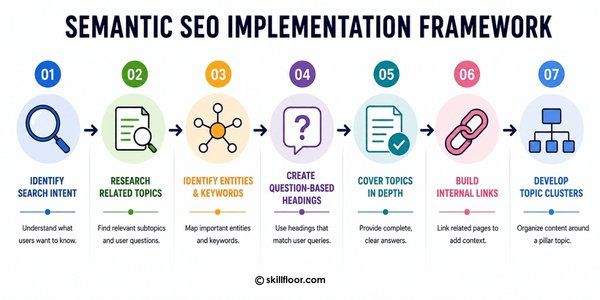
Applying Semantic SEO means shifting your focus from individual keywords to building complete topic coverage that matches user intent and search context. A structured approach helps ensure your content is both user-friendly and search-engine friendly.
1. Identify Search Intent
Before writing, understand what users are actually looking for: information, comparison, or action, and align your content format accordingly.
2. Research Related Topics
Go beyond primary keywords and explore supporting ideas, questions, and subtopics that are closely connected to your main subject.
3. Create Question-Based Headings
Structure your content using headings that reflect real user queries, making it easier for both users and search engines to understand the content flow.
4. Cover Topics in Depth
Address both primary and secondary questions within the same content to provide complete and meaningful coverage of the topic. Building this level of content depth often requires a solid understanding of SEO principles, which many professionals develop through platforms such as Skillfloor.
5. Build Internal Links
Connect related pages using descriptive anchor text to strengthen topical relationships across your website.
6. Develop Topic Clusters
Organize content into clusters around a central pillar topic with supporting articles that reinforce authority and relevance
What Common Semantic SEO Mistakes Should You Avoid?
Many websites still rely on outdated SEO practices that prioritize keywords over meaning, which limits their ability to perform well in modern search engines.
-
Focusing only on exact-match keywords: Many websites overuse specific keywords instead of writing naturally. This reduces readability and prevents search engines from understanding the overall topic context.
-
Ignoring search intent: When content does not match what users are actually looking for, it fails to satisfy their query. This leads to poor engagement and lower rankings.
-
Publishing thin content: Short or incomplete content that does not fully explain a topic struggles to compete with in-depth, comprehensive pages.
-
Weak internal linking: When pages are not properly connected, search engines find it harder to understand how content is related, which weakens site structure.
-
Not covering related concepts: Focusing on a single keyword without supporting ideas limits topical authority and reduces content depth.
-
Creating disconnected content: Publishing unrelated articles without a clear structure prevents search engines from recognizing overall expertise in a topic.
Avoiding these mistakes helps improve both search visibility and user experience. Modern Semantic SEO works best when content is structured, contextual, and interconnected across related topics.
FAQs on Semantic SEO
1. Do I need to use exact keywords for Semantic SEO to work?
No. Semantic SEO focuses more on topic coverage and intent, not keyword repetition.
2. Can a single page rank for multiple searches?
Yes. If your content covers a topic in depth, it can rank for many related queries, not just one keyword.
3. What is the biggest mistake in Semantic SEO?
Writing content only for keywords instead of building a complete topic understanding.
4. Does internal linking matter in Semantic SEO?
Yes. It helps search engines understand relationships between pages and topics.
5. Is Semantic SEO only for blogs?
No. It applies to blogs, landing pages, and full websites to improve overall visibility.
6. What actually improves topical authority?
Consistently publishing related, connected, and in-depth content on the same subject.
Semantic SEO shifts SEO from keyword targeting to a more meaningful approach built around user intent, topical relevance, and content relationships. As search engines continue to improve their understanding of language and context, businesses that focus on comprehensive topic coverage will be better positioned to earn visibility and authority. By combining search intent, topic clusters, internal linking, and entity-based optimisation, websites can build stronger long-term organic growth while creating a better experience for users.
Sources & references:
-
Google's Search Ranking Systems
https://developers.google.com/search/docs/appearance/ranking-systems-guide -
8 billion searches per day
https://www.demandsage.com/google-search-statistics/
Digital Marketing Course in Ahmedabad | Digital Marketing Course in Bangalore | Digital Marketing Course in Chennai | Digital Marketing Course in Coimbatore | Digital Marketing Course in Hyderabad | Digital Marketing Course in Pune | Digital Marketing Course in Delhi | Digital Marketing Course in Mumbai
Digital Marketing Courses in Other Locations in India
Ahmedabad | Aurangabad | Bangalore | Bhilai | Bhopal | Bhubaneshwar | Chandigarh | Chennai | Cochin | Coimbatore | Dehra Dun | Delhi | Faridabad | Ghaziabad | Gorakhpur | Guntur | Gurgaon | Guwahati | Hyderabad | Jaipur | Kanpur | Khammam | Kolkata | Lucknow | Madurai | Mumbai | Mysore | Nagpur | Noida | Patna | Pondicherry | Pune | Ranchi | Shimoga | Surat | Thane | Thiruvananthapuram | Tiruchirappalli | Tirupati | Vadodara | Visakhapatnam | Warangal | Jalandhar | Jodhpur | Indore | Durgapur | Jamshedpur | Dhanbad | Kota | Karnal | Udaipur | Amritsar | calicut | Nashik | Ludhiana | varanasi | thrissur | Mangalore | Raipur |