






























Agentic AI Skills for Students and Professionals
Build Agentic AI skills for students and professionals. Learn how AI agents work, use tools, save time, and handle real tasks at school and work step by step.

Learning Agentic AI skills for students and professionals can feel challenging at first. With new AI tools and technologies developing rapidly, many beginners have the same questions.
-
What skills are required to learn Agentic AI?
-
Can students learn Agentic AI without coding?
-
Is Agentic AI a good career choice in 2027?



These are common questions among students, freshers, and working professionals. The good news is that beginners can start with AI fundamentals, prompt engineering, and basic automation before moving into advanced technical skills.
Why do Agentic AI skills matter in 2027?
-
AI Automation: Businesses are exploring AI agents to manage complex workflows.
-
Career Opportunities: AI skills can support careers in technology, marketing, and business.
-
Practical Learning: Building AI projects helps demonstrate real-world skills.
As AI adoption grows, learners with practical knowledge of AI agents may gain an advantage in developing new workplace skills.
This guide covers essential Agentic AI skills, tools, learning paths, practical projects, and career opportunities for 2027.
Quick Answer
The most important Agentic AI skills for students and professionals in 2027 include prompt engineering, Python programming, Large Language Models (LLMs), AI agent planning, API integration, workflow automation, RAG, and multi-agent systems. Students can start learning Agentic AI without coding through AI fundamentals and no-code automation tools. Building practical AI projects helps freshers and working professionals develop skills relevant to AI development, intelligent automation, and future career opportunities.
Key Takeaways
-
Top Agentic AI Skills: Prompt engineering, Python, LLMs, API integration, RAG, multi-agent systems, and AI agent testing are essential learning areas.
-
Beginner-Friendly Learning: Students from technical and non-technical backgrounds can start learning Agentic AI without prior coding experience.
-
Agentic AI Learning Roadmap: A structured 12-week learning plan covers AI fundamentals, automation, agent frameworks, practical projects, and testing.
-
Popular Agentic AI Tools: ChatGPT, n8n, LangChain, LangGraph, CrewAI, and the OpenAI Agents SDK support different stages of AI learning.
-
Real-World AI Projects: AI research assistants, customer support agents, marketing report agents, and document analysis tools help learners build practical portfolios.
-
Agentic AI Career Opportunities: Relevant career paths include AI Agent Developer, Generative AI Engineer, AI Automation Developer, and AI Solutions Engineer.
-
Future Skills for 2027: AI agent architecture, API and MCP integration, workflow orchestration, AI evaluation, and cybersecurity are important areas to develop.
What Is Agentic AI and How Does It Work?
Agentic AI is a type of Artificial Intelligence that can plan, use tools, and take actions to complete a goal with limited human guidance. Unlike basic AI chatbots that mainly respond to questions, AI agents can connect multiple steps and work toward a specific result.
For example, imagine a working professional who needs to prepare a weekly performance report. Instead of manually collecting data from different sources, an AI agent could gather information from connected tools, organize the results, identify important changes, and prepare a draft report for review.
An Agentic AI system commonly works through five stages:
-
Understand the goal: Identify the task and expected result.
-
Create a plan: Break the task into smaller actions.
-
Use available tools: Access approved software, APIs, or databases.
-
Review the results: Check whether the actions produced the expected output.
-
Complete or revise: Finish the task or adjust the plan when required.
AI agents are not always accurate or fully independent. Important actions, including financial transactions and changes to customer records, should have appropriate human approval.
Why Are Agentic AI Skills Important for Students and Professionals
AI skills are becoming valuable because organizations are exploring ways to automate complex tasks, connect business applications, and support employees with intelligent systems. These developments create learning opportunities for students, graduates, and experienced professionals.


According to the World Economic Forum's Future of Jobs Report 2026, AI and big data are among the fastest-growing skill areas expected through 2030. The report also identifies analytical thinking, creative thinking, and technological literacy as important workforce skills.
Learning Agentic AI can be useful for several reasons:
-
Growing AI applications: Businesses are exploring AI agents for customer support, reporting, research, and operations.
-
Practical skill development: Students can build projects that demonstrate AI knowledge.
-
Workplace productivity: Professionals can reduce time spent on repetitive activities.
-
Career flexibility: AI knowledge can support careers in software development, analytics, marketing, and business.
-
Problem-solving ability: Building AI agents develops planning, testing, and logical thinking skills.
-
Continuous learning: Understanding AI systems helps professionals adapt as workplace tools change.
However, learning Agentic AI does not guarantee a job. Employers may also expect technical knowledge, communication skills, industry experience, and practical project work.
What Are the Top 10 Agentic AI Skills to Learn
The most useful Agentic AI skills for students and professionals combine technical knowledge, workflow design, problem-solving, and responsible AI practices. Beginners do not need to master every skill immediately. They can start with AI fundamentals and progress toward building complete AI agent systems.
|
Agentic AI Skill |
What You Will Learn |
Practical Application |
|
Prompt Engineering |
Writing clear AI instructions |
AI task planning |
|
Python Programming |
Basic programming and logic |
Building AI applications |
|
Large Language Models |
How language models process information |
Intelligent assistants |
|
AI Agent Planning |
Breaking goals into smaller tasks |
Multi-step workflows |
|
API Integration |
Connecting software applications |
Automated data collection |
|
Workflow Automation |
Creating connected task processes |
Business automation |
|
RAG and Agent Memory |
Retrieving and using relevant information |
Knowledge assistants |
|
Multi-Agent Systems |
Coordinating specialized agents |
Complex task management |
|
Model Context Protocol |
Connecting AI applications to tools and data |
AI integrations |
|
AI Agent Evaluation and Safety |
Testing performance and controlling risks |
Reliable AI systems |
1. Prompt Engineering and AI Instructions
Prompt engineering is the ability to give AI models clear instructions, context, and expected outputs. Students should learn how to write structured prompts, define tasks, and improve responses through testing.
For example, a marketing student can create a prompt that asks an AI assistant to analyze a campaign report and identify three possible improvements.
2. Python Programming Fundamentals
Python is widely used in AI development because it supports data processing, APIs, and AI frameworks. Beginners should focus on variables, functions, loops, data structures, and error handling.
These basics help learners understand how AI agents execute programmed actions and interact with other applications.
3. Large Language Models (LLMs)
Large Language Models help AI systems understand instructions, process text, and generate responses. Students should understand model capabilities, limitations, context windows, and common errors.
Knowing how LLMs work makes it easier to select suitable models and recognize when an AI response needs verification.
4. AI Agent Planning and Reasoning
AI agents often need to divide a large task into smaller steps. Learners should understand task planning, decision rules, tool selection, and how an agent checks its progress.
For example, a research agent might search for information, compare reliable sources, summarize findings, and prepare a report.
5. API Integration and Tool Calling
Application Programming Interfaces, or APIs, allow software systems to exchange information. Agentic AI developers use APIs to connect AI models with business tools and external services.
A practical project could involve an AI agent retrieving approved information from a database and preparing a summary.
6. AI Workflow Automation
Workflow automation connects different tasks into a repeatable process. Students can learn how triggers, actions, conditions, and approvals work together.
For example, an AI workflow could classify incoming customer questions, prepare draft responses, and send them to an employee for review.
7. Retrieval-Augmented Generation and Agent Memory
Retrieval-Augmented Generation, or RAG, helps AI applications retrieve relevant information from documents or databases before producing an answer. Agent memory helps systems retain useful context, depending on how the application is designed.
These skills are useful when building assistants that answer questions using approved company knowledge.
8. Multi-Agent Systems and Orchestration
A multi-agent system uses different AI agents to handle specialized activities. One agent may collect information, another may analyze it, and a third may prepare the final output.
Orchestration is the process of coordinating these actions, managing their order, and controlling information shared between agents.
9. Model Context Protocol (MCP)
Model Context Protocol is an open standard for connecting AI applications with external tools and information sources. Learning MCP can help technical students understand how AI agents access connected systems through standardized interfaces.
Beginners should first become comfortable with APIs and tool calling before studying MCP in detail.
10. AI Agent Testing, Evaluation, and Responsible AI
AI agents need testing to check whether they complete tasks correctly, follow instructions, and handle unexpected situations safely. Important concepts include evaluation datasets, activity logs, permissions, guardrails, and human approval.
For example, an AI agent should not automatically delete customer information or send sensitive documents without proper authorization.
Essential Technical Skills Required to Build AI Agents
Building an AI agent requires more than writing prompts. Students who want to become Agentic AI developers should understand programming, data handling, software connections, and testing.
The most useful technical foundations include:
-
Python or JavaScript: Write programs and connect AI components.
-
APIs and JSON: Exchange structured information between applications.
-
LLM Fundamentals: Understand model inputs, outputs, and limitations.
-
Databases: Store, retrieve, and organize information.
-
Vector Search: Find relevant information using numerical representations of text.
-
Git and GitHub: Manage code and document project development.
-
Agent Frameworks: Build and coordinate agent workflows.
-
Testing and Debugging: Identify errors and improve system performance.
-
Security Fundamentals: Manage access permissions and sensitive information.
Students can learn these skills gradually by building small projects instead of trying to understand every advanced concept at once.
Can Students Learn Agentic AI Without Coding Experience?
Yes, students can begin learning Agentic AI without coding experience. Beginners can start with AI fundamentals, prompt engineering, task planning, and visual automation tools. These concepts help learners understand how AI agents work before moving into programming.
For example, a student can create a simple no-code workflow that receives a form response, prepares a summary using an AI model, and saves the draft for review. This develops an understanding of triggers, connected tools, and workflow design.
However, students who want to develop advanced AI agents will benefit from learning Python, APIs, databases, and testing methods. Coding gives developers more control over how AI systems work and how problems are solved.
A useful learning sequence is:
-
Understand basic AI concepts.
-
Practice prompt engineering.
-
Explore visual AI automation.
-
Learn Python fundamentals.
-
Build a simple tool-connected agent.
-
Test the system using realistic examples.
Agentic AI Skills for Non-Technical Students and Working Professionals
Agentic AI is not limited to Computer Science students or software developers. Professionals in marketing, finance, human resources, education, and business operations can also learn how to apply AI agents to everyday tasks.
Non-technical learners should focus on understanding business problems, designing simple workflows, reviewing AI results, and using tools responsibly.
Some useful skills include:
-
AI Workflow Design: Identify tasks that could benefit from automation.
-
Prompt Writing: Provide clear instructions for business activities.
-
Data Interpretation: Understand reports and AI-generated insights.
-
No-Code Automation: Connect applications using visual workflows.
-
Process Mapping: Identify the steps required to complete a task.
-
Output Verification: Check AI-generated content and recommendations.
-
AI Governance: Understand privacy, access permissions, and approval requirements.
A human resources professional, for instance, could use an AI workflow to organize approved training feedback and prepare a summary for management. Sensitive employee information would still require careful handling.
Best Agentic AI Tools and Frameworks for Beginners
Learning AI tools helps students connect theory with practical application. Different tools support model interaction, automation, agent development, and testing.
|
Tool or Framework |
Main Purpose |
Suitable For |
|
ChatGPT |
AI interaction and prompt practice |
Beginners |
|
Programming AI applications |
Technical learners |
|
|
n8n |
Visual workflow automation |
Beginners and professionals |
|
LangChain |
Developing LLM-powered applications |
Developers |
|
LangGraph |
Building stateful agent workflows |
Intermediate learners |
|
OpenAI Agents SDK |
Creating and coordinating AI agents |
Developers |
|
CrewAI |
Building multi-agent workflows |
Intermediate learners |
|
Microsoft Copilot Studio |
Creating business agents |
Business professionals |
|
Model Context Protocol |
Standardized AI tool connections |
Developers |
Students should select tools based on their learning goals rather than attempting to master every platform. A beginner might start with ChatGPT and n8n, while a Python learner could progress toward an agent framework.
Tool features, pricing, and technical requirements can change, so learners should check official documentation before starting a project.
How Is Agentic AI Different from Generative AI and Traditional Automation?
Generative AI, Agentic AI, and traditional automation can all support business activities, but they work differently.
Generative AI focuses mainly on producing content such as text, images, and code. Agentic AI uses models and connected tools to plan and complete tasks. Traditional automation usually follows predefined steps and conditions.
|
Feature |
Generative AI |
Agentic AI |
Traditional Automation |
|
Main Purpose |
Generate content |
Complete goal-based tasks |
Execute defined processes |
|
Task Planning |
Usually prompted by users |
Can plan multiple actions |
Usually predefined |
|
Tool Integration |
Depends on application |
Commonly central to the system |
Based on programmed connections |
|
Flexibility |
Strong for content tasks |
Can adapt within defined limits |
Limited by workflow rules |
|
Example |
Drafting an email |
Researching and preparing an email draft |
Sending a scheduled email |
These technologies can also work together. An Agentic AI workflow might use a generative model to prepare content and traditional automation to save the approved result.
How to Start Learning Agentic AI: A Step-by-Step Roadmap
Learning Agentic AI becomes easier with a structured roadmap that helps students and professionals develop essential skills step by step. Beginners can start with AI fundamentals and gradually move toward building AI agents, working with automation tools, and completing real-world projects.
-
Weeks 1–2: AI Fundamentals and Prompt Engineering – Understand basic AI concepts, how AI agents work, and how to write effective prompts.
-
Weeks 3–4: Python Basics and No-Code Automation – Learn basic Python programming or explore no-code tools to create simple automated workflows.
-
Weeks 5–6: LLMs, APIs, and Tool Calling – Understand Large Language Models, connect applications using APIs, and practice retrieving information.
-
Weeks 7–8: AI Agent Planning and Frameworks – Learn how AI agents plan tasks, make decisions, and use frameworks to complete workflows.
-
Weeks 9–10: RAG, Memory, and Multi-Agent Systems – Explore how AI agents retrieve information, maintain context, and work together on complex tasks.
-
Weeks 11–12: AI Testing and Portfolio Development – Test AI agent performance, identify errors, and build a practical project to showcase your skills.
Real-World Agentic AI Projects Students Can Build for Their Portfolios
Building real-world Agentic AI projects helps students and freshers gain practical experience and demonstrate their technical skills to potential employers. Beginners can start with simple AI applications and gradually develop advanced projects involving automation, data analysis, and intelligent decision-making.
-
AI Research Assistant: Build an AI agent that collects information from trusted sources, summarizes findings, and prepares research reports.
-
Customer Support Assistant: Create an AI assistant that answers common customer questions using company documents and knowledge bases.
-
Marketing Report Agent: Develop an AI agent that analyzes marketing campaign data, tracks performance, and generates useful reports.
-
AI Study Planning Agent: Design an AI assistant that creates personalized study schedules, organizes learning tasks, and tracks student progress.
-
Document Analysis Agent: Build an AI application that reads documents, retrieves relevant information, and generates accurate summaries.
-
Multi-Agent Content Workflow: Create a system where multiple AI agents work together to research topics, draft content, and review information.
Career Opportunities for Students and Professionals with Agentic AI Skills
Learning Agentic AI may support careers in AI development, software engineering, data science, AI automation, and business technology. Some employers advertise specialized agent development positions, while others include these responsibilities within existing technical roles.
|
Career Role |
Relevant Skills |
|
Python, LLMs, APIs, orchestration |
|
|
Generative AI Engineer |
LLM integration, RAG, evaluation |
|
AI Automation Developer |
Workflow automation, APIs, tool integration |
|
Machine Learning Engineer |
Python, ML fundamentals, model evaluation |
|
AI Application Developer |
Software development, AI frameworks |
|
AI Solutions Engineer |
System design, integration, testing |
|
AI Product Specialist |
Business analysis, AI product knowledge |
|
AI Workflow Consultant |
Process mapping, automation, AI governance |
Freshers can begin with internships, junior development positions, and portfolio projects. Experienced professionals can explore AI applications within their current fields before moving toward more specialized responsibilities.
Job titles and qualification requirements vary between organizations. Learners should compare real job descriptions and develop skills that match their target roles.
Which Agentic AI Skills Will Employers Look for in 2027 and Beyond?
As organizations test and adopt AI agent systems, professionals who understand both technical development and responsible deployment may be better prepared for changing roles.
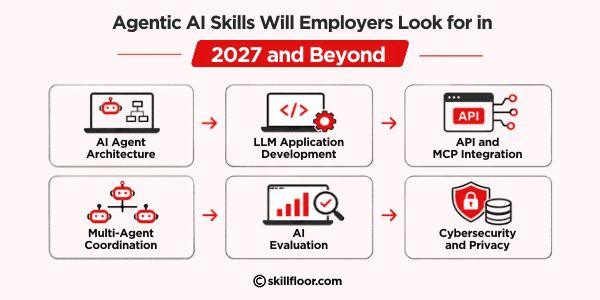
Based on current agent development practices, several skills are likely to remain useful:
-
AI Agent Architecture: Designing systems that combine models, tools, and workflows.
-
LLM Application Development: Building practical applications using language models.
-
API and MCP Integration: Connecting AI systems with approved tools and data.
-
Multi-Agent Coordination: Managing specialized agents and their responsibilities.
-
AI Evaluation: Measuring accuracy, task completion, and reliability.
-
Cybersecurity and Privacy: Protecting connected systems and sensitive information.
A major challenge for organizations is building reliable AI systems.
According to Deloitte's Agentic AI readiness survey, only 15% of the 501 surveyed US organizations had scaled coordinated, cross-functional multi-agent adoption.
The same survey found that 70% of respondents reported challenges related to trusting and governing AI agents.
These findings highlight the importance of combining Agentic AI development skills with testing, security, and responsible AI practices.
How Can Working Professionals Use Agentic AI to Improve Their Careers?
AI professionals can begin applying Agentic AI without changing their careers immediately. The first step is to identify repetitive tasks that require collecting information, comparing data, preparing drafts, or coordinating activities.
For example, a project manager may use an AI-assisted workflow to track project progress and prepare reports, while a business analyst may develop an AI assistant to summarize business data and identify important insights.
A practical approach includes identifying one business problem, selecting suitable tools, building a small workflow, measuring its results, and improving it through testing.
Professionals should also continue developing communication, analytical thinking, and industry-specific knowledge. These abilities remain important when deciding whether an AI-generated recommendation is useful or appropriate.
Common Challenges Beginners Face While Learning Agentic AI
Agentic AI can appear difficult because it combines several technical concepts. Beginners may encounter unfamiliar tools, programming errors, unpredictable model responses, and challenges when connecting applications.
Common learning challenges include:
-
Too Many Tools: Start with one workflow tool before studying multiple frameworks.
-
Limited Coding Knowledge: Learn basic Python and gradually increase project complexity.
-
Unclear Learning Goals: Choose a specific project to guide your studies.
-
Inaccurate AI Outputs: Compare results with trusted information and test different cases.
-
Integration Errors: Practice APIs and JSON using sample data.
-
Security Concerns: Use limited permissions, test environments, and approval controls.
-
Lack of Project Experience: Build small applications and record what you learn.
Beginners should also understand that AI agents can make mistakes even when their instructions appear correct. Testing and supervision are necessary parts of developing reliable systems.
How Skillfloor Helps Students Develop Practical Agentic AI Skills
Learning Agentic AI becomes more useful when theoretical concepts are connected with practical activities. Students need opportunities to understand AI fundamentals, explore tools, work on projects, and develop the ability to solve real business problems.
Skillfloor offers career-focused professional education in areas including Artificial Intelligence, Machine Learning, Data Science, and Digital Marketing. Its learning approach emphasizes practical skill development, helping students, freshers, and working professionals build knowledge relevant to changing industry requirements.
Learners interested in Agentic AI can begin with AI fundamentals, programming concepts, automation, and project-based learning. They should review the latest Skillfloor course syllabus to confirm which Agentic AI topics, tools, projects, and learning options are currently included.
By developing a strong foundation and practicing consistently, learners can prepare to explore AI development, intelligent automation, and other technology-related opportunities.
FAQ’s
1. What are the most important Agentic AI skills for beginners?
The most important beginner skills include prompt engineering, AI fundamentals, task planning, basic Python, API concepts, and workflow automation. Learners can study advanced topics such as RAG and multi-agent systems after building a strong foundation.
2. Can a non-IT student learn Agentic AI?
Yes. Students from business, commerce, arts, science, and other educational backgrounds can begin with AI fundamentals and no-code tools. Advanced technical development may require programming and software knowledge.
3. Is Python necessary for learning Agentic AI?
Python is not required to understand Agentic AI concepts or create basic no-code workflows. However, it is highly useful for developing custom AI agents, connecting APIs, and building advanced applications.
4. What is the difference between Generative AI and Agentic AI?
Generative AI mainly creates content such as text, images, or code. Agentic AI can plan tasks, use connected tools, and perform multiple actions toward a goal. Agentic systems often use generative AI models as one of their main components.
5. How long does it take to learn Agentic AI?
Beginners may develop basic knowledge within a few weeks of regular study. Building reliable applications can take several months or longer, depending on coding experience, project complexity, and available study time.
6. What are the best Agentic AI projects for students?
Useful beginner projects include AI research assistants, study planning agents, document question-answering systems, customer support assistants, and automated reporting workflows. Choose projects that can be tested and explained clearly.
Agentic AI skills for students and professionals can open new learning opportunities in Artificial Intelligence, automation, software development, and business applications. Skills such as prompt engineering, Python, AI agent planning, API integration, and workflow automation provide a useful foundation for understanding how intelligent systems operate. Students can begin with simple AI tools and gradually develop practical projects, while working professionals can explore ways to apply Agentic AI within their existing responsibilities. With consistent learning, hands-on practice, and responsible use of technology, learners can prepare for changing career requirements in 2027 and beyond. Skillfloor supports career-oriented learning across AI and related technology fields, helping learners build practical knowledge as they prepare for future professional opportunities.
Digital Marketing Courses in Other Locations in India
Ahmedabad | Aurangabad | Bangalore | Bhilai | Bhopal | Bhubaneshwar | Chandigarh | Chennai | Cochin | Coimbatore | Dehra Dun | Delhi | Faridabad | Ghaziabad | Gorakhpur | Guntur | Gurgaon | Guwahati | Hyderabad | Jaipur | Kanpur | Khammam | Kolkata | Lucknow | Madurai | Mumbai | Mysore | Nagpur | Noida | Patna | Pondicherry | Pune | Ranchi | Shimoga | Surat | Thane | Thiruvananthapuram | Tiruchirappalli | Tirupati | Vadodara | Visakhapatnam | Warangal | Jalandhar | Jodhpur | Indore | Durgapur | Jamshedpur | Dhanbad | Kota | Karnal | Udaipur | Amritsar | calicut | Nashik | Ludhiana | varanasi | thrissur | Mangalore | Raipur |