





































Top Cyber Security Jobs in Pune: Salary & Career Scope
Find top cyber security jobs in Pune, salary details, skills, career options and growth opportunities to help you choose the right role and build your career.

Technology has become a vital part of modern business, as companies rely on online banking, e-commerce, cloud computing, and digital payments. Nevertheless, rising digital adoption also leaves organisations open to cyber threats like hacking, ransomware, phishing, and data breaches, which makes cybersecurity indispensable.
Pune is an expanding IT hub in India, where IT firms, multinational corporations, startups, and financial organisations create opportunities for cybersecurity professionals. Such businesses require skilled experts to safeguard networks, applications, cloud infrastructure, and sensitive information, which drives growing interest in cyber security jobs in Pune.
Cybersecurity provides career paths in ethical hacking, network security, penetration testing, cloud security, and security analysis. For those aspiring to enter the field, it is important to understand job roles, technical skills, certifications, and salary expectations. This guide examines career opportunities and assists freshers and experienced candidates in planning their next steps.
Key Takeaways


-
Pune offers cybersecurity job opportunities across IT, banking, healthcare, manufacturing, and other industries.
-
Popular job roles include SOC Analyst, Cyber Security Analyst, Ethical Hacker, and Cloud Security Engineer.
-
Freshers may earn around ₹3.5–6 LPA in entry-level cybersecurity positions, depending on their skills, qualifications, and employer.
-
Networking, Linux, Python, ethical hacking, and security monitoring are valuable skills for cybersecurity careers.
-
Industry-recognised certifications, practical training, and hands-on projects can help freshers develop job-ready cybersecurity skills.
-
With relevant experience and continuously updated technical knowledge, professionals can progress into senior security, specialist, and management positions.
What Is the Career Scope of Cyber Security Jobs in Pune?
Cybersecurity is becoming a key career field because more businesses rely on computers, networks, websites, and online services. Companies in Pune need skilled professionals to keep their systems, customer information, and business data safe from online attacks. This opens up job opportunities in IT companies, banking, healthcare, manufacturing, and other industries.
The career scope of cybersecurity includes:
-
Security Analysis: Monitor computer systems and find possible security risks.
-
Ethical Hacking: Test websites, networks, and applications to find security weaknesses.
-
Network Security: Protect company networks from hackers and unwanted access.
-
Cloud Security: Keep online data and cloud systems safe from cyber threats.
-
Incident Response: Find the cause of cyberattacks and help companies recover from them.
-
Application Security: Identify and fix security problems in websites and software.
Pune's growing IT sector and strong industrial base give opportunities to people who have the right cybersecurity knowledge and practical skills. Freshers and experienced professionals alike can look into different roles depending on their interests and qualifications.
Why Is Pune Becoming a Growing Destination for Cyber Security Careers?
Pune is a big center for IT and business in Maharashtra, and it is home to many software, automobile, and manufacturing companies. According to the Ministry of Electronics and Information Technology (MeitY), in FY 2025–26, Maharashtra's STPI-registered units brought in about ₹1.63 lakh crore from software exports.
As businesses rely more on digital services, they increasingly need to protect their company data and networks. This opens up chances for cybersecurity professionals to stop cyberattacks and keep business information safe.
Here are some reasons why Pune offers career opportunities in cybersecurity:
-
Growing IT Industry: Pune's IT companies require cybersecurity professionals to protect their networks, software, and business data.
-
Banking and Financial Services: Banks require security experts to protect customer information and online transactions.
-
Manufacturing and Automotive Sector: Companies use digital systems that need protection from cyber threats and data theft.
-
Increasing Use of Cloud Services: Businesses require skilled professionals to secure cloud data, applications, and online systems.
Due to these factors, Pune is a promising place for students, freshers, and working professionals who want to build a career in cybersecurity.
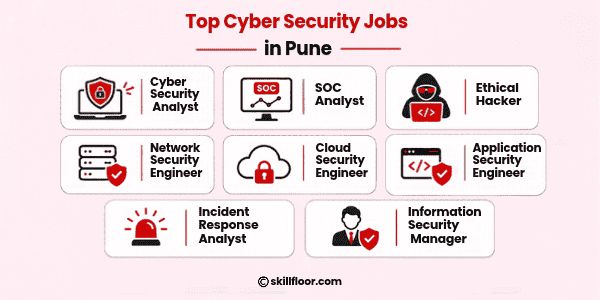
Top Cyber Security Jobs in Pune
Cybersecurity is a large field that includes many specialised job roles. Every role comes with its own duties, technical skills, and salary potential.
1. Cyber Security Analyst
A Cyber Security Analyst keeps company systems, networks, and sensitive data safe from online threats. They watch security activities, spot risks, look into suspicious behaviour, and recommend suitable security solutions.


Key Responsibilities:
-
Monitor networks and systems to detect suspicious activities.
-
Identify security threats and investigate potential cyberattacks.
-
Perform vulnerability assessments to find system weaknesses.
-
Support incident response and recommend security improvements.
Required Skills:
-
Knowledge of networking fundamentals.
-
Understanding of Linux and Windows operating systems.
-
Familiarity with SIEM and security monitoring tools.
-
Basic scripting and vulnerability assessment skills.
Career Scope: Cyber Security Analysts can progress into Security Engineers, Threat Analysts, Security Consultants, and Security Operations Managers.
2. SOC Analyst (Security Operations Centre Analyst)
A SOC Analyst watches company networks and systems to find cyber threats. They look into security alerts, examine suspicious activities, and help stop attacks before they do serious damage.
Key Responsibilities:
-
Monitor security alerts and system logs to detect threats.
-
Investigate suspicious network activities and security incidents.
-
Identify malware, phishing, and unauthorized access attempts.
-
Report security issues and escalate serious incidents.
Required Skills:
-
Knowledge of networking fundamentals.
-
Familiarity with SIEM tools like Splunk and Microsoft Sentinel.
-
Understanding of common cyber threats and log analysis.
-
Knowledge of incident detection and response.
Career Scope: SOC Analysts can progress from Tier 1 to Tier 2 and Tier 3 roles before specialising in threat hunting, incident response, or security engineering.
3. Ethical Hacker / Penetration Tester
An Ethical Hacker tests websites, applications, and networks to find security weaknesses. They carry out authorised security tests, spot possible risks, and suggest ways to protect systems from hackers.
Key Responsibilities:
-
Perform authorised penetration testing on websites and networks.
-
Identify security weaknesses in applications and systems.
-
Test login systems and access controls.
-
Prepare security reports and suggest solutions.
Required Skills:
-
Knowledge of networking and operating systems.
-
Understanding of web application security and Linux.
-
Basic knowledge of Python and scripting.
-
Familiarity with OWASP and vulnerability testing tools.
Popular Tools: Burp Suite, Nmap, Metasploit, Wireshark, and Kali Linux.
Career Scope: Ethical Hackers can progress into Senior Penetration Testers, Red Team Specialists, Application Security Engineers, and Security Consultants.
4. Network Security Engineer
A Network Security Engineer keeps company networks safe from unauthorized access and cyberattacks. They manage firewalls, watch network traffic, spot security issues, and keep network connections safe.
Key Responsibilities:
-
Configure and manage firewalls to protect company networks.
-
Monitor network traffic to detect suspicious activities.
-
Set up VPNs and access controls for secure connections.
-
Identify network weaknesses and investigate security issues.
Required Skills:
-
Knowledge of TCP/IP and networking fundamentals.
-
Understanding of firewall configuration and management.
-
Familiarity with VPN, IDS, and IPS technologies.
-
Knowledge of network monitoring, routing, and switching.
Career Scope: Network Security Engineers can move into Senior Network Security Engineer, Infrastructure Security Architect, or Network Security Consultant positions.
5. Cloud Security Engineer
A Cloud Security Engineer protects data, applications, and systems stored on cloud platforms. They manage access controls, spot security risks, and help businesses keep their cloud environments safe.
Key Responsibilities:
-
Secure cloud infrastructure.
-
Implement identity and access management.
-
Monitor cloud security configurations.
-
Identify cloud vulnerabilities.
Required Skills:
-
AWS, Microsoft Azure, or Google Cloud.
-
Cloud networking and IAM.
-
Encryption and access controls.
-
Cloud monitoring tools and infrastructure security.
Career Scope: Cloud Security Engineers can progress into Senior Cloud Security Engineers, Cloud Security Architects, and Cloud Security Consultants.
6. Application Security Engineer
An Application Security Engineer protects websites, mobile apps, and software from security threats. They find coding errors, test applications, and work with developers to make software more secure through cybersecurity practices.
Key Responsibilities:
-
Perform application security testing.
-
Identify vulnerabilities in web and mobile applications.
-
Conduct secure code reviews.
-
Test APIs and application components.
Required Skills:
-
Programming fundamentals.
-
Web application security and API security.
-
OWASP Top 10.
-
SSDLC, SAST, and DAST tools.
Career Scope: Professionals can move into Senior Application Security Engineer, Product Security Specialist, DevSecOps Engineer, and Application Security Architect roles.
7. Incident Response Analyst
An Incident Response Analyst investigates cyberattacks, data breaches, and suspicious activities. They find the source of security problems, reduce damage, support recovery, and help stop future attacks.
Key Responsibilities:
-
Investigate security incidents.
-
Identify the source and impact of attacks.
-
Analyse system logs and suspicious activities.
-
Coordinate incident containment and system recovery.
Required Skills:
-
Incident response methodologies.
-
Digital forensics fundamentals.
-
Log analysis and malware analysis basics.
-
Endpoint detection and response tools and threat intelligence.
Career Scope: Incident Response Analysts can specialise in Digital Forensics, Threat Hunting, Malware Analysis, and Cyber Defence.
8. Information Security Manager
An Information Security Manager creates security plans and policies to protect company information. They manage security teams, assess risks, support compliance, and make sure data protection practices are followed.
Key Responsibilities:
-
Develop information security policies.
-
Manage cybersecurity teams.
-
Conduct security risk assessments.
-
Ensure regulatory compliance and coordinate security audits.
Required Skills:
-
Information security management.
-
Risk assessment and GRC.
-
ISO 27001 and security frameworks.
-
Leadership and communication.
Career Scope: Information Security Managers can progress into Security Directors, Head of Information Security, and Chief Information Security Officer (CISO) positions.
Cyber Security Salary in Pune: Role-Wise Breakdown
Salary is among the most important factors to consider when selecting a career.
The cybersecurity salary in Pune is influenced by multiple factors, such as job responsibilities, experience, technical skills, certifications, company size, and industry specialisation.
Here is an indicative salary comparison for popular cybersecurity positions.
|
Cybersecurity Job Role |
Indicative Annual Salary |
|
Cyber Security Analyst |
₹5–10 LPA |
|
SOC Analyst |
₹4–8 LPA |
|
Ethical Hacker |
₹6–12 LPA |
|
Network Security Engineer |
₹5–10 LPA |
|
Cloud Security Engineer |
₹12–25 LPA |
|
Application Security Engineer |
₹8–16 LPA |
|
Incident Response Analyst |
₹6–11 LPA |
|
Information Security Manager |
Varies significantly by experience |
Note: These are indicative market estimates, not guaranteed Pune-specific salary averages. Actual compensation varies by employer, experience, technical proficiency, and job requirements.
Salary References: Indeed – Cyber Security Jobs in Pune and Glassdoor – Cyber Security Analyst Salary in Pune
What Factors Influence Cyber Security Salaries in Pune?
-
Experience: Professionals who have more hands-on experience may be eligible for jobs that pay more.
-
Technical Skills: Knowing about network security, Python, Linux, and security tools can lead to better job chances.
-
Certifications: Certifications like CEH, Security+, and CISSP can help your career grow.
-
Specialisation: Skills in cloud security, ethical hacking, and application security can lead to specialised roles.
-
Company Size: Big IT companies and product-based companies may pay different salaries.
-
Job Responsibilities: Professionals who handle security planning, risk management, and team leadership may earn more.
Before setting salary expectations, candidates should look at job descriptions, required skills, experience, and salary details. Looking at current job openings and salary reports can also help them understand cybersecurity career opportunities in Pune.
What Skills Do You Need to Get a Cyber Security Job in Pune?
Cybersecurity professionals need a mix of technical knowledge, problem-solving ability, and communication skills. Employers seek candidates who can protect computer systems, spot security risks, stop cyberattacks, and keep company data safe.
Essential Technical Skills
-
Networking: Understanding IP addresses, firewalls, routers, and network security helps protect computer networks.
-
Linux: Knowledge of Linux commands and systems is useful for security testing and monitoring.
-
Python Programming: Helps automate security tasks and identify possible threats.
-
Ethical Hacking: Helps find security weaknesses in websites, applications, and computer systems.
-
Cloud Security: Helps protect data, applications, and systems stored on cloud platforms.
-
SIEM Tools: Helps monitor system activity, detect threats, and investigate security alerts.
Important Soft Skills
-
Analytical thinking
-
Problem-solving
-
Communication
-
Attention to detail
-
Teamwork
-
Quick decision-making
Developing these skills through practical projects, hands-on training, and certifications can help candidates improve their knowledge and prepare for cyber security jobs in Pune.
Best Cyber Security Certifications to Boost Your Career
Cybersecurity certifications are valuable for candidates seeking to build their technical knowledge, gain practical skills, and boost their confidence. They can also enhance career growth and improve job opportunities.
CompTIA Security+ is a beginner-friendly certification that addresses foundational security concepts, network protection, risk management, and cyber threats. This certification is ideal for individuals starting their careers in cybersecurity.
2. Certified Ethical Hacker (CEH)
Certified Ethical Hacker (CEH) teaches candidates how hackers exploit system vulnerabilities and how to defend against such attacks. It includes topics on ethical hacking, security testing, and common attack methods.
3. Certified Information Systems Security Professional (CISSP)
Certified Information Systems Security Professional (CISSP) is designed for experienced professionals. This certification covers areas such as security management, risk assessment, network security, and strategic planning for protecting business information.
4. Offensive Security Certified Professional (OSCP)
Offensive Security Certified Professional (OSCP) emphasizes hands-on penetration testing. Candidates learn to identify security weaknesses, test systems, and develop methods to prevent cyber-attacks.
5. Certified Information Security Manager (CISM)
Certified Information Security Manager (CISM) is suitable for professionals aiming for security leadership roles. It encompasses topics such as risk management, security governance, incident management, and business protection.
6. AWS Certified Security – Specialty
There's also a certification focused on cloud security. Candidates learn how to safeguard AWS data, manage access controls, secure applications, and monitor cloud environments.
When choosing a certification, consider your experience, career goals, and preferred specialization. Engaging in practical training and hands-on projects can help you apply what you learn effectively.
Top Industries Hiring Cyber Security Professionals in Pune
Pune provides cybersecurity job opportunities in many industries. Companies need skilled workers to keep business data, networks, applications, and digital systems safe.
1. IT and Software Development
IT companies look after business applications, customer information, and cloud systems. They hire cybersecurity experts to protect networks, stop attacks, and keep software secure.
2. Banking and Financial Services
Banks and financial companies deal with customer details, payment systems, and financial records. They need security experts to stop fraud, data theft, and cyber-attacks.
3. Healthcare and Pharmaceuticals
Healthcare and pharmaceutical companies handle patient records, medical information, and research data. Cybersecurity experts help keep sensitive information and digital systems safe.
4. Automotive and Manufacturing
Pune has many automotive and manufacturing companies that use connected machines and digital systems. They need experts to protect factory networks and operations.
Top Locations in Pune for Cyber Security Job Opportunities
Pune has a number of IT parks and business hubs where job seekers can find cybersecurity job opportunities. These places have IT companies, multinational organisations, and businesses that need skilled security professionals.
1. Hinjewadi IT Park
Hinjewadi is a big IT hub in Pune, with many technology companies and multinational organisations based there. Job seekers can find opportunities in security operations, network security, and cyber security consulting.
2. Kharadi and EON Free Zone
Kharadi is a well-known place for business and technology. It offers opportunities in financial services, cloud security, enterprise IT, and information security.
3. Magarpatta City
Magarpatta City is home to several IT and business organisations. Job seekers can find roles in infrastructure security, security operations, risk management, and data protection.
4. Baner and Balewadi
Baner and Balewadi have growing technology and business centres. Job seekers can look for opportunities in application security, cloud security, software development, and IT operations.
Career Scope and Future Opportunities in Cyber Security
The future of cybersecurity seems bright, since more businesses rely on digital technologies and need stronger protection against online threats.
1. Cloud Security
Businesses use cloud platforms to store data and run applications, which creates a need for professionals who can keep cloud systems safe.
2. Artificial Intelligence in Cybersecurity
AI-based security tools help spot threats, find unusual activity, and speed up responses, which opens new opportunities for skilled professionals.
3. Ethical Hacking and Penetration Testing
Companies hire ethical hackers to find security gaps, test systems, and fix problems before attackers can take advantage of them.
4. Application and API Security
The rising use of websites, mobile apps, and APIs creates a need for professionals who can spot and stop software security problems.
5. Governance, Risk, and Compliance
Organisations need security professionals to handle risks, follow security rules, write policies, and keep important business information safe.
6. Digital Forensics and Incident Response
Professionals look into cyber attacks, gather digital evidence, find the causes, and help organisations recover from security incidents.
Overall, cybersecurity offers several career paths for professionals who are willing to continuously update their technical knowledge and practical skills.
How to Start a Career in Cyber Security in Pune?
To begin a career in cybersecurity, you need some basic technical knowledge, hands-on training, and a habit of learning regularly. By following these steps, you can build the skills that job opportunities require.
Step 1: Learn Networking Fundamentals
Get to know computer networks, TCP/IP, DNS, firewalls, ports, and communication protocols. These basics help you see how systems connect and how network attacks take place.
Step 2: Develop Operating System Knowledge
Learn the Linux and Windows operating systems, basic commands, file permissions, and system settings. This knowledge is helpful for security testing and monitoring.
Step 3: Understand Cyber Security Basics
Learn about malware, phishing, encryption, authentication, access control, and common cyber-attacks. These topics help you understand security risks and the ways to prevent them.
Step 4: Choose a Specialisation and Get Practical Training
Pick an area such as ethical hacking, SOC operations, or cloud security. An Ethical Hacking Course in Pune can help you gain practical knowledge through guided training and lab exercises.
Step 5: Practise with Security Tools and Build Projects
Work with tools such as Wireshark, Nmap, Burp Suite, and SIEM platforms. Finish authorised lab projects and keep a record of your practical learning.
Step 6: Earn Certifications and Apply for Jobs
Think about certifications such as CompTIA Security+ or CEH. Prepare your resume, highlight practical projects, and apply for internships, SOC Analyst, and Junior Security Analyst roles in Pune.
Why Choose Professional Cyber Security Training to Build Your Career in Pune?
Starting a career in cybersecurity needs a good learning method and steady hands-on practice. Learning about security tools, spotting system weaknesses, and figuring out how to deal with cyber threats can help candidates meet what the industry expects.
Professional training lets learners understand security concepts, practise technical tasks, and build the skills required for various cyber security roles.
Skillfloor offers Cyber Security Training in Pune for students, graduates, working professionals, and people who plan to enter the cyber security field. The programme emphasises technical learning and hands-on experience so learners can understand common security challenges.
What Can You Learn Through Skillfloor's Cyber Security Programme?
-
Core Security Concepts: Learn about network security, cyber threats, protecting systems, and basic security practices.
-
Ethical Hacking Skills: Find out how to spot system weaknesses and understand the methods attackers commonly use.
-
Security Tool Practice: Look at the tools used for network scanning, vulnerability testing, and security monitoring.
-
Practical Assignments: Put your knowledge into practice with exercises and projects related to security.
-
Certification Support: Get a course certificate after you successfully meet the programme requirements.
-
Career Preparation: Make your resume better, practise interviews, and learn about the different cybersecurity job roles.
Before you sign up, check the course modules, how the practical training works, the internship details, what you need for certification, and the fee structure so you can decide with all the facts.
Frequently Asked Questions (FAQs)
1. What is the average salary of a cyber security professional in Pune?
Cyber security professionals in Pune may earn around ₹3.5–6 LPA at the entry level. Salaries increase with experience, technical skills, certifications, and job responsibilities.
2. Is cyber security a good career option in Pune?
Yes. Pune has opportunities in IT services, banking, manufacturing, and technology companies. Candidates can explore careers in ethical hacking, cloud security, network security, and security operations.
3. How can I get a cyber security job in Pune?
Learn networking, Linux, Python, and security fundamentals. Practise with security tools, complete hands-on projects, earn relevant certifications, and apply for entry-level cyber security positions.
4. Which cyber security course is best for beginners in Pune?
Beginners can consider courses covering networking, ethical hacking, penetration testing, Linux, and security tools. Choose a programme that includes practical training and guided projects.
5. What qualifications are required for cyber security jobs in Pune?
A degree in computer science, IT, or a related field can be helpful. However, employers also consider technical skills, certifications, practical knowledge, and relevant experience.
6. Which cyber security skills are most in demand in Pune?
Networking, Linux, ethical hacking, cloud security, Python programming, and SIEM tools are useful skills. Practical knowledge of these areas can help candidates prepare for different cyber security roles.
Cybersecurity is becoming a key part of how modern businesses operate, and this creates great career opportunities for skilled professionals. With Pune's growing IT sector and the need for digital security, people who want to enter the field can look into several career paths in this industry.
There are roles for professionals with different interests and experience levels, from SOC Analysts and Cyber Security Analysts to Ethical Hackers, Cloud Security Engineers, and Information Security Managers.
But building a successful career takes more than book knowledge. It is essential to develop practical skills, get hands-on experience, earn relevant certifications, and keep up with new security technologies.
If you are thinking about entering the cybersecurity industry, now is a good time to start building your technical foundation and exploring the opportunities that are available.
Are you ready to start your cybersecurity career in Pune? Focus on practical learning, pick the right specialisation, and build the skills you need to succeed in this growing industry.
Digital Marketing Courses in Other Locations in India
Ahmedabad | Aurangabad | Bangalore | Bhilai | Bhopal | Bhubaneshwar | Chandigarh | Chennai | Cochin | Coimbatore | Dehra Dun | Delhi | Faridabad | Ghaziabad | Gorakhpur | Guntur | Gurgaon | Guwahati | Hyderabad | Jaipur | Kanpur | Khammam | Kolkata | Lucknow | Madurai | Mumbai | Mysore | Nagpur | Noida | Patna | Pondicherry | Pune | Ranchi | Shimoga | Surat | Thane | Thiruvananthapuram | Tiruchirappalli | Tirupati | Vadodara | Visakhapatnam | Warangal | Jalandhar | Jodhpur | Indore | Durgapur | Jamshedpur | Dhanbad | Kota | Karnal | Udaipur | Amritsar | calicut | Nashik | Ludhiana | varanasi | thrissur | Mangalore | Raipur |