


































What is Cyber Threat Intelligence and Why is it Important?
Learn what cyber threat intelligence is, why it matters, and how it helps businesses find threats, prevent cyberattacks, and keep their valuable data safe online.

Did you know? Cyber threats are becoming increasingly advanced and can harm businesses through ransomware, phishing, malware, data breaches, and unauthorised access. Organisations of all sizes must understand these risks to effectively protect their systems, networks, and sensitive information today.
Traditional security tools, such as firewalls and antivirus software, are still essential, but they cannot detect every new threat. Cyber Threat Intelligence (CTI) enables organisations to gather, examine, and understand information about attackers, their motives, tactics, techniques, indicators of compromise, and vulnerabilities.
For instance, intelligence about a phishing campaign aimed at a particular business sector can help security teams identify suspicious emails, alert employees, and improve email protection. By using reliable sources and analysing information regularly, CTI helps organisations make informed decisions, respond to incidents more quickly, and build cybersecurity resilience.
This guide explores what CTI is, how it works, why it is essential for organisations, and its impact on cybersecurity careers.


What Is Cyber Threat Intelligence?
Cyber Threat Intelligence (CTI) involves gathering, examining, and interpreting information on current and emerging cyber threats. It enables organizations to gain insight into cybercriminal behavior, attack methods, vulnerabilities, and possible security threats.
The primary purpose of Cyber Threat Intelligence is to deliver actionable insights that enable security teams to prevent, identify, and handle cyberattacks more effectively.
Rather than merely responding after a cyberattack has taken place, CTI allows organizations to adopt a proactive cybersecurity strategy.
For instance, if security analysts find that cybercriminals are targeting a specific industry through phishing emails, organizations in that sector can reinforce email security, train employees, and watch for suspicious activity before they become victims.
Why Cyber Threat Intelligence is Important
Cyber Threat Intelligence (CTI) is a critical part of modern cybersecurity because it strengthens how organisations understand, prioritise, and respond to threats in real time. It is not just about collecting threat data; it is about turning that data into meaningful direction for security teams.
1. Improves Understanding of Real Threats
Most organisations face thousands of alerts and security signals every day, but not all of them represent real danger. A better understanding of how attacks actually work and how different network security threats operate in real environments helps security teams focus only on meaningful risks instead of unnecessary noise.
2. Strengthens Decision-Making in Security Operations
Without intelligence, security decisions are often based on assumptions or generic risk scores. CTI changes this by providing context around attacker behaviour, campaign trends, and exploitation patterns. This helps teams decide what to prioritise — whether it is patching vulnerabilities, blocking malicious infrastructure, or adjusting detection rules.
3. Enhances Threat Detection Capabilities
CTI improves the ability of security systems and analysts to detect attacks earlier in the kill chain. By using indicators of compromise (IOCs) and known attacker techniques, organisations can identify malicious activity before it fully develops into a breach. This reduces detection time and limits attacker movement inside systems.
4. Reduces Impact of Cyber Attacks
The faster an organisation detects and responds to a threat, the lower the potential damage. CTI supports quicker containment by giving security teams prior knowledge of attacker behaviour and methods. This often results in reduced downtime, lower recovery costs, and less operational disruption.
5. Improves Vulnerability Prioritisation
Most organisations deal with large numbers of vulnerabilities at any given time. Not all of them are equally dangerous. CTI helps identify which vulnerabilities are actively being exploited in the real world, allowing security teams to prioritise remediation efforts based on actual threat activity rather than theoretical severity scores.
6. Supports Strategic Security Planning
CTI is not only useful for technical teams, but it also supports leadership decision-making. Security leaders use intelligence insights to understand long-term threat trends, evaluate risk exposure, and allocate resources effectively. This ensures that security investments are aligned with real-world threats rather than general assumptions. CTI also supports modern security frameworks such as the Zero Trust security model by helping organisations continuously evaluate trust decisions based on current threat activity.
7. Improves Organisational Preparedness
With CTI, organisations can anticipate attacker behaviour rather than react to it. This allows them to prepare defences in advance, simulate potential attack scenarios, and strengthen weak areas before they are targeted. Over time, this builds a more resilient and adaptive security posture.
The Four Types of Cyber Threat Intelligence
Cyber Threat Intelligence (CTI) is not a single type of information. It includes different forms of intelligence that help organisations understand threats, assess risks, and make informed security decisions. These classifications also align with how different types of cybersecurity threats are observed and analysed in real environments.
|
Type of CTI |
Who Uses It |
What It Covers |
Example |
|
Strategic Intelligence |
CISOs, Board Members, Senior Leadership |
High-level threat trends, geopolitical risks, and industry targeting patterns |
Nation-state groups are increasing attacks on healthcare organisations |
|
Tactical Intelligence |
Security Managers, Security Architects |
Attacker TTPs (Tactics, Techniques, and Procedures) |
How a ransomware group gains access and moves through a network |
|
Operational Intelligence |
SOC Analysts, Incident Responders |
Active attack campaigns and threat actor activities |
A phishing campaign targeting HR teams with fake payroll emails |
|
Technical Intelligence |
Security Engineers, Security Analysts |
Indicators of Compromise (IOCs) such as IPs, domains, file hashes, and malware signatures |
Command-and-control server IPs linked to a banking trojan |
Together, these intelligence types provide a complete view of the threat landscape, helping organisations strengthen threat detection, improve incident response, and make more effective cybersecurity decisions.
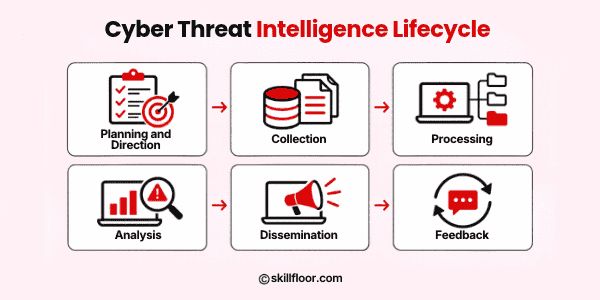
How Does the CTI Lifecycle Work?
Cyber Threat Intelligence (CTI) is a continuous process that helps organisations turn raw threat data into actionable security insights. Rather than simply collecting information, the CTI lifecycle ensures that intelligence is gathered, analysed, shared, and refined to support better security decisions.
1. Planning and Direction
The lifecycle begins by defining clear intelligence requirements. Security teams identify which assets need protection, which threats are most relevant, and what security questions need to be answered. This ensures intelligence efforts remain focused on business and security priorities.
2. Collection
Once objectives are established, relevant information is gathered from multiple sources, including OSINT, threat feeds, dark web monitoring, industry sharing communities, and internal security systems. The goal is to collect information that may indicate potential threats or attacker activity.


3. Processing
The collected information is prepared for analysis. Data is organised, standardised, and filtered to remove irrelevant information, making it easier to review and investigate.
4. Analysis
Security analysts examine the processed information to uncover patterns, identify potential threats, assess risks, and determine what actions should be taken. This stage transforms raw data into meaningful threat intelligence.
5. Dissemination
The intelligence is shared with the appropriate stakeholders. Executives receive strategic insights, while security teams receive technical details that support threat detection, investigation, and response activities.
6. Feedback
The final stage evaluates how useful and accurate the intelligence was. Feedback helps refine future intelligence efforts and ensures the programme continues to improve over time.
Real-World Examples of Cyber Threat Intelligence in Action
-
Ransomware Early Warning: A financial services organisation receives intelligence that a ransomware group is actively targeting similar businesses through phishing emails. Based on this information, the security team updates email security controls and alerts employees before the campaign reaches the organisation. As a result, the attack is blocked before it can compromise any systems.
-
Vulnerability Prioritisation: A security team discovers hundreds of vulnerabilities across its environment, but cannot patch them all immediately. Using Cyber Threat Intelligence, the team identifies which vulnerabilities are actively being exploited by threat actors and prioritises them for remediation. This helps reduce risk more effectively than relying on severity scores alone.
-
Project Glasswing: AI-Powered CTI at Scale: In 2026, Anthropic's Project Glasswing demonstrated how AI can enhance Cyber Threat Intelligence. Using the Claude Mythos model, the initiative identified thousands of high-severity vulnerabilities across widely used software and systems. The project highlighted how modern CTI can help organisations discover potential risks earlier, improve vulnerability management, and strengthen proactive cybersecurity efforts.
-
Faster Incident Response: A security team detects unusual network activity that suggests an attacker may have gained access to internal systems. By comparing the activity with known threat actor behaviours and attack techniques, analysts quickly determine the nature of the threat and contain the incident before it spreads further.
Who Uses Cyber Threat Intelligence?
Cyber Threat Intelligence (CTI) is used across multiple cybersecurity roles, helping teams understand threats, prioritise risks, and make more informed security decisions.
-
SOC Analysts: Use CTI to validate alerts, identify malicious activity more quickly, and improve threat detection accuracy.
-
Threat Hunters: Leverage intelligence on attacker tactics and techniques to proactively search for hidden threats within the environment.
-
Incident Responders: Apply CTI during investigations to understand attack patterns, assess the scope of an incident, and accelerate containment efforts.
-
Vulnerability Management Teams: Use intelligence on actively exploited vulnerabilities to prioritise remediation and reduce exposure to real-world threats.
-
Security Architects: Incorporate CTI insights when designing security controls and defensive strategies that address relevant attack methods.
-
CISOs and Security Leaders: Rely on strategic intelligence to assess organisational risk, allocate security resources, and support long-term cybersecurity planning.
-
Government and Industry Organisations: Share and consume CTI to improve collective defence, track emerging threats, and strengthen sector-wide cybersecurity resilience.
Key Tools and Frameworks Used in Cyber Threat Intelligence
Several tools and frameworks help security teams collect, analyse, share, and apply Cyber Threat Intelligence more effectively.
|
Tool / Framework |
Purpose |
How It Supports CTI |
|
MITRE ATT&CK |
Knowledge base of attacker tactics and techniques |
Helps security teams understand attacker behaviour, map threats, and improve detection strategies. |
|
STIX / TAXII |
Standards for threat intelligence sharing |
Enables structured and automated exchange of threat intelligence between organisations and security platforms. |
|
MISP |
Open-source threat intelligence platform |
Allows teams to share, manage, and consume threat data from trusted communities. |
|
CISA KEV Catalogue |
List of known exploited vulnerabilities |
Helps organisations prioritise vulnerabilities that are actively being targeted by attackers. |
|
VirusTotal & Shodan |
Open-source intelligence (OSINT) tools |
Used to investigate suspicious files, domains, IP addresses, and internet-exposed assets. |
|
ThreatConnect & Recorded Future |
Commercial threat intelligence platforms |
Aggregate, enrich, and operationalise threat intelligence for enterprise security teams. |
As Cyber Threat Intelligence programmes mature, these tools help organisations move beyond basic threat monitoring and make more informed security decisions based on real-world threat activity.
Why Cyber Threat Intelligence Matters for Your Career
As cyber threats continue to evolve, organisations are placing greater emphasis on proactive security strategies rather than simply responding to incidents after they occur. This shift has made Cyber Threat Intelligence (CTI) one of the fastest-growing and most valuable areas within cybersecurity.
Professionals with CTI skills help organisations identify emerging threats, understand attacker behaviour, assess security risks, and make informed decisions to strengthen their defences. As a result, demand for threat intelligence professionals continues to grow across industries such as finance, healthcare, government, technology, and critical infrastructure.
Key Skills for CTI Roles
-
Understanding of attacker tactics and techniques
-
Strong knowledge of network and system security fundamentals
-
Log analysis and security monitoring skills
-
Threat investigation and research capabilities
-
Analytical thinking and problem-solving abilities
-
Communication and reporting skills for technical and non-technical audiences
Many learners build these skills through structured cybersecurity training programs that focus on practical, job-ready knowledge, and Skillfloor is one such platform that helps develop industry-relevant cybersecurity capabilities.
Common Career Paths into CTI
-
SOC Analyst (Tier 1 or Tier 2) — Develops monitoring, alert triage, and investigation skills that form the foundation of CTI work.
-
Incident Response Analyst — Builds hands-on experience in analysing attacks, understanding attacker behaviour, and managing security incidents.
-
Threat Hunter — Focuses on proactively identifying hidden threats and investigating suspicious activity across an organisation's environment.
Relevant Certifications
-
CompTIA CySA+
-
SANS GIAC GCTI
-
EC-Council C|TIA
If you are interested in building a career in cybersecurity, developing skills in threat analysis, security operations, and network security can provide a strong foundation for future roles in Cyber Threat Intelligence. Skillfloor's cybersecurity training programs help learners gain practical knowledge and industry-relevant skills needed to grow in this field.
Frequently Asked Questions
1. What is the difference between Cyber Threat Intelligence and threat monitoring?
Threat monitoring focuses on detecting and alerting on security events. Cyber Threat Intelligence (CTI) adds context by explaining what the activity means, who may be behind it, and what action should be taken. Monitoring is reactive; CTI is proactive.
2. Is Cyber Threat Intelligence only for large organisations?
No. Large enterprises may have dedicated CTI teams, but smaller organisations also use threat intelligence through advisories, threat feeds, and ISAC sharing to stay aware of active threats.
3. What are Indicators of Compromise (IOCs)?
IOCs are signs of potential system compromise, such as malicious IPs, domains, file hashes, or unusual network activity. They help security tools detect known threats faster.
4. What is the MITRE ATT&CK framework?
MITRE ATT&CK is a knowledge base of real attacker tactics and techniques. CTI teams use it to understand attacker behaviour and improve detection and defence strategies.
5. How is CTI different from cybersecurity?
Cybersecurity is the overall practice of protecting systems. CTI is part of it, focusing specifically on understanding threats to improve defence decisions.
6. Do I need technical skills for CTI?
Basic cybersecurity knowledge is important, but CTI also relies heavily on analysis, research, and communication skills. Many professionals enter CTI through SOC or incident response roles.
Cyber Threat Intelligence (CTI) has become a core part of modern cybersecurity because it shifts defence from reaction to prevention. Instead of only responding to attacks after they occur, CTI helps organisations understand emerging threats, attacker behaviour, and real-world risks in advance.
By combining data, analysis, and context, CTI improves decision-making across security teams, from detecting threats faster to prioritising vulnerabilities and strengthening overall defence strategies. It also supports long-term planning by helping organisations focus resources on the most relevant risks.
As cyber threats continue to grow in scale and complexity, CTI is no longer optional. It is a key capability for building stronger, smarter, and more resilient security systems.
Sources & references:
1. Google Cloud’s Threat Intelligence research - https://cloud.google.com/blog/topics/threat-intelligence
2. Global Cyber Threat Intelligence Report - https://www.ibm.com/reports/threat-intelligence
3. NIST Cybersecurity Framework - https://www.nist.gov/cyberframework
Digital Marketing Courses in Other Locations in India
Ahmedabad | Aurangabad | Bangalore | Bhilai | Bhopal | Bhubaneshwar | Chandigarh | Chennai | Cochin | Coimbatore | Dehra Dun | Delhi | Faridabad | Ghaziabad | Gorakhpur | Guntur | Gurgaon | Guwahati | Hyderabad | Jaipur | Kanpur | Khammam | Kolkata | Lucknow | Madurai | Mumbai | Mysore | Nagpur | Noida | Patna | Pondicherry | Pune | Ranchi | Shimoga | Surat | Thane | Thiruvananthapuram | Tiruchirappalli | Tirupati | Vadodara | Visakhapatnam | Warangal | Jalandhar | Jodhpur | Indore | Durgapur | Jamshedpur | Dhanbad | Kota | Karnal | Udaipur | Amritsar | calicut | Nashik | Ludhiana | varanasi | thrissur | Mangalore | Raipur |