


































What Is Programmatic SEO? A Complete Guide for Beginners
Learn what programmatic SEO is, how it works, its benefits, tools, real-world examples, and steps to create search-optimized pages at scale.

Creating a separate web page for every keyword can take weeks or even months. Businesses that target hundreds of products, services, locations, or search queries often need a faster way to create useful web pages. This is where programmatic SEO comes in.
Programmatic SEO combines keyword research, structured data, page templates, and automation to create search-optimized web pages at scale. Travel platforms, e-commerce websites, job portals, and online learning platforms can use this strategy to reach users searching for specific information.
For digital marketing professionals, understanding programmatic SEO can help them build advanced skills in search engine optimization, content planning, data management, and automation.
But how does programmatic SEO work? Is it different from traditional SEO? Can businesses use automation without violating Google's search guidelines?


This guide explains programmatic SEO, its benefits, tools, real-world examples, and implementation steps.
What Is Programmatic SEO?
Programmatic SEO (pSEO) is a search engine optimization strategy that uses structured data, reusable page templates, and automation to create multiple web pages targeting specific search queries. Each page follows a similar structure but contains information relevant to its target keyword and user intent.
For example, an educational platform offering digital marketing courses across India may target keywords such as:
-
Digital marketing courses in Bangalore
-
Digital marketing courses in Chennai
-
Digital marketing courses in Hyderabad
-
Digital marketing courses in Pune
-
Digital marketing courses in Coimbatore
Instead of manually building every page from scratch, the platform can use a common template with relevant location-specific information, course details, and learning opportunities.
The objective of programmatic SEO is not simply to publish more pages. It is to answer multiple search queries with useful, accurate, and relevant information.
Why Is Programmatic SEO Important in Digital Marketing?
Programmatic SEO is important in digital marketing because it helps businesses target multiple relevant search queries without manually developing every landing page. It combines SEO with automation to support scalable organic growth.
Traditional content creation works well for individual blogs and service pages. However, businesses with thousands of products, locations, or categories may require a more structured approach.
Programmatic SEO helps businesses:
-
Target specific long-tail keywords.
-
Reach users with different search needs.
-
Create consistent website structures.
-
Reduce repetitive content creation tasks.
-
Expand organic search visibility opportunities.
-
Cover relevant topics across multiple markets.
-
Manage and update website information efficiently.
For digital marketers, programmatic SEO also creates opportunities to combine content strategy with technical SEO, data analysis, and automation.
How Does Programmatic SEO Work?
Programmatic SEO works by identifying repeated keyword patterns, collecting relevant data, and using reusable templates to create individual web pages. Each page targets a specific search query while maintaining a consistent website structure.
The process involves five main stages:
|
Stage |
Process |
|
Keyword Research |
Identify keywords with repeated search patterns |
|
Data Collection |
Gather accurate and relevant information |
|
Template Creation |
Design a reusable web page structure |
|
Page Generation |
Create pages using data and automation |
|
SEO Monitoring |
Track rankings, indexing, traffic, and conversions |
For example, a job portal can create individual pages for digital marketing jobs in Bangalore, Chennai, and Hyderabad. Each page can display different job openings, company details, salary ranges, and eligibility requirements.
Although these pages follow the same template, their information and purpose are specific to each location.
What Is the Difference Between Programmatic SEO and Traditional SEO?
Traditional SEO often focuses on creating and optimizing individual web pages manually, while programmatic SEO uses structured data and automation to create multiple search-optimized pages. Both strategies aim to improve organic search visibility and satisfy user intent.


|
Factors |
Traditional SEO |
Programmatic SEO |
|
Content Creation |
Mostly manual |
Data-driven and automated |
|
Keyword Targeting |
Individual keywords or topics |
Repeated keyword patterns |
|
Scalability |
Requires more manual effort |
Supports large-scale publishing |
|
Page Structure |
Individually designed |
Reusable templates |
|
Technical Requirements |
Basic to advanced |
Moderate to advanced |
|
Data Dependency |
Varies by content type |
Usually high |
|
Best Suited For |
Blogs and individual service pages |
Directories, listings and location pages |
|
Content Updates |
Often updated individually |
Can be updated centrally |
|
Quality Control |
Individual page review |
Template and page-level review |
Businesses can combine both strategies to build a strong organic search presence. Programmatic SEO does not replace traditional SEO but provides another way to manage large-scale content requirements.
What Are the Key Components of Programmatic SEO?
A successful programmatic SEO strategy requires accurate data, relevant keywords, well-designed templates, and strong technical SEO. Each component plays a role in creating pages that serve users and search engines.
1. Keyword Research
Identify search queries that follow a common pattern. Understanding how to find the right keywords for your business helps identify relevant opportunities for scalable page creation.
2. Structured Data Collection
Collect and organize information in spreadsheets, databases, or APIs. Every data record should contain accurate and useful information for its target page.
3. Page Templates
Develop reusable page layouts containing headings, descriptions, tables, images, internal links, and other relevant content sections.
4. SEO Automation
Use scripts, content management systems, and automation tools to generate pages, metadata, and URLs from structured information.
5. Technical SEO
Focus on crawlability, mobile usability, page speed, canonical tags, XML sitemaps, and internal linking.
6. Content Quality Control
Review generated pages for factual accuracy, originality, completeness, and search intent before publishing.
How to Implement Programmatic SEO Step by Step
Implementing programmatic SEO involves identifying scalable keyword opportunities, preparing reliable data, developing page templates, and publishing useful content. Businesses should start with a small group of pages before expanding their strategy.
Step 1: Identify Scalable Keywords
Find keywords that follow a repeated search pattern and have a clear purpose.
|
Main Keyword |
Modifier |
Target Keyword |
|
Digital marketing courses |
Bangalore |
Digital marketing courses in Bangalore |
|
Data science courses |
Chennai |
Data science courses in Chennai |
|
SEO jobs |
Hyderabad |
SEO jobs in Hyderabad |
|
Python training |
Beginners |
Python training for beginners |
Step 2: Understand Search Intent
Identify what users expect when searching for each keyword. Understanding search intent in SEO helps businesses create pages that match users' actual requirements.
For example, someone searching for course fees expects pricing information, while someone searching for a course syllabus expects detailed learning modules.
Step 3: Build a Database
Create a structured database containing relevant information such as course names, fees, locations, duration, eligibility, learning outcomes, and career opportunities.
Step 4: Create a Page Template
Design a reusable template that answers the main search query and provides supporting information. Include relevant headings, unique data, FAQs, and navigation links.
Step 5: Generate Search-Optimized Pages
Connect the database with a content management system or automation tool to generate individual pages with relevant titles, descriptions, and URLs.
Step 6: Perform Quality Checks
Review pages for duplicate content, inaccurate information, broken links, missing metadata, and poor user experience. Avoid publishing pages that offer no meaningful value.
Step 7: Monitor and Improve Performance
Use Google Search Console and Google Analytics 4 to track indexing, impressions, clicks, organic traffic, user engagement, and conversions. Improve or consolidate underperforming pages based on the findings.
What Are Some Real-World Examples of Programmatic SEO?
Companies across software, finance, travel, and design use scalable page structures to address different search queries. Their websites demonstrate how structured information can serve specific user needs.
|
Company |
Page Targeting Example |
Value Provided |
|
Zapier |
Google Sheets and Slack integration |
Automation workflows and integration options |
|
Wise |
USD to INR conversion |
Exchange rates and currency conversion |
|
Tripadvisor |
Things to do in Bangalore |
Attractions, reviews and travel information |
|
Canva |
Business presentation templates |
Relevant editable design templates |
|
G2 |
Best CRM software |
Software reviews and product comparisons |
For example, Zapier provides pages for different software combinations, helping users discover ways to connect their applications. Similarly, Wise provides currency-specific pages with conversion tools and exchange rate information.
These public-facing page structures illustrate programmatic SEO principles. The exact internal publishing methods of each company may differ.
The key lesson is that successful scalable pages provide useful information or functionality instead of simply changing keywords within a template.
What Are the Best Tools for Programmatic SEO?
Programmatic SEO tools help digital marketers conduct keyword research, organize databases, automate page creation, and monitor organic search performance. The right tools depend on website size, technical requirements, and available resources.
|
Tool |
Purpose |
|
Semrush |
Keyword research and competitor analysis |
|
Ahrefs |
Keyword discovery and backlink analysis |
|
Google Keyword Planner |
Keyword research and search demand estimation |
|
Google Sheets |
Data organization and management |
|
Airtable |
Structured database management |
|
Python |
Data processing and automation |
|
WordPress |
Website content management |
|
Webflow |
CMS-based dynamic page creation |
|
Screaming Frog |
Technical SEO audits |
|
Google Search Console |
Search performance and indexing analysis |
|
Google Analytics 4 |
User behaviour and conversion tracking |
|
ChatGPT |
Content planning and AI-assisted workflows |
Beginners can start with Google Sheets, WordPress, and Google Search Console. Advanced professionals can explore Python, APIs, and database-driven website development.
What Are the Benefits of Programmatic SEO?
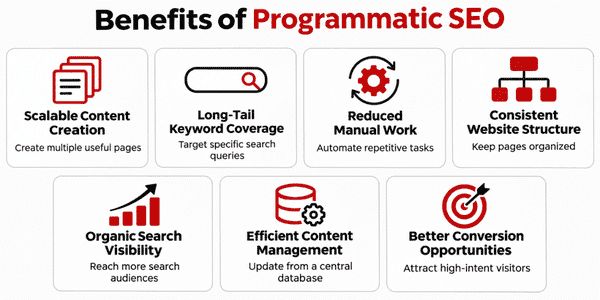
Programmatic SEO helps businesses expand their search presence, reduce repetitive tasks, and manage large websites efficiently. When implemented correctly, it can support sustainable organic growth and provide useful information to different audiences.
-
Scalable Content Creation: Create multiple useful pages through a structured process.
-
Long-Tail Keyword Coverage: Target specific search queries with clear user intent.
-
Reduced Manual Work: Automate repetitive tasks such as metadata generation and data updates.
-
Consistent Website Structure: Maintain organized layouts and navigation across related pages.
-
Organic Search Visibility: Reach audiences searching for different products, services, and locations.
-
Efficient Content Management: Update information across multiple pages from a central database.
-
Better Conversion Opportunities: Attract visitors with specific needs and purchase intentions.
However, publishing more pages does not guarantee higher rankings or increased organic traffic.
What Are the Common Programmatic SEO Mistakes to Avoid?
Programmatic SEO can create serious website quality issues when businesses prioritize page quantity over usefulness. Poor data, repetitive content, and technical problems can negatively affect organic search performance.
Common programmatic SEO mistakes include:
-
Publishing Thin Content: Creating pages with insufficient information.
-
Ignoring Search Intent: Targeting keywords without answering users' actual questions.
-
Creating Duplicate Pages: Changing only product names, keywords or city names.
-
Keyword Cannibalization: Creating multiple pages that compete for the same search intent.
-
Using Inaccurate Data: Publishing outdated prices, statistics or service information.
-
Poor Internal Linking: Making important pages difficult for users and search engines to discover.
-
Excessive AI Dependence: Publishing AI-generated information without human review.
-
Ignoring Indexing Issues: Generating thousands of URLs without checking their search eligibility.
Start with fewer, high-quality pages and expand only when the existing pages demonstrate meaningful value.
Is Programmatic SEO Safe According to Google Guidelines?
Yes, programmatic SEO can comply with Google Search guidelines when pages provide genuine value to users. However, creating large numbers of low-value pages mainly to manipulate search rankings can violate Google's spam policies.
According to Google Search Central's spam policies, scaled content abuse occurs when many pages are created mainly to manipulate search rankings rather than help users. This applies regardless of whether the content is created manually, through automation, or using AI.
Google's guidance on generative AI content also explains that AI-generated pages without meaningful user value may violate its spam policies.
Programmatic SEO Best Practices
-
Publish useful, accurate, and original information.
-
Create pages only when there is a meaningful user need.
-
Avoid doorway pages targeting similar searches without offering distinct value.
-
Use relevant data from trustworthy sources.
-
Conduct regular human quality checks.
-
Follow Google's technical SEO and spam policies.
-
Update outdated information regularly.
A successful programmatic SEO strategy should focus on solving user problems rather than manipulating search engines.
How Does Programmatic SEO Work With AI, AEO and GEO?
Programmatic SEO can work alongside Artificial Intelligence (AI), Answer Engine Optimization (AEO), and Generative Engine Optimization (GEO) to create structured, accessible, and useful content.
While programmatic SEO focuses on scalable page creation, Answer Engine Optimization (AEO) focuses on providing direct answers to user questions. Similarly, Generative Engine Optimization (GEO) focuses on improving content visibility and citation opportunities within AI-generated answers.
|
Strategy |
Primary Purpose |
|
Programmatic SEO |
Create relevant search-optimized pages at scale |
|
Artificial Intelligence |
Support research, data processing, and content workflows |
|
AEO |
Provide direct answers to user questions |
|
GEO |
Improve discovery opportunities in generative search experiences |
How to Optimize Programmatic SEO Pages for AEO and GEO
-
Provide direct answers immediately after question-based headings.
-
Use clear definitions and simple explanations.
-
Present comparisons through structured tables.
-
Include relevant questions and answers.
-
Support factual claims with reliable sources.
-
Maintain accurate brand and entity information.
-
Add original research, practical examples, and useful insights.
-
Use appropriate structured data that matches visible page content.
According to Google's guide to optimizing for generative AI features, established SEO practices, technical accessibility, and helpful content remain important for visibility in generative search experiences.
Automation alone does not guarantee rankings, AI mentions, or citations.
Why Should Digital Marketing Professionals Learn Programmatic SEO?
Digital marketing professionals should learn programmatic SEO because it combines search engine optimization, automation, data analysis, and technical skills. These skills are useful for managing websites with large numbers of products, services, or location-based pages.
Essential Skills to Learn for Programmatic SEO
-
Advanced keyword research and search intent analysis
-
On-page and technical SEO
-
Content management systems
-
Spreadsheet and database management
-
Basic HTML, CSS, and Python
-
AI tools and marketing automation
-
Google Search Console and GA4
-
AEO and GEO strategies
These skills are relevant to career roles such as SEO Specialist, Technical SEO Specialist, Growth Marketer, SEO Manager, and Digital Marketing Analyst.
Students, graduates, and working professionals can build these foundations by enrolling in digital marketing courses through learning platforms like Skillfloor, Coursera, and Udemy. Practical projects can help learners understand how keyword research, website optimization, and automation work together.
Frequently Asked Questions About Programmatic SEO
1. What is programmatic SEO in simple words?
Programmatic SEO is a method of creating multiple search-optimized web pages using data, reusable templates, and automation to answer specific search queries.
2. Is programmatic SEO suitable for beginners?
Yes. Beginners can start with keyword research, spreadsheets, and content management systems before learning advanced automation and technical SEO.
3. Does programmatic SEO require coding?
No. Basic programmatic SEO can be implemented using no-code tools and CMS platforms. Coding becomes useful for advanced automation and database integration.
4. Can AI be used for programmatic SEO?
Yes. AI can support keyword grouping, content planning, data processing, and metadata creation. Human review remains important for accuracy and quality.
5. Can small businesses use programmatic SEO?
Yes. Small businesses can use programmatic SEO for product categories, service areas, and other relevant landing pages when each page provides distinct value.
6. How long does programmatic SEO take to show results?
There is no fixed timeline. Results depend on competition, website authority, content quality, indexing, and technical SEO performance.
7. Is programmatic SEO the same as AI SEO?
No. Programmatic SEO focuses on scalable page creation using structured data and templates, while AI SEO involves using AI technologies to support search optimization.
8. How can I learn programmatic SEO?
Start by learning SEO fundamentals, keyword research, technical SEO, and content management. Then practise creating data-driven pages through small projects.
Conclusion
Programmatic SEO is a valuable digital marketing strategy that combines keyword research, structured data, automation, and technical SEO to create useful web pages at scale. It helps businesses address different search queries while reducing repetitive content creation tasks.
However, successful programmatic SEO depends on content quality, accurate information, search intent, and compliance with Google's search guidelines. Creating more pages alone will not improve rankings.
For aspiring digital marketers, learning SEO, AI, automation, AEO, and GEO through practical training can help build the skills required to manage modern websites and develop effective organic growth strategies.
Digital Marketing Courses in Other Locations in India
Ahmedabad | Aurangabad | Bangalore | Bhilai | Bhopal | Bhubaneshwar | Chandigarh | Chennai | Cochin | Coimbatore | Dehra Dun | Delhi | Faridabad | Ghaziabad | Gorakhpur | Guntur | Gurgaon | Guwahati | Hyderabad | Jaipur | Kanpur | Khammam | Kolkata | Lucknow | Madurai | Mumbai | Mysore | Nagpur | Noida | Patna | Pondicherry | Pune | Ranchi | Shimoga | Surat | Thane | Thiruvananthapuram | Tiruchirappalli | Tirupati | Vadodara | Visakhapatnam | Warangal | Jalandhar | Jodhpur | Indore | Durgapur | Jamshedpur | Dhanbad | Kota | Karnal | Udaipur | Amritsar | calicut | Nashik | Ludhiana | varanasi | thrissur | Mangalore | Raipur |