


































Data Analytics Internship vs Full-Time Job: Which Should You Choose?
Confused between a data analytics internship and a full-time job? Compare their benefits, skills, responsibilities, and work experience to choose the right path.

Data analytics is becoming a popular career option because more companies rely on data to make informed business decisions. As opportunities in this field increase, many freshers want to begin their careers as data analysts. However, selecting the right starting point is important. Should you gain experience through an internship, or should you apply directly for a full-time position?
A data analytics internship helps beginners develop practical experience and learn how companies use data. During an internship, you might use tools such as Excel, SQL, Python, and Power BI to analyze data, prepare reports, and create dashboards. It also allows you to strengthen your skills and learn about real business challenges.
A full-time data analyst position provides a steady salary, greater responsibilities, and more opportunities for career growth. However, many companies require freshers to know the basics of data tools and have some project experience. In this guide, we will compare internships and full-time jobs by salary, skills, work experience, and career growth to help you select the best path.
Why Is Choosing Between an Internship and a Full-Time Job Difficult?
Beginning a career in data analytics can be difficult, particularly for recent graduates who understand theoretical concepts but have little industry experience.


You may know how to write SQL queries, build dashboards in Power BI, or analyse data with Python. However, employers often want candidates to know how to use these skills to solve real-world business problems.
Some common challenges aspiring data analysts face include:
-
Lack of Practical Experience: Knowing tools such as Excel, SQL, Python, and Power BI alone is not sufficient. You must also know how to apply them in real-world projects.
-
Limited Project Experience: Freshers often struggle to demonstrate their skills to employers because they have limited experience with practical projects.
-
High Job Competition: Since many candidates apply for entry-level data analyst positions, freshers face more competition when seeking selection.
-
Lack of Career Direction: Many freshers are uncertain whether to begin with an internship or apply directly for a full-time position.
-
Salary Expectations: Internships may pay less, whereas full-time jobs generally offer a regular monthly salary.
-
Skill Gap: Some candidates may understand the basics of data analytics but still need to strengthen their technical, communication, and problem-solving skills to meet company expectations.
Data Analytics Internship vs Full-Time Job: What Should You Choose?
Before deciding, it is important to understand what each career option offers. A data analytics internship and a full-time job can offer different learning experiences, work opportunities, and career advantages. The best choice depends on your skills and career goals.
A data analytics internship is a good option for freshers who want to develop their skills, gain hands-on experience, and learn from experienced professionals. Completing a data analytics course can also help you build a strong foundation before applying for internships. It also helps you see how companies use data to address business problems.
In contrast, a full-time data analyst position is suitable for candidates who already have strong technical knowledge and some project experience. It gives you the chance to handle more responsibilities, receive a regular salary, and advance professionally.
Your decision should be based on your current skills, practical experience, financial needs, and long-term career goals. Before choosing between these two options, consider what you need most at this point in your career.
Understanding a Data Analytics Internship
What Is a Data Analytics Internship?
A data analytics internship is a short-term work opportunity where students, recent graduates, and future professionals can gain hands-on experience analysing data.
During an internship, you handle datasets, learn to use analytical tools, create reports, and assist experienced data analysts in solving business problems.
The main goal of an internship is to help you learn how data analytics is applied in a professional setting.
Depending on the organization, an internship can last from a few weeks to several months. Some internships offer payment, while others may be unpaid.
Key Responsibilities of a Data Analytics Intern
As a data analytics intern, your responsibilities may include:
-
Collecting data from different sources.
-
Cleaning and organizing datasets.
-
Performing basic data analysis using Excel or Python.
-
Writing SQL queries to retrieve information.
-
Creating dashboards and reports using Power BI or Tableau.
-
Identifying patterns and trends in datasets.
-
Supporting senior analysts with ongoing projects.
-
Presenting findings to team members.
For example, you might work on a sales analysis project where you examine monthly revenue, identify the best-performing products, and create a dashboard to help the business understand its sales performance.


This experience teaches you to apply your technical skills to analyse real data, address business challenges, and help a company make better decisions.
Benefits of Choosing a Data Analytics Internship
1. Gain Practical Industry Experience
An internship lets you use what you learned in class on real-world projects. You gain practical experience working with datasets and learn how businesses use data to address everyday challenges.
2. Improve Your Technical Skills
You can strengthen your abilities in Excel, SQL, Python, Power BI, and Tableau. Completing practical tasks also teaches you how to use these tools effectively.
3. Learn from Experienced Professionals
During an internship, you have the opportunity to work alongside experienced data analysts. Their advice and feedback help you develop your skills and see how real projects are completed.
4. Build a Professional Network
An internship gives you the opportunity to connect with managers, data analysts, and other team members. These relationships can help you discover industry opportunities and develop valuable professional connections.
5. Improve Your Chances of Getting a Full-Time Job
Internship experience strengthens your resume by highlighting your practical abilities. Some companies may also give interns full-time job offers based on their performance and available positions.
6. Understand Real Business Problems
Working on company projects helps you see how businesses use data. You learn how to find valuable information, recognize trends, and support stronger business decisions.
Challenges of a Data Analytics Internship
While internships provide many chances to learn, they also have some challenges that you should think about before deciding.
-
Lower Compensation: Data analytics internships generally pay less than full-time jobs, which can make it harder to cover personal expenses.
-
Temporary Employment: Most internships continue for only a few months, so you may have to look for another opportunity after your training ends.
-
Limited Responsibilities: Interns typically begin with simple tasks and may have limited opportunities to manage complete projects or make major business decisions.
-
Less Job Security: Finishing an internship does not ensure a permanent position, since full-time opportunities depend on the company’s needs and your overall performance.
Even with these challenges, an internship is a useful starting point for freshers who want to gain practical experience, develop their skills, and learn how the data analytics industry operates.
Understanding a Full-Time Data Analytics Job
What Is a Full-Time Data Analytics Job?
A full-time data analytics job is a permanent or continuing role where you work as a professional data analyst for an organization.
Unlike an internship, a full-time role carries more responsibility for analysing data, recognizing business trends, and offering insights to guide decisions.
As a full-time data analyst, you should understand business needs, handle assigned tasks independently, and provide accurate results by the deadlines.
Your duties may differ based on the organization, industry, and level of experience.
Key Responsibilities of a Full-Time Data Analyst
A full-time data analyst may perform several responsibilities, including:
-
Analysing large datasets to identify trends and patterns.
-
Writing complex SQL queries to extract and manipulate data.
-
Cleaning and transforming data for analysis.
-
Developing interactive dashboards using Power BI or Tableau.
-
Performing statistical analysis.
-
Preparing reports for business stakeholders.
-
Identifying opportunities for business improvement.
-
Communicating analytical findings to management teams.
For example, a data analyst working in an e-commerce company might analyse customer purchasing behaviour, identify popular products, and recommend strategies to improve sales and customer retention.
To perform this work well, you need strong technical abilities and a clear understanding of business objectives to analyse data and deliver useful insights that support better decisions.
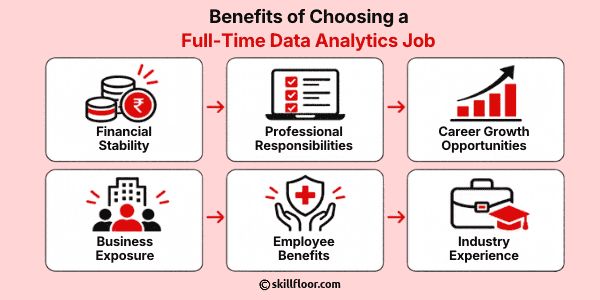
Benefits of Choosing a Full-Time Data Analytics Job
1. Financial Stability
A full-time data analytics position offers a steady monthly income, making it easier to manage your expenses and financial needs. Some companies also provide bonuses and additional benefits.
2. Greater Professional Responsibilities
A full-time job allows you to work on important projects, analyse complex datasets, create reports, and present useful findings that support better business decisions.
3. Better Career Growth Opportunities
A full-time data analytics job can help you move into more senior roles as you gain experience. You can pursue roles such as Senior Data Analyst, Business Analyst, and Analytics Manager.
4. Exposure to Real Business Problems
Full-time work helps you see how companies use data to improve operations, increase sales, understand customers, and solve business problems by making better decisions.
5. Employee Benefits
Many companies give full-time employees extra benefits, including paid leave, health insurance, performance bonuses, retirement plans, and learning opportunities that support their professional development.
6. Opportunity to Build Industry Experience
Regularly working with data and business teams helps you build valuable industry experience. You develop new skills, manage a variety of tasks, and gain more confidence in your work.
Data Analytics Internship vs Full-Time Job: Key Differences
Now that you understand both career paths, let’s compare them using key factors to help you choose the right one.
|
Factors |
Data Analytics Internship |
Full-Time Job |
|
Main Purpose |
Focuses on learning and gaining practical experience. |
Focuses on completing tasks and delivering business results. |
|
Duration |
Usually lasts for a few weeks or months. |
Offers ongoing employment with no fixed end date. |
|
Salary |
Generally, provides lower pay or monthly stipends. |
Provides a regular salary and possible additional benefits. |
|
Experience |
Suitable for freshers with limited work experience. |
Requires skills based on the job role. |
|
Responsibilities |
Mainly involves basic tasks and learning activities. |
Includes handling projects and managing important responsibilities. |
|
Work Pressure |
Usually involves fewer tasks and lower work pressure. |
May involve tight deadlines and multiple project responsibilities. |
|
Mentorship |
Often includes guidance from experienced team members. |
Depends on the company's training and support system. |
|
Job Security |
Employment usually ends after the internship period. |
Offers relatively better stability and long-term employment. |
|
Career Growth |
Helps build skills for future job opportunities. |
Provides opportunities for promotions and higher positions. |
|
Practical Exposure |
Provides basic experience through small projects and tasks. |
Offers deeper experience through regular business projects. |
The main difference is that an internship places greater emphasis on learning and building practical skills, while a full-time job centers on using those skills to meet business goals.
However, your learning and work experience can differ depending on the company, team members, project needs, and responsibilities assigned to you during your internship or full-time job.
Where to Find Data Analytics Jobs and Internships in India?
Once you understand the differences between these two career paths, you can begin searching for opportunities on popular job-search platforms. Below are several helpful platforms for finding data analytics jobs and internships in India.
Data Analytics Jobs in India
Data Analytics Internships in India
Tip: As a fresher, begin by looking for internship opportunities to build practical skills and gain industry experience. If you already possess strong technical knowledge and relevant project experience, consider applying directly for full-time data analytics roles.
Internship vs Full-Time Job: Which Is Better for Freshers?
No single answer is suitable for everyone. The best choice depends on what you currently know, your hands-on experience, and your career goals.
Choose a Data Analytics Internship If:
1. You Are a Recent Graduate
If you have recently graduated and have little industry experience, an internship can help you learn how professional workplaces function.
2. You Have Theoretical Knowledge but Limited Practical Skills
If you know concepts such as SQL, Excel, Python, and data visualization but have not worked on real-world projects, an internship can help you build practical experience.
3. You Want to Build Your Portfolio
An internship can provide opportunities to complete practical tasks and projects that showcase your analytical skills.
4. You Need Industry Exposure
If you do not know how data analytics teams work, an internship can familiarize you with business requirements, reporting procedures, and collaboration in the workplace.
Choose a Full-Time Data Analytics Job If:
1. You Already Have Strong Technical Skills
If you are confident using SQL, Excel, Python, and data visualization tools, you may be ready to apply for entry-level data analyst jobs.
2. You Have Completed Relevant Projects
If you have completed projects involving sales analysis, customer segmentation, financial analysis, or dashboard creation, you can show employers your practical knowledge.
3. You Can Solve Business Problems Using Data
Having technical skills by themselves is not sufficient. You also need to interpret results, recognize trends, and explain useful insights clearly.
4. You Need Financial Stability
If a steady income is your main priority, applying directly for full-time positions may be the better choice.
Important Tip: Do not believe that every fresher has to complete an internship before applying for a full-time job. If you have the necessary skills and can prove your abilities through projects, you should begin applying for suitable entry-level positions.
Essential Skills Required for Both Career Options
Whether you pursue an internship or a full-time job, building the right combination of technical and soft skills is important
Technical Skills
-
Microsoft Excel: Excel makes it easier to organize, clean, and analyse data. Learn formulas, functions, PivotTables, charts, and lookup functions to use data and create reports.
-
SQL: SQL allows you to collect, filter, and manage information in databases. Learn SELECT, WHERE, GROUP BY, JOINs, subqueries, and window functions to complete various data tasks.
-
Python: Python is helpful for cleaning, analysing, and visualizing data. Learn libraries such as Pandas, NumPy, and Matplotlib to work with datasets and discover useful information.
-
Power BI or Tableau: Power BI and Tableau make it easier to build dashboards and reports. Learn to connect data, clean information, create charts, and present findings clearly.
-
Statistics: Statistics helps you understand data and identify useful patterns. Learn averages, percentages, probability, correlation, and basic statistical methods to understand data more effectively.
-
Data Cleaning and Visualization: Data cleaning helps eliminate errors and missing values from datasets. Data visualization presents information using charts and graphs, making results easier to understand and explain.
Soft Skills
In addition to technical knowledge, you should build strong communication and problem-solving skills to understand tasks, collaborate with team members, and explain your findings clearly.
Important soft skills include:
-
Critical thinking and problem-solving.
-
Analytical and logical thinking.
-
Business understanding.
-
Communication and presentation skills.
-
Teamwork and collaboration.
-
Time management and attention to detail.
Building these technical and soft skills can help you do better work, address data-related problems, communicate more effectively, and become a stronger candidate for data analytics internships and full-time jobs.
How to Transition from a Data Analytics Internship to a Full-Time Job
Beginning your career with an internship is an effective way to gain experience. Follow these easy steps to build your skills and improve your chances of finding a full-time data analytics job.
1. Work on Real-World Projects
Participate in projects that address real business problems. Work with sales reports, customer data, and dashboards to learn how companies use data.
2. Improve Your Technical Skills
Use your internship to strengthen your knowledge of Excel, SQL, Python, and Power BI. Practicing regularly will help you handle data-related tasks with greater confidence.
3. Ask for Regular Feedback
Discuss your work with your manager or senior team members. Their feedback can help you recognize your mistakes, develop your skills, and perform more effectively.
4. Show Your Work and Achievements
Record the projects you finish and the tasks you complete. Emphasize your contributions, such as preparing reports or saving time with improved dashboards.
5. Build a Strong Resume
Include your internship experience, technical skills, and completed projects on your resume. Explain your work and achievements clearly so employers can understand your abilities.
6. Connect with Industry Professionals
Keep in touch with your managers, mentors, and colleagues. You can also find learning opportunities at institutes such as Skillfloor, which provides data analytics courses and training.
7. Apply for Full-Time Jobs
Begin searching for entry-level data analyst jobs before your internship finishes. Apply for positions that fit your skills, experience, and career goals.
8. Keep Learning and Practising
Keep learning new tools and developing your analytical skills. Practise using real datasets and answering interview questions to prepare for full-time data analytics roles.
Common Mistakes to Avoid When Choosing Your Career Path
Choosing between an internship and a full-time job is an important decision. While comparing a Data Analytics Internship vs Full-Time Job, avoid these common mistakes to make a better career choice.
-
Focusing Only on Salary: Do not select an internship based only on pay; focus on learning opportunities, skill growth, and long-term career development.
-
Ignoring Practical Experience: Do not depend only on theory; get practical experience with data analytics tools to solve real business problems.
-
Applying Without Preparation: Prepare your resume, improve your technical knowledge, and create a project portfolio that clearly shows your current skills and abilities.
-
Accepting Internships Without Learning Opportunities: Select internships that provide meaningful projects, good mentorship, practical support, and experience with real-world data analytics practices.
-
Waiting Too Long to Apply: Do not wait until you know every analytical tool; keep learning while actively looking for suitable internships and jobs.
-
Ignoring Communication Skills: Build strong communication skills so you can explain analytical results clearly to both technical and non-technical team members.
Remember that your first career opportunity does not determine your entire professional path. Work on improving your skills, gaining practical experience, and selecting opportunities that support your long-term career development.
Frequently Asked Questions (FAQs)
1. Is a data analytics internship worth it for freshers?
Yes, it provides practical experience, improves technical skills, and helps freshers understand industry expectations while strengthening their resumes.
2. Can I get a data analyst job without an internship?
Yes, strong technical skills, practical projects, and analytical knowledge can help you secure an entry-level data analyst job.
3. What is the average salary of a data analytics intern?
The salary varies depending on the company, location, skills, and internship duration. Check current job listings for accurate information.
4. What is the difference between a data analyst intern and a full-time data analyst?
Interns support senior professionals and learn analytical processes, while full-time analysts independently handle datasets, reports, and business insights.
5. Can a data analytics internship lead to a full-time job?
Yes, companies may offer full-time positions to interns based on their performance, skills, and available job opportunities.
6. How long should I work as a data analytics intern?
Most internships last a few months. Focus on gaining practical experience, improving skills, and completing meaningful projects.
7. Which is better for freshers: a paid internship or a full-time job?
A full-time job offers stability, while a paid internship provides practical experience and industry exposure for beginners.
8. What skills should I learn before applying for a data analytics internship?
Learn Excel, SQL, basic statistics, and data visualization. Python, Power BI, Tableau, and practical projects can strengthen your profile.
Choosing between a data analytics internship and a full-time job depends on your current skills and career goals. If you are a recent graduate with limited practical experience, an internship can be an excellent starting point. It allows you to apply your theoretical knowledge, develop technical skills, understand business requirements, and gain valuable industry exposure.
Conversely, if you already possess strong technical skills, relevant project experience, and confidence in solving real-world analytical problems, applying directly for a full-time data analyst position may be the better choice.
It's important to note that completing an internship is not mandatory to secure your first full-time job in data analytics. Ultimately, the best career path is the one that helps you develop the skills, experience, and confidence needed to succeed in the data analytics field. Instead of focusing solely on internships or full-time positions, prioritize becoming job-ready, gaining practical knowledge, and building a strong foundation for long-term career growth.
Digital Marketing Courses in Other Locations in India
Ahmedabad | Aurangabad | Bangalore | Bhilai | Bhopal | Bhubaneshwar | Chandigarh | Chennai | Cochin | Coimbatore | Dehra Dun | Delhi | Faridabad | Ghaziabad | Gorakhpur | Guntur | Gurgaon | Guwahati | Hyderabad | Jaipur | Kanpur | Khammam | Kolkata | Lucknow | Madurai | Mumbai | Mysore | Nagpur | Noida | Patna | Pondicherry | Pune | Ranchi | Shimoga | Surat | Thane | Thiruvananthapuram | Tiruchirappalli | Tirupati | Vadodara | Visakhapatnam | Warangal | Jalandhar | Jodhpur | Indore | Durgapur | Jamshedpur | Dhanbad | Kota | Karnal | Udaipur | Amritsar | calicut | Nashik | Ludhiana | varanasi | thrissur | Mangalore | Raipur |