











































Digital audience connection is important for businesses of all sizes in the fast-paced world of today. Reaching customers, establishing brand recognition, and boosting sales all depend on digital marketing, an area that is always changing. It combines a variety of strategies that enable companies to create an online presence through focused efforts on multiple channels, including social media and search engines.
In addition to providing information that lets companies assess their performance and improve their strategies, digital marketing gives companies a chance to reach previously unreachable groups. From the basics and history of digital marketing to more complex strategies, this guide will cover it all. Each section will explain the basics of digital marketing and offer insights into its elements, advantages, and opportunities. This guide is an excellent resource for anyone looking to expand their knowledge of the wide world of digital marketing, whatever their experience level.
You will have a strong understanding of the fundamentals of digital marketing and why it is a key component of any modern marketing strategy by the end of this guide. Explore its development, significance, and how to use digital marketing strategies to get the best outcomes by diving in.
What is Digital Marketing?
Promoting goods or services via a variety of digital platforms in order to reach potential customers is known as digital marketing. Digital marketing effectively reaches people using online platforms like social media, websites, search engines, and emails, compared to traditional marketing, which depends on media like print and television.
Digital marketing is designed to reach customers where they spend most of their time: online. It is perfect for both small and large enterprises since it is accessible, data-driven, and flexible. Through interactive platforms, educational information, and customized advertisements, digital marketing enables businesses to communicate with customers on a personal level. Providing value for customers while building brand loyalty and increasing conversions is the ultimate goal.
Because this marketing strategy is so measurable, companies can evaluate the effectiveness of their efforts in real-time. Digital marketing is one of the most flexible tools available today because it enables marketers to fine-tune their strategies with the help of data like click-through rates, conversion rates, and engagement metrics.
History of Digital Marketing
While digital marketing has its origins in the early years of the internet, it really took off in the 1990s when search engines like Yahoo were introduced. Digital marketing developed along with the internet, and the introduction of Google AdWords in 2000 was a major turning point. Digital marketing was transformed by social media sites like Facebook and Twitter, which gave companies fresh ways to communicate with customers.
Smartphones and mobile internet connectivity started to revolutionize digital marketing once more in the late 2000s, which increased mobile advertising. Businesses realized how effective it was to contact clients anywhere, at any time. From the first days of email marketing to the more advanced techniques used today, digital marketing has developed into one of the best methods for connecting and interacting with audiences.
The field of digital marketing has been constantly changed by technological advances over time. To improve targeting and audience personalization, modern digital marketing uses real-time data insights, predictive algorithms, and analytics based on artificial intelligence. Digital marketing is becoming an essential component of modern business plans due to this historical development.
Different Types of Digital Marketing
A variety of techniques are used in digital marketing, all of which are designed to achieve particular objectives, such as increasing brand recognition, boosting conversions, and building customer loyalty. Here is a thorough look at each of the main categories of digital marketing:
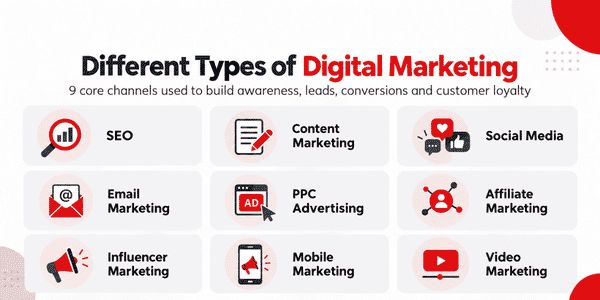
Search Engine Optimization (SEO)
The process of improving a website's technical components, content, and structure to raise its rating on search engine results pages (SERPs) is known as SEO. This procedure includes:
-
Keyword Research: Finding terms and phrases that prospective buyers are using when searching and incorporating them into content is known as keyword research.
-
On-Page SEO: Optimizing individual web pages with meta tags, headings, content, internal links, and picture alt text is known as on-page SEO.
-
Off-Page SEO: Increasing reputation and ranking by constructing backlinks (external links) from reliable websites.
-
Technical SEO: Making sure the website is set up to be readily crawled and indexed by search engines. This includes making sure the site architecture, loading speed, and mobile responsiveness are all optimized.
-
Local SEO: Increasing a company's visibility using Google Maps, local listings, and location-based keywords so that local customers can find them more easily.
Content Marketing
The goal of content marketing is to attract and hold onto a target audience by creating and sharing good information. It consists of:
Blog Posts: Educational pieces with keyword optimization that address frequently asked consumer queries or offer perspectives on business-related subjects.
E-books and White Papers: Comprehensive manuals or reports that offer useful information in return for contact information, which aids in lead generation.
Videos: To engage people more dynamically, use explainer films, tutorials, or demos to deliver stories visually.
Infographics: Visual depictions of data or procedures that simplify and facilitate the sharing of complex information.
Webinars and Podcasts: Podcasts and webinars are interactive or on-demand events that allow viewers to learn directly from professionals, building brand authority and a sense of community.
Social Media Marketing
Social media marketing makes use of social media channels to increase traffic, brand visibility, and audience engagement. Important components consist of:
Organic Content
Posts, pictures, and videos that engage audiences, give insights, or highlight products without the use of paid advertising are referred to as organic content.
Stories and Reels
Short, transient content that shows up at the top of a user's feed and is perfect for short, interesting messages or behind-the-scenes looks.
User-Generated Content
Sharing user-generated content, which promotes authenticity and community trust, is done by consumers or followers.
Social Listening
Social listening is the process of keeping an eye on and reacting to feedback from customers or market trends in order to better customize material to the tastes of the audience.
Paid Social Ads
Sponsored postings that target particular demographics according to factors like age, location, interests, and more are known as paid social ads.
Email Marketing
A highly customized method of building customer relations is email marketing. It includes:
-
Welcome Series: A series of emails used to connect new subscribers with the company, foster trust, and showcase special features.
-
Newsletters: Continuous updates that convey business news, exclusive deals, or insightful information relevant to the audience.
-
Segmentation and Targeting: Email lists can be grouped according to demographics, past purchases, or activity to deliver customized messages. This process is known as segmentation and targeting.
-
Behavioural Trigger Emails: Automated emails that are triggered by customer actions, such as reminders for abandoned carts or campaigns to re-engage inactive users, are known as behavioural trigger emails.
-
A/B Testing: Testing different email versions to increase open, click-through and conversion rates is known as A/B testing.
Pay-Per-Click (PPC) Advertising
PPC advertising includes paying for clicks on advertisements, frequently via social media or search engines. Key elements of PPC include:
-
Search Ads: Text advertisements that show up on search engine results pages when users type in pertinent terms are known as search advertising.
-
Display Ads: Display advertising is visual banners that are shown on websites that are part of a network, such as Google Display, to help reach users while they browse.
-
Remarketing: Remarketing is the practice of showing advertisements to people who have already visited the website in an attempt to get them to come back and finish an action.
-
Bid Management: Bid management is the process of modifying bids for various keywords or ad locations to optimize reach while adhering to financial constraints.
-
Ad Extensions: Ad extensions are extra details that can be included in advertisements to increase click-through rates, such as call or location buttons.
Affiliate Marketing
Under the performance-based affiliate marketing model, companies partner with affiliates who sell their goods in return for a commission. Important elements consist of:
Affiliate Networks
Affiliate networks are online communities that facilitate communication between companies and affiliates while streamlining tracking and payment procedures.
Product Reviews and Recommendations
Affiliates produce content (blogs, videos) that influences sales by promoting a brand's goods.
Tracking Links
Special URLs that monitor clicks, purchases, or other activities to make sure affiliates receive proper credit for their work.
Performance Monitoring
Performance monitoring is the process of assessing affiliates' efficacy using metrics like sales volume, conversion rates, and ROI.
Influencer Marketing
Influencer marketing involves working together with people who have a significant following in specific niches. This kind of advertising may consist of:
-
Micro-Influencers: People with a smaller but very active following who usually show greater trust and authenticity.
-
Sponsored Content: Influencers showcasing products to their followers through posts, stories, or videos are known as sponsored content.
-
Brand Ambassadors: Business ambassadors have lasting connections with influential people who continuously advocate and advance a company.
-
Giveaways and Contests: Partnerships in which influencers hold a giveaway or contest to increase brand visibility and engagement.
-
Affiliate Links or Promo Codes: Promo codes or affiliate links are incentives for the influencer's followers to buy something, frequently with codes or links that can be tracked to determine their efficacy.
Mobile Marketing
Using mobile-friendly strategies, mobile marketing seeks to reach customers on smartphones and tablets. It consists of:
-
SMS and MMS Marketing: Directly sending text or multimedia messages to consumers, frequently for promotions or important updates, is known as SMS and MMS marketing.
-
Mobile Apps: Using apps that provide extra convenience, such as loyalty programs or access to unique content, to engage audiences.
-
In-App Advertising: Ads that show up inside other mobile apps and can be highly tailored to a user's preferences are known as in-app advertising.
-
Push Notifications: Push notifications are notifications that are sent via applications to users with updates, offers, or reminders.
-
Mobile-Responsive Design: Making sure emails and websites show up as best they can on mobile devices to improve user experience and engagement is known as mobile-responsive design.
Video Marketing
Video marketing promotes brand values, highlights products, and engages customers through visual storytelling. This strategy includes:
Live Streaming: Live streaming is the practice of actively engaging audiences through real-time video conversations, frequently on websites like Facebook, Instagram, or YouTube.
Product Demos and Tutorials: Product tutorials and demos are videos that highlight aspects of products and instruct viewers on how to utilize them.
Customer Testimonials: Customer testimonials are videos in which pleased clients discuss their positive experiences, promoting social proof and confidence.
Explainer Videos: Explainer videos are brief, interesting films that help audiences learn difficult subjects in a lasting way.
360-Degree and VR Videos: VR and 360-degree videos are immersive experiences that let users interact with the content, providing a unique brand connection.
Benefits of Digital Marketing
Given its many advantages, digital marketing is important for companies trying to stay competitive. Among the main benefits are:
-
Cost-Effectiveness: Compared to traditional forms of promotion, digital marketing techniques like email marketing and social media ads are frequently less expensive.
-
Global Reach: By removing geographic limitations, digital marketing enables companies to connect with customers anywhere in the world.
-
Targeted Audience: Brands can engage with particular demographics by using advanced advertising decisions, which ensures that the proper individuals see their message.
-
Measurable Results: Digital strategies, compared to traditional marketing, offer quantifiable data that enables companies to assess the success of campaigns.
-
Enhanced Engagement: Through social media interactions, customized emails, and interactive content, digital marketing helps companies interact directly with their customers.
-
Higher Conversion Rates: Digital marketing initiatives frequently have higher conversion rates than traditional advertising when they use accurate targeting and customized messaging.
Digital marketing is a great tool for every organization since it allows for real-time campaign modification based on data analysis and audience input.
Need for Digital Marketing
In today's digitally-first world, digital marketing is essential for companies to remain visible, relevant, and competitive. Since the majority of consumers do their research and make purchases online, digital marketing makes sure that brands are available on the channels that customers use most frequently, enabling customized, immediate interaction. Digital channels, as opposed to traditional marketing, allow companies to reach targeted audiences with customized messaging, creating more intimate relationships and boosting loyalty to customers.
The huge quantity of data that digital marketing produces is one of its main benefits. Every engagement, be it a click on an email, a social network, or a website visit, offers information about the preferences, behaviour, and purchasing patterns of the customer in question. Businesses can develop data-driven strategies with data analytics, changing them according to what attracts their target market. Additionally, by identifying new patterns, these insights help organizations better serve their customers and anticipate changes in their needs. In a competitive environment, digital marketing's agility can make all the difference.
Businesses of all sizes can compete on an
Related Posts
The World of Digital Marketing: Your Friendly Guide
Explore the dynamic world of digital marketing and unlock its limitless potentia...

Journey Through Time: Friendly History of Digital Marke...
Explore the future of data science in digital marketing. Join us on a friendly j...
Digital Marketing Course Syllabus: Modules, Topics, and...
Explore the complete Digital Marketing Course Syllabus for 2026. Learn SEO, Goog...