







































Digital Marketing Course Syllabus: Modules, Topics, and What You Actually Learn
Explore the complete Digital Marketing Course Syllabus for 2026. Learn SEO, Google Ads, social media, AI tools, analytics, email marketing, and more.

If you're researching a digital marketing course, the first thing worth knowing is exactly what the syllabus covers, not just a list of buzzwords, but the specific modules, tools, skills, and outcomes you should expect from a well-structured program.
A strong digital marketing course syllabus covers more than the basics. It includes SEO, Google Ads, Meta Ads, content strategy, email marketing, performance marketing, web analytics with GA4, and increasingly, AI tools that are now standard in most marketing roles. Done well, it takes you from zero familiarity to hands-on campaign execution across multiple channels.
This guide breaks down every module you should find in a job-ready digital marketing curriculum, what each one actually teaches, and what questions to ask before you enrol.
What Is a Digital Marketing Course Syllabus?
A digital marketing course syllabus is the structured curriculum that outlines every module, topic, tool, and skill you'll study during the program. It determines whether the course prepares you for real work — or just gives you a surface-level overview.


Not all syllabuses are equal. Some focus heavily on theory. Others are tool-specific without a teaching strategy. A genuinely job-ready syllabus integrates foundational knowledge, platform skills, live project work, and current industry tools, including AI and automation.
When reviewing any program's syllabus, you're essentially asking: Will this prepare me for what employers, clients, and businesses actually need from a digital marketer today?
Core Modules in a Modern Digital Marketing Course Syllabus
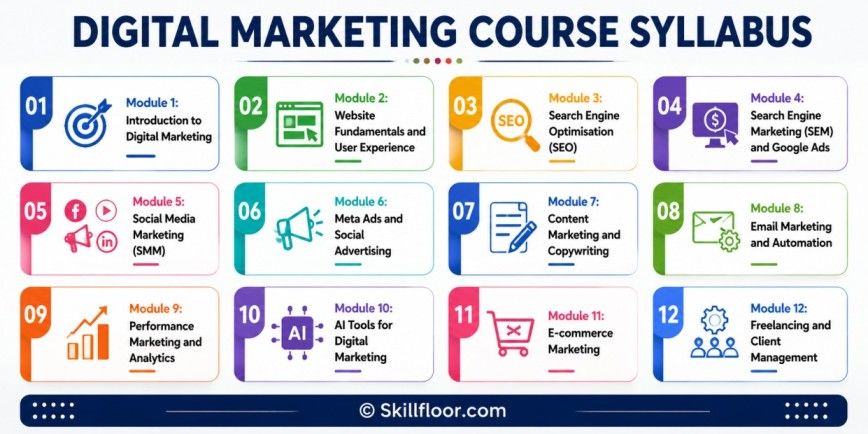
The following modules represent what a comprehensive, industry-aligned digital marketing curriculum should include. Some programs cover these as standalone modules; others integrate them across projects and campaigns.
Module 1: Introduction to Digital Marketing
Every strong program begins with a clear picture of the digital marketing landscape before moving into tools and tactics.
This module typically covers:
-
What digital marketing is and how it differs from traditional marketing
-
The digital marketing ecosystem: search, social, email, content, paid, analytics
-
How the buyer's journey maps to different marketing channels
-
Overview of the digital marketing career landscape: roles, specialisations, and industry verticals
-
Key performance indicators (KPIs) used across channels
This is a short but necessary foundation. If a course skips this and jumps straight into tools, it is likely to leave gaps in your strategic thinking.
Module 2: Website Fundamentals and User Experience
A digital marketer who doesn't understand how websites work will always be limited. This module covers the basics without requiring coding expertise.
Topics typically include:
-
How websites work: domains, hosting, CMS platforms (WordPress, Webflow)
-
Website structure, navigation, and landing page anatomy
-
User experience (UX) basics: page speed, mobile-friendliness, clear calls-to-action
-
Google Search Console and Google Analytics 4 setup
-
Basics of conversion rate optimisation (CRO)
Module 3: Search Engine Optimisation (SEO)
SEO remains one of the highest-return long-term skills in digital marketing. A quality SEO module should go well beyond "use keywords."
A well-structured SEO curriculum covers:
-
How search engines work: crawling, indexing, and ranking
-
Keyword research: tools, intent classification, opportunity scoring (using Google Keyword Planner, Ahrefs, SEMrush, or Ubersuggest)
-
On-page SEO: title tags, meta descriptions, heading structure, content optimisation
-
Technical SEO: site speed, Core Web Vitals, mobile optimisation, crawlability, structured data
-
Off-page SEO: link building principles, authority building, digital PR
-
Local SEO: Google Business Profile, local citations, map rankings

-
SEO for AI and answer engines: optimising for AI Overviews, featured snippets, and voice search


A modern SEO syllabus should explicitly address how AI-powered search features are changing how pages rank and get discovered.
Module 4: Search Engine Marketing (SEM) and Google Ads
Paid search delivers immediate visibility and measurable ROI. This module should take you from understanding how auctions work to running and optimising live campaigns.
Key topics:
-
How Google Ads works: the auction model, Quality Score, Ad Rank
-
Campaign types: Search, Display, Shopping, Video, Performance Max
-
Keyword match types, negative keywords, and search query analysis
-
Writing effective ad copy and ad extensions
-
Bidding strategies: manual CPC, target CPA, target ROAS, maximise conversions
-
Conversion tracking setup via Google Tag Manager and Google Ads
-
Reading and interpreting campaign reports
-
Introduction to Microsoft Advertising (Bing Ads)
Module 5: Social Media Marketing (SMM)
Social media marketing is platform-specific but strategy-led. A strong module teaches platform mechanics alongside content strategy and community management.
Topics should include:
-
Platform-by-platform strategy: Meta (Facebook and Instagram), LinkedIn, YouTube, X (Twitter), Pinterest, and emerging platforms
-
Organic vs paid social: when and why to use each
-
Content formats by platform: reels, carousels, stories, long-form posts, polls
-
Social media content calendar planning and scheduling tools (Buffer, Hootsuite, Meta Business Suite)
-
Community management and engagement
-
Social listening and brand monitoring
-
Influencer and creator marketing basics
-
Social commerce and product discovery
Module 6: Meta Ads and Social Advertising
Running paid campaigns on Meta platforms is a distinct skill that warrants its own module in any serious curriculum.
This module typically covers:
-
Meta Business Manager and Ads Manager setup
-
Campaign objectives: awareness, consideration, and conversion
-
Audience targeting: custom audiences, lookalike audiences, interest and behavioural targeting
-
Ad formats: single image, video, carousel, collection, and lead generation ads
-
Facebook Pixel and Meta Conversions API setup
-
A/B testing ad creatives and audiences
-
Retargeting strategy and funnel-based campaign structure
-
Budgeting and campaign scaling principles
Module 7: Content Marketing and Copywriting
Content is the raw material of almost every digital marketing channel. This module should teach you to plan, create, and measure content, not just write it.
Topics include:
-
Content strategy: audience research, content pillars, editorial calendars
-
Types of content: blog posts, guides, videos, infographics, case studies, podcasts
-
SEO content writing: keyword-led research, search intent matching, structured writing
-
Copywriting principles: AIDA, PAS, headline writing, CTA writing
-
Long-form vs short-form content strategy
-
Content distribution: organic, paid, social, email, and syndication
-
Measuring content performance: traffic, engagement, leads, and revenue attribution
Module 8: Email Marketing and Automation
Email consistently delivers among the highest ROI of any digital channel. A good email marketing module teaches both the creative and technical sides.
Topics typically covered:
-
Email marketing fundamentals: list building, segmentation, and deliverability
-
Email campaign types: newsletters, promotional, drip sequences, transactional
-
Writing subject lines and email copy that gets opened and clicked
-
Platform training: Mailchimp, HubSpot, Brevo, Klaviyo, or ConvertKit
-
Marketing automation: welcome sequences, abandoned cart flows, re-engagement campaigns
-
A/B testing subject lines, send times, and content
-
Email metrics: open rate, click-through rate, unsubscribe rate, and revenue per email
-
GDPR, CAN-SPAM, and permission-based marketing compliance
Module 9: Performance Marketing and Analytics
Performance marketing is the discipline of running campaigns with clear, measurable outcomes. This module bridges paid channels with data-driven decision making.
Key areas:
-
Performance marketing fundamentals: cost per click (CPC), cost per lead (CPL), cost per acquisition (CPA), return on ad spend (ROAS)
-
Funnel mapping: awareness, consideration, conversion, and retention
-
Attribution models: first-click, last-click, linear, time decay, data-driven
-
Google Analytics 4: events, conversions, audiences, and exploration reports
-
Google Tag Manager: setting up tracking without developer dependency
-
Campaign reporting frameworks: what to measure, how often, and what to act on
-
Cross-channel performance analysis and budget allocation
Module 10: E-commerce Marketing
For anyone working with or building online stores, e-commerce marketing is a critical specialisation.
This module covers:
-
E-commerce platforms: Shopify, WooCommerce, and marketplace channels (Amazon, Flipkart)
-
Product listing optimisation and SEO for e-commerce
-
Google Shopping campaigns and Performance Max for retail
-
Meta Shopping and dynamic product ads
-
Cart abandonment recovery: email, retargeting, and push notifications
-
Customer lifecycle marketing: acquisition, retention, upsell, and win-back
-
E-commerce analytics: revenue attribution, average order value, lifetime value
Module 11: AI Tools and Marketing Automation
This is no longer an advanced add-on; it belongs in every modern digital marketing syllabus as a core module.
Employers increasingly expect proficiency in AI-assisted marketing. Topics should include:
-
AI content creation tools: ChatGPT, Gemini, Claude, Jasper, and Copy.ai — use cases, limitations, and prompt engineering basics
-
AI for SEO: automated keyword clustering, content briefs, meta tag generation
-
AI image and visual content tools: Canva AI, Adobe Firefly, Midjourney for marketing use cases
-
Marketing automation platforms: HubSpot, ActiveCampaign, Zoho, and Marketo fundamentals
-
Predictive analytics and customer segmentation using AI
-
Chatbots and AI-powered customer engagement
-
Workflow automation with tools like Zapier and Make (Integromat)
-
Ethical use of AI in marketing: accuracy, disclosure, and brand consistency
Module 12: Video Marketing and YouTube
Video is the dominant content format across platforms. A serious syllabus includes both strategy and production.
Topics include:
-
Video strategy: short-form vs long-form, platform-specific approaches
-
YouTube channel setup, SEO, and growth strategy
-
YouTube Ads: TrueView, non-skippable, bumper ads, and targeting options
-
Short-form video: Instagram Reels, YouTube Shorts, and TikTok marketing
-
Basic video production: scripting, filming on phone, editing with CapCut or DaVinci Resolve
-
Video metrics: watch time, retention, CTR, and subscriber growth
Module 13: Digital Marketing Strategy and Campaign Planning
This capstone module ties everything together. Strategy is what separates marketers who execute tactics from those who drive business outcomes.
Topics covered:
-
Integrated digital marketing strategy: setting goals, budgets, and channel mix
-
Brand positioning and audience persona development
-
Go-to-market campaign planning for product launches and seasonal campaigns
-
Competitive analysis and market research
-
Marketing funnel construction: TOFU, MOFU, BOFU content and campaigns
-
Reporting to stakeholders: dashboards, monthly reviews, and ROI communication
-
Agency vs in-house marketing models and career pathways
Module 14: Capstone Projects, Internship, and Career Support
Real skill comes from doing, not just learning. A strong program includes structured project work and career preparation.
This should include:
-
Live campaign projects across Google Ads, Meta Ads, SEO, and email
-
Case study analysis and campaign audits
-
Portfolio development: what to include and how to present it
-
Resume building for digital marketing roles
-
Interview preparation and mock interviews
-
LinkedIn profile optimisation
-
Freelance project-finding and client management basics
-
Certification preparation: Google Ads, Google Analytics, HubSpot, Meta Blueprint
Digital Marketing Course Syllabus: Quick Comparison Table
|
Module |
What You Learn |
Key Tools |
|
Digital Marketing Foundations |
Channels, KPIs, ecosystem overview |
— |
|
Website and UX Basics |
CMS, landing pages, CRO |
WordPress, Google Search Console |
|
SEO |
Keyword research, on-page, technical, local, AI search |
Ahrefs, SEMrush, Google Search Console |
|
Google Ads / SEM |
Search, Display, Shopping, Performance Max |
Google Ads, Google Tag Manager |
|
Social Media Marketing |
Platform strategy, organic content, scheduling |
Meta Business Suite, Buffer |
|
Meta Ads |
Paid social, targeting, retargeting, pixel setup |
Meta Ads Manager |
|
Content Marketing |
Strategy, writing, SEO content, distribution |
Semrush, Surfer SEO, Google Docs |
|
Email Marketing |
Campaigns, automation, segmentation |
Mailchimp, Brevo, HubSpot |
|
Performance Marketing |
Attribution, analytics, funnel analysis |
Google Analytics 4, Looker Studio |
|
E-commerce Marketing |
Product ads, lifecycle campaigns, Shopify |
Google Shopping, Meta Catalogue |
|
AI Tools and Automation |
AI writing, automation workflows, chatbots |
ChatGPT, Zapier, HubSpot AI |
|
Video Marketing |
YouTube SEO, Reels, video ads, editing basics |
YouTube Studio, CapCut |
|
Campaign Strategy |
Integrated planning, budgeting, and reporting |
Looker Studio, Notion |
|
Projects and Career Support |
Live campaigns, portfolio, interviews, certifications |
Google Ads cert, Meta Blueprint |
What a Modern Digital Marketing Syllabus Should Include That Older Courses Don't
Many digital marketing courses are still teaching a 2019 curriculum. Here is what a genuinely current syllabus needs to address:
-
AI tools as a core skill, not an afterthought. Job descriptions increasingly list ChatGPT, Jasper, HubSpot AI, and prompt engineering as required or preferred skills. A course that treats AI as a bonus module is already behind.
-
GA4, not Universal Analytics. Google Analytics Universal Analytics was sunset in 2023. Any course still teaching the old GA is outdated by definition.
-
Performance Max and Smart campaigns. Google Ads has moved heavily toward automated campaign types. Understanding how to guide automation, setting proper goals, creative assets, and exclusions is now a core Google Ads skill.
-
AI-powered search and AEO. Google's AI Overviews, Perplexity, ChatGPT Search, and Gemini are changing how people find information. A forward-looking syllabus should cover how to optimise content for answer engines, not just traditional search rankings.
-
Short-form video. Instagram Reels, YouTube Shorts, and their associated advertising formats are now central to social media and paid media strategy, not optional extras.
-
First-party data and privacy. With third-party cookie deprecation ongoing, understanding first-party data strategy, server-side tracking, and consent management is increasingly important for performance marketers.
How to Evaluate Any Digital Marketing Course Syllabus Before You Enrol
Before committing to a program, ask these questions directly:
-
Is the curriculum updated for the current year? Ask when the syllabus was last revised.
-
Do you work on live campaigns or only simulated ones? Real campaign experience — even with small budgets — is significantly more valuable than simulations.
-
Which certifications does the course prepare you for? Google Ads, Google Analytics, HubSpot, and Meta Blueprint are the most recognised.
-
Who teaches the course? Look for instructors with verifiable industry experience, not just academic backgrounds.
-
What career support is included? Placement assistance, internship access, portfolio reviews, and LinkedIn coaching vary significantly across providers.
-
Is AI included as a working module? Not to mention, the actual hands-on use of AI tools for real marketing tasks.
-
What is the student-to-mentor ratio in live sessions? Smaller groups mean more individual attention to your actual work.
Who Should Take a Digital Marketing Course?
A structured digital marketing course is worth considering if you are:
-
A student or a fresh graduate who wants a job-ready skill set, rather than waiting to learn everything on the job
-
A working professional looking to transition into marketing, content, advertising, or analytics roles
-
An entrepreneur or business owner who wants to understand and manage their own digital marketing before hiring a team
-
A freelancer looking to expand into paid advertising, SEO, or content strategy services
-
A marketing professional who needs to get current on AI tools, GA4, performance marketing, or paid social
Digital marketing skills compound over time. The earlier you build a proper foundation, the faster you progress from execution to strategy to leadership.
Career Outcomes After a Digital Marketing Course
A comprehensive program opens doors to several well-defined career paths:
|
Role |
Primary Skills Required |
|
SEO Specialist / Analyst |
Keyword research, technical SEO, content strategy, GSC |
|
PPC / Performance Marketing Specialist |
Google Ads, Meta Ads, attribution, analytics |
|
Social Media Manager |
Platform strategy, content creation, community management |
|
Content Marketer / Strategist |
SEO writing, editorial planning, and content analytics |
|
Email Marketing Specialist |
Automation, segmentation, copywriting, and deliverability |
|
Digital Marketing Manager |
Strategy, budgeting, cross-channel campaign management |
|
E-commerce Marketer |
Google Shopping, retargeting, customer lifecycle |
|
AI Marketing Specialist |
AI tools, automation platforms, prompt engineering |
|
Freelance Digital Marketer |
Multi-channel execution, client reporting, and project management |
Frequently Asked Questions
-
What is covered in a digital marketing course syllabus?
A comprehensive digital marketing syllabus covers SEO, Google Ads, social media marketing, Meta Ads, content marketing, email marketing, performance analytics, e-commerce marketing, video marketing, and increasingly, AI tools and marketing automation. The best programs combine theory with live project work. -
How long does it take to complete a digital marketing course?
Most professional digital marketing certification programs run between 3 and 6 months, depending on whether you attend full-time or part-time. Short online courses can cover basics in a few weeks, but do not typically include live project work or career support. -
Do digital marketing courses include AI topics?
Modern courses should include AI tools as a core module, not an optional add-on. You should learn to use AI for content creation, SEO, campaign reporting, audience research, and workflow automation. Ask any course provider directly whether AI is actively taught with hands-on practice. -
Which certifications should a digital marketing course prepare me for?
The most recognised certifications include Google Ads certifications (Search, Display, Shopping, Video), Google Analytics 4 certification, HubSpot Marketing certifications, Meta Blueprint certifications, and SEMrush Academy certifications. A strong program prepares you for at least three of these. -
Is digital marketing a good career in 2026 and beyond?
Yes. Digital marketing roles continue to grow as businesses invest more in online customer acquisition and retention. Roles that combine technical platform skills with strategic thinking and AI proficiency are seeing especially strong demand. The field rewards continuous learning, which makes ongoing upskilling important. -
What is the difference between a digital marketing syllabus and a curriculum?
A syllabus lists the specific topics, modules, and tools covered in a course. A curriculum refers to the broader educational structure, including assessments, projects, learning outcomes, and teaching methodology. When evaluating a program, you want to examine both what is taught and how it is taught. -
Can I learn digital marketing without a degree?
Yes. Digital marketing is one of the few technical career fields where demonstrated skills and certifications often carry more weight than academic degrees. Employers and clients value your portfolio, campaign results, and certification credentials over a formal educational background. -
How do I know if a digital marketing course syllabus is up to date?
Check whether the syllabus mentions GA4 (not Universal Analytics), AI tools like ChatGPT or HubSpot AI, Performance Max campaigns, and short-form video. If it still lists outdated platforms or lacks AI content, the curriculum likely has not been updated recently.
Digital marketing is a skill set that rewards structured learning. Whether you're starting your first role, switching careers, or growing a business, understanding what a course syllabus actually covers helps you make a better decision about where to invest your time. The modules in this guide, from SEO and paid ads to analytics and AI tools, represent what the industry currently expects from a working digital marketer. If the course you're evaluating covers these areas with practical training and real tool access, you're looking at a curriculum worth your time. If it doesn't, now you know what to ask for.
Sources and References
The following sources informed the research, module structure, and industry context in this article. Readers are encouraged to consult them for further reference.
-
Google Search Central — developers.google.com/search
-
Google Ads Help Centre — support.google.com/google-ads
-
HubSpot Academy — academy.hubspot.com
-
Meta Blueprint — www.facebook.com/business/learn
-
Google Analytics 4 Help — support.google.com/analytics
-
Google Skillshop (Certifications) — skillshop.withgoogle.com
-
U.S. Bureau of Labour Statistics, Advertising, Promotions, and Marketing Managers — bls.gov
-
LinkedIn Workforce Report (Digital Skills) — linkedin.com/pulse/workforce-confidence
Ready to See the Full Skillfloor Digital Marketing Syllabus?
If you're serious about building a career in digital marketing or accelerating the one you're already in, Skillfloor's Certified Digital Marketing Professional Course is designed around a practical, industry-current curriculum.
The program includes live sessions with experienced mentors, hands-on projects using real tools and budgets, preparation for Google, HubSpot, and Meta certifications, AI marketing tools training, and internship and career support.
Digital Marketing Courses in Other Locations in India
Ahmedabad | Aurangabad | Bangalore | Bhilai | Bhopal | Bhubaneshwar | Chandigarh | Chennai | Cochin | Coimbatore | Dehra Dun | Delhi | Faridabad | Ghaziabad | Gorakhpur | Guntur | Gurgaon | Guwahati | Hyderabad | Jaipur | Kanpur | Khammam | Kolkata | Lucknow | Madurai | Mumbai | Mysore | Nagpur | Noida | Patna | Pondicherry | Pune | Ranchi | Shimoga | Surat | Thane | Thiruvananthapuram | Tiruchirappalli | Tirupati | Vadodara | Visakhapatnam | Warangal | Jalandhar | Jodhpur | Indore | Durgapur | Jamshedpur | Dhanbad | Kota | Karnal | Udaipur | Amritsar | calicut | Nashik | Ludhiana | varanasi | thrissur | Mangalore | Raipur |



-
 Vishwa RThank you for this well-structured and comprehensive digital marketing syllabus.