













































How to Become a Machine Learning Engineer - Complete Beginner Roadmap
Learn how to become a machine learning engineer with this beginner roadmap. Explore the key skills, tools, projects, and steps you need to start your ML career.

Machine learning engineers are among the most in-demand professionals in India’s growing AI economy. As startups, enterprises, and global tech companies rapidly adopt artificial intelligence, the demand for skilled professionals who can build intelligent systems continues to rise.
But many beginners still struggle with one major question:
Where should I actually start?
With so many courses, tools, and AI trends online, learning machine learning can feel overwhelming at first. Learners spend months watching tutorials without building the practical skills companies actually expect.
The good news is that even beginners without an AI background can enter this field with the right roadmap, consistent practice, and real-world projects.


Let's break down everything you need to know to become a machine learning engineer in 2026, including essential skills, learning roadmap, projects, salaries, tools, interview preparation, and career growth opportunities.
What is Machine Learning?
Machine learning is a branch of artificial intelligence (AI) that enables computers to learn from data and improve their performance without being explicitly programmed for every task.
Instead of following fixed instructions, machine learning systems identify patterns in data, make predictions, and continuously improve as they process more information.
Today, machine learning powers many everyday technologies, including
-
voice assistants
-
recommendation systems
-
face recognition
-
fraud detection
-
smart surveillance systems
-
search engines
For example, Amazon uses machine learning to recommend products based on browsing and purchase history, while companies like Meta use it to personalize advertisements and improve user engagement.
What Does a Machine Learning Engineer Do?
Building intelligent systems that can learn from data and make predictions or judgments is the responsibility of a machine learning engineer. They transform real-world issues into scalable machine learning solutions.
They ensure that models are not only accurate but also efficient and usable in production contexts across many applications and industries by working at the nexus of data science and software engineering.
The responsibilities of machine learning engineers frequently consist of:
-
Problem Understanding
-
Data Collection and Preprocessing
-
Exploratory Data Analysis (EDA)
-
Model Selection and Training
-
Model Evaluation
-
Model Optimization
-
Deployment of ML Models
-
Monitoring and Maintenance
-
Collaboration with Cross-Functional Teams
Each of these responsibilities ensures a smooth transition of machine learning systems from development to practical application.
When combined, they assist in the development of scalable, dependable, and production-ready AI solutions.
Why Become a Machine Learning Engineer?
In India, machine learning engineering is a rapidly expanding field with more than 20,000 job vacancies on Indeed and similar platforms.


Particularly in the IT, finance, healthcare, and e-commerce sectors, demand has grown by more than 40% in recent years, indicating robust growth and prospects for qualified workers.
-
High Salary Growth: In India and around the world, machine learning engineers are paid well, and their incomes are growing quickly as their knowledge and expertise continue to advance.
-
Strong Job Demand: Machine learning experts are needed by businesses across all sectors to develop AI systems, creating extremely stable and expanding employment possibilities.
-
Exciting AI Work: You get to work on intelligent AI systems that use data and algorithms to learn, predict, and resolve real-world issues.
-
Future Career Scope: Opportunities for long-term career advancement in AI research, product development, and advanced technical leadership positions are provided by machine learning engineering.
-
Global Opportunities: Competent machine learning engineers may collaborate with multinational corporations, distant teams, and foreign projects in a variety of global industries.
-
Continuous Learning: This line of employment keeps your abilities current and adds interest and value to your work by assisting you in learning new technologies on a regular basis.
What Skills Are Needed to Become a Machine Learning Engineer?
Technical Skills
-
Python Programming and Libraries: Python programming and libraries such as NumPy, Pandas, and Scikit-learn facilitate efficient data analysis, manipulation, and machine learning model construction for practical uses.
-
Machine Learning Algorithms: Building predictive models, classification systems, and regression-based solutions that successfully address business and data issues in the real world requires an understanding of machine learning techniques.
-
Mathematics and Statistics: Understanding model behavior and enhancing algorithm accuracy and performance in machine learning systems requires a grasp of mathematics, particularly linear algebra, probability, and statistics.
-
Data Preprocessing and Feature Engineering: Cleaning data, addressing missing values, and modifying datasets are all part of data preparation and feature engineering, which greatly enhances model performance and forecast accuracy.
-
Deep Learning Frameworks: Neural networks and sophisticated AI models are built using deep learning frameworks like TensorFlow and PyTorch for challenging tasks like speech and picture recognition.
-
SQL and Database Management: Large structured datasets necessary for effectively training and assessing machine learning models can be extracted, queried, and managed with the use of SQL and database management expertise.
-
Model Deployment and APIs: Using APIs for user interaction and scalability, machine learning models may be integrated into practical applications through model deployment utilizing Flask and FastAPI.
-
Cloud Platforms: Scalable model training, deployment, and management of machine learning systems in production settings are made possible by cloud platforms such as AWS, GCP, and Azure.
Soft Skills
-
Problem-Solving Ability: Proficiency in problem-solving techniques facilitates the analysis of intricate datasets and the creation of machine learning techniques that effectively tackle practical commercial and technical obstacles.
-
Communication and Teamwork: Working with data scientists, developers, and stakeholders to successfully complete machine learning projects requires effective communication and teamwork abilities.
-
Critical Thinking: In order to effectively enhance machine learning systems, critical thinking skills are necessary for assessing model performance, identifying problems, and making well-informed judgments.
-
Adaptability: In the quickly developing fields of artificial intelligence and machine learning, adaptability enables engineers to pick up new tools, frameworks, and technologies quickly.
-
Attention to Detail: When managing data, fine-tuning models, and guaranteeing precise forecasts and dependable machine learning system outputs, attention to detail is crucial.
-
Time Management: In fast-paced settings, time management abilities enable machine learning engineers to finish projects effectively while upholding quality and meeting deadlines.
Step-by-Step Roadmap to Become a Machine Learning Engineer
Although becoming a machine learning engineer might seem difficult at first, you can develop a successful AI career with the correct plan, roadmap, consistent learning, and everyday practice.
1. Learn Python Basics
In machine learning, Python is the primary language. Before entering into more complex machine learning concepts, start with basic coding exercises and gradually gain confidence.
-
Learn variables, loops, and functions
-
Practice small coding exercises daily
-
Understand basic object-oriented programming
-
Use simple Python projects for practice
2. Understand Math and Statistics
To identify patterns and create predictions, machine learning uses mathematics. You only need basic comprehension at the start, so concentrate on learning concepts rather than complex calculations.
-
Learn basic probability concepts
-
Understand averages and data patterns
-
Study simple linear algebra basics
-
Practice real examples with datasets
3. Learn Machine Learning Concepts
Understand the procedure of machine learning models prior to deep learning. Discover how systems analyze data, generate predictions, and enhance outcomes through testing and training techniques.
-
Learn supervised learning basics
-
Understand classification and regression
-
Study model training and testing
-
Practice using small datasets
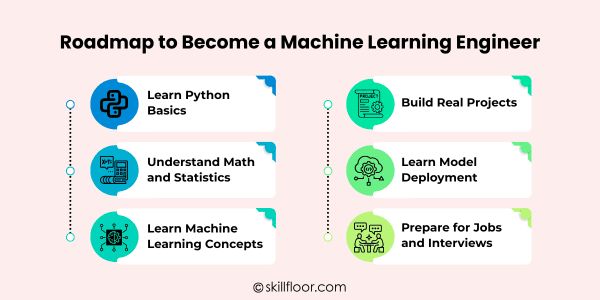
4. Build Real Projects
Projects provide you with self-assurance and let recruiters see your skills. Real projects also teach problem-solving more effectively than lengthy courses without practical experience.
-
Build a spam message detector
-
Create a movie recommendation app
-
Make a simple chatbot project
-
Upload projects on GitHub regularly
5. Learn Model Deployment
Engineers with online machine learning model deployment skills are in high demand. Understanding deployment enables you to transform projects into practical apps that people can use on a regular basis.
-
Learn Flask or FastAPI basics
-
Understand APIs and web apps
-
Practice using Docker containers
-
Try simple cloud deployment projects
6. Prepare for Jobs and Interviews
Being well-prepared boosts your interview confidence. To improve your chances of getting employed more quickly, concentrate on code, projects, communication, and the fundamentals of machine learning.
-
Practice coding interview questions
-
Explain projects with confidence
-
Improve problem-solving skills daily
-
Build a clean professional portfolio
Best Learning Resources for Aspiring ML Engineers
Using reliable resources rather than random lessons makes studying machine learning easier. You can stay motivated and develop skills more quickly with the help of quality books, practice platforms, and courses.
-
Beginner Online Courses: For greater comprehension and learning confidence, start with beginner-friendly Python and machine learning courses from institutes like Skillfloor that gradually explain ideas with hands-on exercises.
-
Educational YouTube Channels: To learn visually and enhance comprehension with simple real-world examples, watch YouTube channels focused on machine learning projects, coding practice, and AI fundamentals.
-
Simple ML Books: Instead of utilizing complex theory and perplexing technical words, read introductory machine learning books that use simple words, graphs, and real-world examples to illustrate challenging topics.
-
Hands-On Practice Platforms: Participate in tournaments, practice datasets, and learn how machine learning applies to practical business and industrial issues by using coding sites such as Kaggle.
-
Explore GitHub Projects: Investigate GitHub repositories to learn about project architectures, enhance coding techniques, and see how seasoned developers create and arrange machine learning programs in a professional manner.
-
Follow AI Communities: To stay updated on new tools, trends, and possibilities in the rapidly expanding machine learning field, frequently follow AI blogs, newsletters, and online communities.
How Long Does It Take to Become a Machine Learning Engineer?
The time depends on your background, learning speed, and practice consistency. Below is a simple breakdown of learning duration.
|
Background Level |
Time Required |
What You Learn |
Key Focus Area |
|
Complete Beginner |
12–18 months |
Python, math basics, ML concepts, small projects |
Building a strong foundation step by step |
|
Programming Experience (Non-AI) |
6–12 months |
ML models, data handling, libraries, deployment basics |
Fast transition using coding skills |
|
Data Analyst Background |
6–10 months |
Advanced ML, feature engineering, model tuning |
Moving from analysis to building models |
|
Software Engineer Transition |
4–8 months |
ML systems, deployment, MLOps, real-world projects |
Applying engineering skills to AI systems |
|
Fast-Track Learner (Full-Time Focus) |
4–6 months |
Core ML, deep learning basics, portfolio projects |
Intensive learning with daily practice |
|
Part-Time Learner |
12–24 months |
Gradual learning of ML concepts and projects |
Consistent learning alongside job or studies |
Machine Learning Engineer Salary and Career Growth (India)
In India, machine learning engineering is one of the professions with the fastest rate of growth. AI specialists are being actively hired by companies in Bengaluru, Hyderabad, Pune, and Chennai.
Machine learning engineers at the entry level typically make between ₹4 and ₹8 LPA, depending on their abilities, projects, and type of business.
According to Indeed, the average salary for a machine learning engineer in India is between ₹6 LPA and ₹10 LPA for freshers and early professionals.
However, applicants with genuine projects, internships, and good abilities can frequently make more money in product-based businesses and rapidly expanding AI companies.
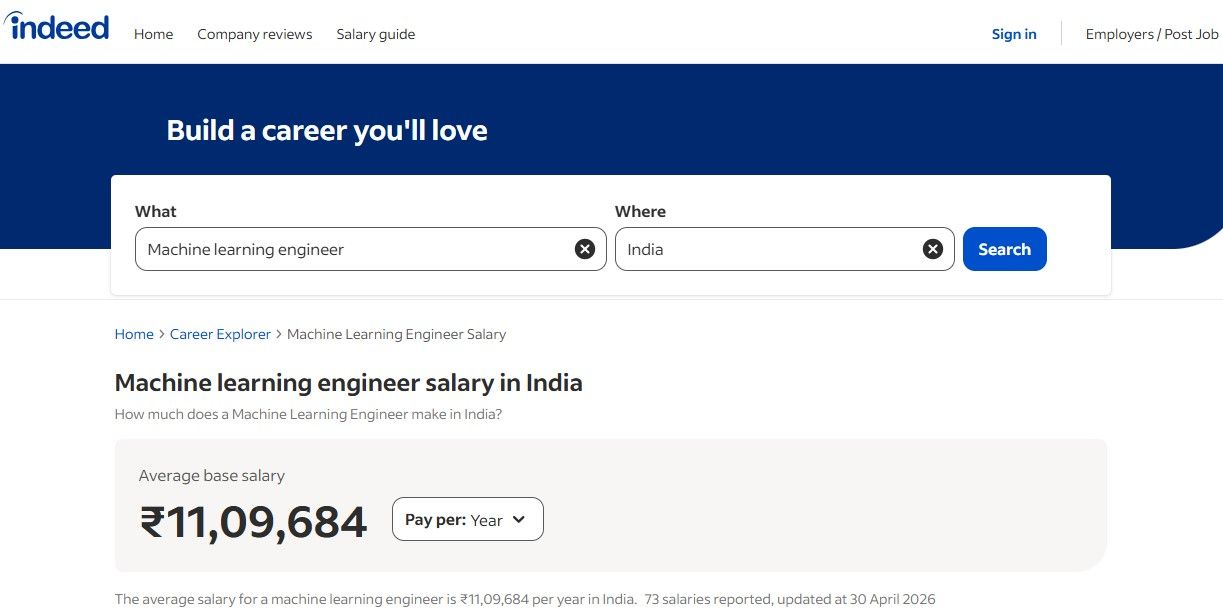
As engineers work on advanced projects and real AI systems, their incomes increase dramatically after two to five years of expertise.
Particularly in product companies and international IT corporations, mid-level professionals in India can make between ₹8 and ₹20 LPA, with faster growth for those who consistently improve their skills.
Depending on their level of experience, senior machine learning engineers and AI professionals in India can make between ₹20 LPA and ₹50+ LPA.
As businesses continue to use AI, there are plenty of options for career advancement, including leadership roles, architectural positions, and remote machine learning and AI jobs worldwide.
How to Prepare for Machine Learning Interviews
Coding, concepts, and project comprehension are tested through machine learning interviews.
Being well-prepared increases your chances of being chosen and develops clarity and confidence.
-
Coding Practice Daily: To increase logic, speed, and problem-solving skills utilizing Python, data structures, and fundamental algorithms, practice coding challenges every day.
-
Machine Learning Basics: During interviews, review regression, classification, clustering, and evaluation metrics to make concepts understandable and to gain insight into the inner workings of algorithms.
-
Work on Projects: Create basic machine learning projects and get an understanding of datasets, models, and outcomes so that you can clearly describe every aspect of the project.
-
Revise Mathematics: To comprehend model behavior and readily respond to basic machine learning theory questions, concentrate on the fundamentals of probability, statistics, and linear algebra.
-
Prepare Resume Well: To make it easier for recruiters to ask pertinent technical questions, create a clear résumé that highlights your skills, tools, and projects.
-
Mock Interviews Practice: To enhance communication, lower anxiety, and acquire structured response strategies for actual machine learning interview situations, practice mock interviews on a regular basis.
Common Mistakes Made by Beginners
Machine learning beginners frequently make basic errors that impede development, lead to misunderstandings, and undermine trust.
You can learn more quickly and develop stronger practical abilities by avoiding these mistakes.
-
Skipping Python Basics: Many beginners step directly into machine learning without having a solid understanding of Python, which makes it difficult to write code and comprehend data management procedures.
-
Ignoring Mathematics: It is challenging to comprehend how machine learning models actually learn and generate predictions when fundamental arithmetic concepts like probability and statistics are ignored.
-
Watching Without Practice: The effectiveness of learning is diminished by watching tutorials without coding exercises because true comprehension can only be attained by constantly building and testing models on your own.
-
Jumping Deep Learning: Beginners frequently jump right into deep learning without fully grasping the principles of machine learning, which causes confusion and a lack of comprehension.
-
Not Building Projects: Without actual projects, students are unable to apply their information, which hinders their ability to build confidence and win over recruiters or employers.
-
Ignoring Deployment Skills: The crucial ability of transforming models into practical, real-world applications is often overlooked by learners who stop at model training.
Future Trends in Machine Learning Engineering
Machine learning engineering is growing rapidly as businesses use AI in daily operations, products, and customer experiences.
One major trend is the rise of Generative AI and Large Language Models (LLMs). Companies now build AI tools that can generate text, images, code, audio, and videos. Because of this, engineers with skills in LLMs, AI agents, and prompt engineering are in high demand.
Another important trend is the growth of MLOps and AI deployment. Companies expect machine learning models to work efficiently in real-world applications, not just during training. Engineers now spend more time building automated pipelines, APIs, cloud systems, and monitoring tools.
Multimodal AI and real-time AI systems are also expanding across industries like healthcare, finance, cybersecurity, and e-commerce. Future machine learning engineers will need skills in software engineering, cloud platforms, and scalable AI systems to stay competitive.
As AI adoption continues to increase worldwide, machine learning engineering is expected to remain one of the strongest long-term technology career paths.
FAQs
1. Do I need a degree to become a Machine Learning Engineer?
No, a formal degree is not mandatory. Many ML engineers are self-taught. What matters most is your skills, projects, and understanding of machine learning concepts.
2. How long does it take to become a Machine Learning Engineer?
On average, it takes around 6 months to 2 years, depending on your background, consistency, and how much time you dedicate to learning and building projects.
3. Is coding required for Machine Learning Engineering?
Yes, coding is essential. Python is the most widely used language, and you should be comfortable with writing programs, working with data, and using ML libraries.
4. Can a fresher get a job as a Machine Learning Engineer?
Yes, but it is competitive. Freshers usually need strong projects, good fundamentals, and a solid portfolio to stand out.
5. What are the career opportunities after learning Machine Learning?
You can work as ML Engineer, Data Scientist, AI Engineer, NLP Engineer, CV Engineer, or grow into senior AI leadership roles.
6. What are the best skills to learn for Machine Learning in 2026?
Key skills include Python, Machine Learning algorithms, Deep Learning, MLOps, SQL, and experience with frameworks like TensorFlow or PyTorch.
Machine learning engineering is one of the fastest-growing career paths in the AI industry. With the right roadmap, practical projects, and consistent learning, even beginners can build strong skills and enter the field successfully.
Start with Python, focus on real-world projects, and gradually learn advanced AI concepts step by step. The demand for skilled machine learning engineers continues to grow across industries, creating excellent opportunities for long-term career growth in 2026 and beyond.
Digital Marketing Courses in Other Locations in India
Ahmedabad | Aurangabad | Bangalore | Bhilai | Bhopal | Bhubaneshwar | Chandigarh | Chennai | Cochin | Coimbatore | Dehra Dun | Delhi | Faridabad | Ghaziabad | Gorakhpur | Guntur | Gurgaon | Guwahati | Hyderabad | Jaipur | Kanpur | Khammam | Kolkata | Lucknow | Madurai | Mumbai | Mysore | Nagpur | Noida | Patna | Pondicherry | Pune | Ranchi | Shimoga | Surat | Thane | Thiruvananthapuram | Tiruchirappalli | Tirupati | Vadodara | Visakhapatnam | Warangal | Jalandhar | Jodhpur | Indore | Durgapur | Jamshedpur | Dhanbad | Kota | Karnal | Udaipur | Amritsar | calicut | Nashik | Ludhiana | varanasi | thrissur | Mangalore | Raipur |