



































Step-by-Step Guide to Social Media Advertising
A step-by-step guide to creating and managing social media ads. Learn to run successful ad campaigns on social media.
Social media advertising has transformed the way businesses attract and engage customers in today’s digital landscape. Brands of all sizes utilize platforms like Facebook, Instagram, LinkedIn, TikTok, and Pinterest to target specific audiences, increase brand awareness, and achieve significant results.
However, effective social media advertising involves more than simply increasing the number of posts or spending more money. A successful advertising strategy requires careful campaign planning, thorough audience research, creative development, expertise in digital marketing, and continuous performance optimization.
This guide outlines essential strategies for social media marketing, including audience targeting, ad creation, performance analysis, testing methods, conversion tracking, and ROI optimization strategies. These insights are drawn from real-world campaign management experience to help you create successful paid social campaigns.
Businesses want a data-driven strategy to make smarter advertising choices as competition increases across digital channels. This comprehensive book will assist marketers in understanding social media advertisements, developing effective campaigns, and putting tried-and-true methods into practice for improved results.


What Is Social Media Advertising?
Social media advertising is a type of digital marketing in which companies pay social media companies to advertise their content, goods, services, or deals to particular audiences.
Paid social media advertising enables businesses to reach a wider and more focused audience through sponsored ads, in contrast to organic social media marketing, where companies rely on frequent updates and user engagement to reach people.
Examples of social media advertising include:
-
Facebook Ads
-
Instagram Ads
-
LinkedIn Sponsored Ads
-
Pinterest Ads
-
YouTube Ads
Businesses use social media ads to achieve goals such as:
-
Increasing brand awareness
-
Driving website traffic
-
Generating leads
-
Increasing product sales
-
Promoting events
-
Growing online communities
Key Elements of Social Media Advertising
-
Paid Social Media Campaigns: These are social media platforms with customized ads that you have to pay for.
-
Social Media Marketing: All social media marketing initiatives, including naturally occurring posts and interactions, are referred to as social media marketing.
-
Digital Advertising: Digital advertising includes social media ads as well as all other forms of internet advertising.
-
Social Media Ad Optimization: Optimizing your social media advertisements to perform better is known as social media ad optimization.
How Does Social Media Advertising Work?
Advertisers compete to display adverts to users who are most likely to take action through a bidding system used in social media advertising.
The basic process includes:
-
Choosing a Campaign Objective: Companies choose their goals, such as website traffic, leads, or revenue.
-
Defining the Target Audience: Users are chosen by advertisers according to their age, geography, hobbies, and behaviour.
-
Creating Advertisements: Companies create eye-catching headlines, videos, graphics, and messaging.
-
Setting Budget and Bidding Strategy: The amount that advertisers wish to spend each day or throughout the course of the campaign is up to them.
-
Launching and Monitoring Campaigns: To gauge outcomes, performance data is gathered.

-
Optimizing Campaigns: By experimenting with various audiences, creatives, and tactics, advertisers can enhance their campaigns.


Benefits of Social Media Advertising
1. Reach a Targeted Audience
One of the biggest advantages of social media advertising is advanced audience targeting.
Businesses can target users based on:
-
Age
-
Gender
-
Location
-
Interests
For example, a digital marketing institute can target:
-
Students aged 18–30
-
Interested in digital marketing
-
Searching for career opportunities
2. Cost-Effective Marketing
Social media advertising allows businesses to control their spending.
You can start with a small budget and increase investment after identifying successful campaigns.
Most platforms allow advertisers to set:
-
Daily budgets
-
Lifetime campaign budgets
-
Maximum cost limits
3. Measurable Results
Unlike traditional advertising, social media advertising provides detailed performance data.
You can track:
-
Number of impressions
-
Click-through rate
-
Cost per click
-
Leads generated
This helps businesses understand whether their advertising investment is profitable.
Step-by-Step Process to Create a Social Media Advertising Campaign
Step 1: Define Your Advertising Goals
Make sure you know exactly what you want to accomplish before making an advertisement.
Common social media advertising goals include:
-
Brand Awareness: Used by companies who wish to increase brand awareness.
-
Website Traffic: Utilised to direct users to your landing page or website.
-
Lead Generation: Used to gather consumer data, including phone numbers and emails.
-
Sales and Conversions: Used to convince consumers to buy goods or services.
Step 2: Understand Your Target Audience
One of the most crucial aspects of social media advertising is audience research.
Before creating ads, understand:
-
Who are your ideal customers?
-
What problems do they have?
-
What solutions are they looking for?
-
Which platforms do they use?
Create a customer persona including:
|
Category |
Example |
|
Age |
20–35 years |
|
Location |
India |
|
Interest |
Digital marketing, technology |
|
Goal |
Learn new skills |
|
Problem |
Finding career opportunities |
Step 3: Choose the Right Social Media Platform
The target audience and advertising goal of each social media platform vary.
-
Facebook Advertising: Facebook Ads use advanced targeting features to help businesses reach a variety of consumers, generate leads, and promote items.
-
Instagram Advertising: Instagram ads work well for visual marketers that want to reach younger people with pictures, videos, and loops.
-
LinkedIn Advertising: LinkedIn Ads assist professionals, recruiters, and B2B organisations in targeting consumers according to industry and career profiles.
-
Pinterest Advertising: Pinterest advertisements assist lifestyle firms in showcasing their goods and connecting with people who are looking for inspiration and original ideas.
Step 4: Create High-Converting Social Media Ads
A successful advertisement needs three important elements:
-
Attractive Visuals: Make captivating commercials with eye-catching photos, captivating films, product demos, and visuals that grab viewers' attention right away.
-
Clear Advertising Message: Clearly communicate your offer by outlining the advantages of your product, its value proposition, and what customers should do next.
-
Strong Call-to-Action (CTA): Make use of attention-grabbing calls to action (CTAs) that drive consumers to perform things like buy, register, download, or find out more.
Step 5: Select the Right Ad Format
Social media platforms provide multiple advertising formats.
-
Image Ads: Image ads successfully sell goods, services, and brands on social media platforms by using eye-catching images and succinct text.
-
Video Ads: Using instructions, demonstrations, and narrative content, video advertisements assist companies in showcasing goods, elucidating services, and captivating viewers.
-
Carousel Ads: Carousel advertising lets firms successfully showcase their products, features, and processes by allowing several images or videos in a single campaign.
-
Stories and Reels Ads: Stories and Reels advertising are full-screen, mobile-friendly commercials that use brief, captivating visual material to draw viewers in.
-
Lead Generation Ads: Through platforms for classes, consultations, and service-based offerings, lead generation advertisements assist companies in directly gathering client data.
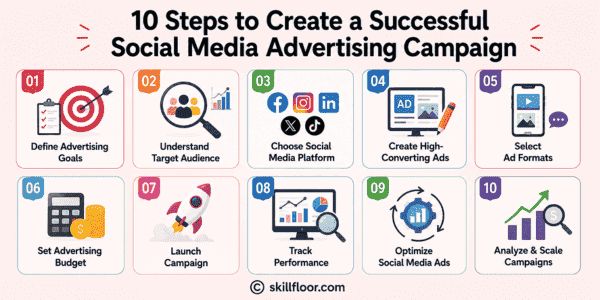
Step 6: Set Your Social Media Advertising Budget
Budget planning is important for campaign success.
Consider:
-
Your marketing goals
-
Competition level
-
Platform advertising costs
-
Expected return on investment
Beginners should start with a testing budget and increase spending after identifying successful campaigns.
A common approach:
-
70% budget → Proven campaigns
-
20% budget → Testing new ideas
-
10% budget → Experimentation
Step 7: Launch Your Social Media Advertising Campaign
Before launching, check:
-
Review Campaign Objectives: Before launching, make sure your campaign goal—such as awareness, traffic, leads, or sales—is appropriately chosen.
-
Verify Audience and Budget Settings: Verify your bidding strategy, advertising budget, target audience, and campaign duration to prevent wasteful expenditure.
-
Check Ad Creatives and Landing Pages: Ensure that your landing site, text, CTA, and ad images offer a seamless user experience.
-
Install Tracking and Monitor Performance: Before making optimisation decisions, set up tracking mechanisms to measure outcomes and for adequate data collecting.
Step 8: Track Social Media Advertising Performance
Monitoring performance helps identify what works and what needs improvement.
Important advertising metrics include:
-
Impressions: Impressions indicate the number of times users saw your advertisement on various social media networks.
-
Reach: Reach calculates how many distinct users see your ad over the course of a given campaign.
-
Click-Through Rate (CTR): CTR shows the proportion of viewers who clicked on your ads.
-
Cost Per Click (CPC): The cost per click (CPC) of your social media ad is calculated.
-
Conversion Rate: The conversion rate displays the proportion of users who finished a targeted action, like making a purchase or registering.
-
Return on Ad Spend (ROAS): To assess the profitability of a campaign, ROAS calculates the income from your advertising investment.
Step 9: Optimize Your Social Media Ads
Optimization improves campaign performance and reduces wasted spending.
Effective optimization strategies include:
-
A/B Testing: To find the best-performing combinations, test various ad elements such as headlines, graphics, videos, CTAs, and audiences.
-
Improve Targeting: Examine audience performance and target users with higher engagement and conversion potential with your money.
-
Refresh Creative Content: To keep viewers interested and avoid creative fatigue, update ad images, videos, offers, and messaging on a frequent basis.
-
Retarget Potential Customers: Get in touch with those who came to your website, looked at your products, put things in their carts, or interacted with your content.
Step 10: Analyze Results and Scale Your Social Media Advertising Campaigns
Businesses can better understand performance, find effective tactics, and make data-driven decisions for future growth by analysing campaign results.
-
Analyze Campaign Performance: Examine crucial indicators such as ROAS, CTR, CPC, conversion rate, and CPA to gauge the success of advertising efforts.
-
Identify Winning Strategies: Determine which audiences, ad creatives, messaging, and platforms are most effective in increasing engagement and improving conversions.
-
Scale Successful Campaigns: Increase funding for successful campaigns by progressively increasing budgets, reaching a wider audience, and investigating untapped markets.
-
Continue Testing and Improving: Test new concepts frequently, keep an eye on trends, and refine campaigns to sustain steady performance and long-term advertising success.
Common Social Media Advertising Mistakes to Avoid
Businesses may increase campaign performance, cut down on unnecessary expenses, and obtain better results from social media marketing initiatives by avoiding typical advertising blunders.
-
Targeting Too Broad an Audience: By reaching visitors who are unlikely to interact or convert, broad audience targeting might squander advertising money.
-
Ignoring Mobile Optimization: Ads should be made for smaller screens and quicker interaction because the majority of people access social media via mobile devices.
-
Creating Weak Advertisements: Weak CTAs, ambiguous messaging, and subpar images can lower audience engagement and have a detrimental effect on campaign performance.
-
Not Tracking Results: Businesses cannot determine effective tactics or maximise their advertising campaigns without keeping an eye on analytics and important indicators.
-
Stopping Campaigns Too Early: Before making wise campaign judgements, social media algorithms require enough time and data to comprehend performance.
Best Practices for Long-Term Social Media Advertising Success
-
Test Campaigns Continuously: Try out various audiences, creatives, and tactics on a regular basis to see what works best for advertising.
-
Use Engaging Video Content: Make brief, educational, and eye-catching videos to draw viewers in and increase their interaction on many platforms.
-
Retarget Website Visitors: To boost conversions and client retention, re-establish contact with past website visitors and active users through tailored advertisements.
-
Analyze Competitor Strategies: To find possibilities and enhance your advertising plan, keep an eye on rival campaigns, messaging, and innovative tactics.
-
Review Campaign Performance Regularly: To measure results, optimize campaigns, and make well-informed advertising decisions, regularly monitor key indicators.
Future Trends in Social Media Advertising
Social media advertising is always changing due to new marketing strategies, shifting customer behaviour, and technological developments. By assisting companies in better audience targeting, automating campaign optimisation, producing personalised content, and more efficiently analysing consumer behaviour, artificial intelligence (AI) is starting to play a significant role in advertising.
Future advertising methods are anticipated to heavily rely on influencer collaborations, social commerce, and short-form video content. Through captivating videos, product demos, and genuine creative partnerships that boost trust and engagement, companies can connect with audiences on platforms like Instagram, TikTok, and other video-focused networks.
Additionally, as companies leverage consumer data and insights to create more relevant ads, personalisation will become more crucial. Businesses can improve consumer experiences, develop more successful social media advertising campaigns, and produce better long-term marketing outcomes by adjusting to these changes.
Frequently Asked Questions About Social Media Advertising
1. What are the main benefits of social media advertising?
Social media advertising helps businesses increase brand visibility, reach targeted audiences, generate leads, drive website traffic, and improve sales through paid promotional campaigns.
2. Which social media platform is best for advertising?
The best platform depends on your audience and business goals. Facebook works well for broad audiences, LinkedIn for B2B, and Instagram for visual brands.
3. How much does social media advertising cost?
Costs depend on factors like platform, audience competition, campaign objective, and budget.
4. How long does it take to see results from social media ads?
Some campaigns generate results quickly, while others require testing and optimization over several weeks.
5. Is social media advertising better than organic marketing?
Both strategies are valuable. Paid advertising provides faster reach, while organic marketing builds long-term audience relationships.
Social media advertising has become an essential digital marketing strategy for businesses looking to reach the right audience, build brand awareness, generate qualified leads, and increase revenue. Paid social media initiatives can help businesses engage with prospective clients and produce quantifiable marketing outcomes when used properly.
However, spending money on advertisements is not the only factor in successful advertising. It necessitates a methodical approach that includes establishing precise goals, comprehending your target market, choosing the appropriate platforms, producing captivating advertising material, efficiently managing finances, monitoring results, and consistently enhancing campaigns.
Businesses can develop data-driven campaigns, make more informed marketing choices, optimize their return on investment, and forge closer ties with their target audience by adhering to this comprehensive guide to social media advertising.
Digital Marketing Courses in Other Locations in India
Ahmedabad | Aurangabad | Bangalore | Bhilai | Bhopal | Bhubaneshwar | Chandigarh | Chennai | Cochin | Coimbatore | Dehra Dun | Delhi | Faridabad | Ghaziabad | Gorakhpur | Guntur | Gurgaon | Guwahati | Hyderabad | Jaipur | Kanpur | Khammam | Kolkata | Lucknow | Madurai | Mumbai | Mysore | Nagpur | Noida | Patna | Pondicherry | Pune | Ranchi | Shimoga | Surat | Thane | Thiruvananthapuram | Tiruchirappalli | Tirupati | Vadodara | Visakhapatnam | Warangal | Jalandhar | Jodhpur | Indore | Durgapur | Jamshedpur | Dhanbad | Kota | Karnal | Udaipur | Amritsar | calicut | Nashik | Ludhiana | varanasi | thrissur | Mangalore | Raipur |