

































Performance Marketing vs Digital Marketing: Which Offers Better Growth?
Performance Marketing vs Digital Marketing helps businesses compare strategies for ROI, scalability, targeting, and growth potential across digital channels.
Ever wondered why some businesses seem to generate leads and sales almost instantly, while others focus on building trust and brand recognition over time? The answer often lies in the marketing strategy they choose. Two approaches that frequently come up in this discussion are Performance Marketing and Digital Marketing.
Although these terms are often used interchangeably, they are not the same. Performance Marketing is centered around measurable results such as clicks, leads, and conversions, whereas Digital Marketing covers a broader range of online strategies designed to increase visibility, engagement, and long-term brand growth.
So, when it comes to achieving business growth, which approach works better? Should businesses prioritize quick, data-driven results through Performance Marketing, or invest in the broader, long-term benefits of Digital Marketing? In this blog, we'll compare both strategies, examine their strengths and limitations, and help you understand which one offers better growth based on your goals.
What Is Digital Marketing?
Digital marketing is the practice of promoting products, services, or brands through online channels such as search engines, social media platforms, websites, email, and mobile apps. It helps businesses reach their target audience, increase brand visibility, and generate leads. By leveraging digital platforms, companies can drive engagement, boost sales, and measure campaign performance effectively.


Key Components of Digital Marketing
-
Search Engine Optimization (SEO)
-
Content Marketing and Video Marketing
-
Social Media Marketing
-
Email Marketing and Influencer Marketing
-
Website Strategy and Online PR
-
Mobile Marketing
Key Characteristics of Digital Marketing
-
Slow but compounding results, especially with SEO and content marketing.
-
Ideal for building long-term brand value rather than quick wins.
-
Focuses on relationships and trust, not just immediate conversions.
-
Builds authority and visibility across multiple digital channels.
-
Requires consistent effort over time to see a meaningful impact.
What Is Performance Marketing?
Performance marketing is a digital marketing approach where advertisers pay only when a specific action is completed, such as a click, lead, app install, or sale. It focuses on measurable results, allowing businesses to track campaign performance and optimize spending for maximum returns. This strategy helps companies achieve targeted outcomes while maintaining greater control over their marketing budget.
Key Components of Performance Marketing
-
Meta Ads (Facebook/Instagram)
-
Google Ads (Search, Display, Shopping)
-
YouTube Ads
-
Affiliate Marketing
-
Conversion Rate Optimization (CRO)
-
Retargeting and Landing page optimization
Key Characteristics of Performance Marketing
-
Delivers fast and measurable results, often visible within days.
-
Ideal for businesses seeking quick ROI and lead generation.
-
Focuses on conversions and actions, not just brand visibility.
-
Highly scalable once a campaign proves successful.
-
Requires continuous monitoring and optimization to stay cost-effective.
Performance Marketing vs Digital Marketing: Key Differences
While both strategies aim to grow your business, they differ in how they work, what they measure, and how fast they deliver results. Understanding these differences helps you decide where to invest your marketing budget.
|
Aspect |
Digital Marketing |
Performance Marketing |
|
Objective |
Build brand awareness and long-term visibility |
Drive specific, measurable actions (clicks, leads, sales) |
|
Payment Model |
Fixed budget or ongoing investment |
Pay only for results (CPC, CPL, CPA) |
|
Timeline |
Long-term results develop gradually over time |
Short-term, results visible within days |
|
Key Metrics |
Traffic, impressions, engagement, brand reach |
Conversions, ROAS, CPA, CTR |
|
Risk Level |
Moderate, returns are not always guaranteed |
Lower, since you pay based on actual performance |
|
Scalability |
Gradual and steady |
Fast, can scale quickly once a campaign works |
Digital Marketing vs Performance Marketing: Pros and Cons
Digital Marketing
Pros
-
Builds strong brand awareness and credibility over time.
-
Generates sustainable organic traffic through SEO and content marketing.

-
Helps create long-term customer relationships and trust.
-
Delivers consistent ROI through multiple marketing channels.
-
Supports business growth even with a limited advertising budget.


Cons
-
Results can take months to become visible, especially with SEO.
-
Requires consistent content creation and optimization efforts.
-
Organic growth can be affected by search engine algorithm changes.
-
Measuring brand-building impact is sometimes difficult.
-
Success often depends on long-term commitment and patience.
Performance Marketing
Pros
-
Delivers quick and measurable results.
-
Provides complete visibility into campaign performance.
-
Allows precise audience targeting and retargeting.
-
Makes budget allocation and ROI tracking easier.
-
Campaigns can be scaled rapidly when they perform well.
Cons
-
Results often stop when advertising spend stops.
-
High competition can increase advertising costs.
-
Requires constant monitoring and campaign optimization.
-
Dependence on advertising platforms and algorithm changes.
-
May focus more on short-term conversions than long-term brand building.
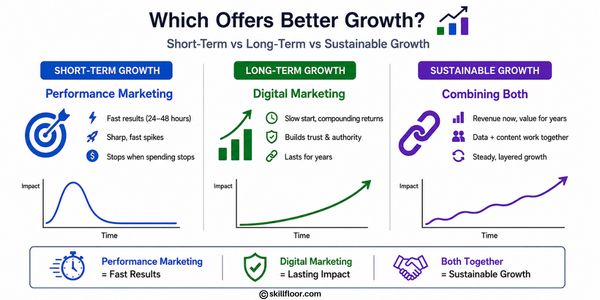
Which Offers Better Growth? Short-Term vs Long-Term vs Sustainable Growth
When you strip away the jargon, the real question isn't "which is better," it's "better for what timeframe?" Growth looks different depending on whether you're measuring it in days, months, or years. Here's how each strategy stacks up:
Short-Term Growth: Performance Marketing
If you need results fast, performance marketing wins hands down. Through channels such as PPC advertising, you're paying directly for clicks, leads, or sales, so the feedback loop is almost immediate. Launch a campaign today, and you can see conversions within 24–48 hours.
-
Best for: Product launches, flash sales, lead generation pushes, seasonal promotions
-
Growth pattern: Sharp, fast spikes, but they taper off quickly once spending stops
-
Example: A festive Google Shopping campaign can double sales in a week, but volumes drop back to baseline the moment the ads pause
-
Limitation: Growth is rented, not owned. Stop paying, and the pipeline dries up almost instantly.
Long-Term Growth: Digital Marketing
Digital marketing plays the slow game, but it compounds. SEO, content, and organic social don't deliver overnight wins, but every blog post, backlink, and piece of content keeps working for you long after it's published, building a growth curve that gets steeper with time.
-
Best for: Brand authority, organic traffic, customer trust, reducing ad dependency
-
Growth pattern: Slow start, gradual incline, then compounding returns as authority builds
-
Example: A blog that takes 6 months to rank can then drive free, consistent traffic for years
-
Limitation: Requires patience and consistency. There's no shortcut, and algorithm changes can disrupt momentum.
Sustainable Growth: Combining Both
This is where the real growth engine lives. Performance marketing fills the short-term revenue gap while digital marketing builds the long-term foundation underneath it, so you're never solely dependent on either paid spend or slow organic compounding.
-
Best for: Businesses scaling steadily without high risk, new market entries, and product launches that need both immediate traction and lasting visibility
-
Growth pattern: Steady, layered growth — performance marketing creates revenue and data now, digital marketing converts that momentum into lasting equity
-
Example: A brand runs paid ads to drive immediate sales while simultaneously investing in SEO content; over time, organic traffic reduces ad-spend dependency, and the combined channels reinforce each other (ad data informs content strategy, content builds trust that improves ad conversion rates)
-
Why it wins: You get cash flow today and brand value tomorrow; neither strategy alone can deliver both.
Performance marketing offers the fastest growth. Digital marketing offers the most durable growth. But sustainable growth, the kind that compounds without constant ad spend and doesn't take a year to show results, comes from running both in parallel, not choosing one over the other.
Performance Marketing vs Digital Marketing: Which Delivers Better ROI?
Return on Investment (ROI), often referred to as marketing ROI, is one of the most important metrics businesses use to evaluate the success of their digital marketing strategies. However, comparing the ROI of Performance Marketing and Digital Marketing isn't always straightforward because they operate on different timelines and objectives.
Performance Marketing ROI
Performance Marketing is designed to generate measurable results quickly. Since advertisers pay for specific actions such as clicks, leads, or sales, ROI can be tracked in real time. Businesses can easily identify which campaigns are performing well and optimize their budgets accordingly.
Why it delivers strong ROI:
-
Immediate visibility into campaign performance.
-
Faster lead generation and sales.
-
Easier budget allocation based on measurable results.
-
Ability to scale successful campaigns quickly.
Challenge: While ROI can be high in the short term, results often decline when advertising spend stops. Rising competition and increasing ad costs can also affect profitability over time.
Digital Marketing ROI
Digital Marketing typically requires a larger upfront investment of time and resources. Strategies such as SEO, content marketing, and social media marketing may take months to generate significant results. However, once established, they can continue to drive traffic, leads, and conversions without incurring the same ongoing advertising costs.
Why it delivers strong ROI:
-
Generates sustainable organic traffic.
-
Reduces long-term customer acquisition costs.
-
Builds brand authority and customer trust.
-
Creates content assets that continue producing value over time.
Challenge: ROI often takes longer to materialize and is more difficult to measure than with paid campaigns.
The answer depends on your goals and timeframe. If you're looking for immediate returns and quick lead generation, Performance Marketing often provides a higher short-term ROI. If your goal is to build a sustainable growth engine that continues generating results over the years, Digital Marketing typically delivers a stronger long-term ROI.
For individuals looking to build expertise in ROI-driven marketing strategies, Skillfloor offers one of the best Digital Marketing Courses covering SEO, PPC, analytics, content marketing, and performance marketing.
Common Mistakes Businesses Make When Choosing Between Performance Marketing and Digital Marketing
-
Treating it as an either-or decision: Many businesses pick only one strategy instead of recognizing that performance and digital marketing work best together, limiting overall growth potential.
-
Ignoring long-term brand building for quick wins: Focusing only on performance marketing campaigns while neglecting SEO and content marketing leads to short-lived results and high long-term dependency on ad spend.
-
Avoiding paid marketing entirely: Relying solely on organic digital marketing efforts and skipping performance marketing often results in slow lead generation and missed short-term revenue opportunities.
-
Expecting instant results from the wrong strategy: Assuming digital marketing will deliver overnight growth, or that performance marketing alone can build lasting brand value, sets unrealistic expectations and leads to premature strategy changes.
-
Lack of strategic integration: Running both strategies without aligning them, for example, not using performance marketing data to inform content strategy, reduces the overall effectiveness of the marketing budget.
-
Not tracking or analyzing combined data: Failing to measure how both strategies influence each other prevents businesses from optimizing campaigns, improving ROI, and making informed budget decisions over time.
Marketing Trends That Will Define 2026 and Beyond
-
AI-powered campaign optimization — Over 80% of marketers are expected to use AI tools for content creation, ad targeting, and customer personalization, making campaigns smarter and more cost-efficient.
-
First-party data takes priority — With privacy regulations tightening and third-party cookies fading out, brands are shifting focus to data collected directly from their own customers.
-
Video marketing dominates — Video content now accounts for more than 80% of global internet traffic, making it a core part of both organic and paid strategies.
-
Voice search optimization grows — As voice assistants become more common, businesses are adapting SEO and content strategies to match conversational search queries.
-
Influencer marketing matures — Brands are moving from one-off posts to long-term partnerships and micro-influencer networks for more authentic reach.
-
Omnichannel customer experience — Customers expect seamless brand interaction across social media, email, search, and apps, making integrated digital and performance strategies essential.
FAQ’s:
1. Is performance marketing better than digital marketing?
Neither is inherently better; the right choice depends on your goals. Performance marketing delivers quick, measurable results, while digital marketing focuses on long-term brand growth and visibility.
2. Which gives better ROI?
Performance marketing often provides a higher short-term ROI through immediate conversions. Digital marketing typically generates stronger long-term ROI by building organic traffic, trust, and brand authority.
3. What are the key metrics in Performance Marketing?
The core KPIs are CPC (Cost Per Click), CPL (Cost Per Lead), CPA (Cost Per Acquisition), ROAS (Return on Ad Spend), CTR (Click-Through Rate), CVR (Conversion Rate), and LTV (Lifetime Value).
4. Which is better for lead generation — Performance Marketing or Digital Marketing?
Performance Marketing (specifically Google Search Ads and Meta Lead Gen Ads) is the fastest and most measurable way to generate leads. However, SEO and content marketing generate high-quality organic leads over time with zero ongoing ad spend.
5. How long does it take to see results from Digital Marketing vs Performance Marketing?
Performance Marketing can generate results within hours to days of launching. SEO and content marketing (core Digital Marketing channels) typically take 3–6 months to show significant results, but deliver compounding, long-term growth.
At the end of the day, Performance Marketing and Digital Marketing aren't rivals; they're partners playing different positions on the same team. Performance Marketing gives you the speed and measurable wins you need today, while Digital Marketing builds the brand equity and organic momentum that sustain you tomorrow. Businesses that choose one over the other end up trading short-term gains for long-term stagnation, or vice versa. The smartest growth strategy isn't about picking a side; it's about letting both work together to deliver results now and resilience for the future.
Sources & references:
1. Digital Marketing - https://en.wikipedia.org/wiki/Digital_marketing
2. Performance Marketing -https://en.wikipedia.org/wiki/Performance-based_advertising
3. Artificial Intelligence in Marketing Statistics - https://www.statista.com/forecasts/1474143/global-ai-market-size/
4. PPC ROI Statistics - https://ppcchief.com/marketing-roi-statistics
Digital Marketing Course in Ahmedabad | Digital Marketing Course in Bangalore | Digital Marketing Course in Chennai | Digital Marketing Course in Coimbatore | Digital Marketing Course in Hyderabad | Digital Marketing Course in Pune | Digital Marketing Course in Delhi | Digital Marketing Course in Mumbai
Digital Marketing Courses in Other Locations in India
Ahmedabad | Aurangabad | Bangalore | Bhilai | Bhopal | Bhubaneshwar | Chandigarh | Chennai | Cochin | Coimbatore | Dehra Dun | Delhi | Faridabad | Ghaziabad | Gorakhpur | Guntur | Gurgaon | Guwahati | Hyderabad | Jaipur | Kanpur | Khammam | Kolkata | Lucknow | Madurai | Mumbai | Mysore | Nagpur | Noida | Patna | Pondicherry | Pune | Ranchi | Shimoga | Surat | Thane | Thiruvananthapuram | Tiruchirappalli | Tirupati | Vadodara | Visakhapatnam | Warangal | Jalandhar | Jodhpur | Indore | Durgapur | Jamshedpur | Dhanbad | Kota | Karnal | Udaipur | Amritsar | calicut | Nashik | Ludhiana | varanasi | thrissur | Mangalore | Raipur |