
































Exploring Different Social Media Campaign Objectives: A Beginner-Friendly Guide
Discover social media goals for successful marketing. Learn to engage your audience, boost brand visibility, generate leads, and optimize conversions with effective content and analytics.
Getting thousands of views on a social media post may seem like a great achievement, but views alone do not always translate into business results. If a company wants to generate enquiries or sell products, it needs to look beyond likes and views and focus on the outcomes that matter.
This is why social media campaign objectives are important. They help marketers plan content and advertisements that pursue a specific business goal, whether that means improving brand recognition, attracting potential customers, or increasing sales. Before launching a campaign, businesses should decide what action they want their audience to take.
For instance, a new business may want to introduce its brand to more people, while an online store may focus on product purchases. A training institute, on the other hand, might aim to receive enquiries from students interested in its courses. Although these businesses use similar social media platforms, each campaign needs a different approach to achieve its purpose.
For students and aspiring digital marketers, understanding campaign objectives is a valuable first step towards creating campaigns that connect marketing activities with measurable business outcomes.


Quick Answer
Social media campaign objectives are the outcomes a business wants to achieve through its social media activities. These may include introducing a brand to new audiences, increasing engagement, attracting website visitors, collecting leads, generating sales, or retaining existing customers. A clear objective helps marketers choose suitable content, reach the right audience, and measure whether a campaign is delivering the intended results.
Key Takeaways
-
Every social media campaign should have a clear purpose.
-
Brand awareness, engagement, traffic, leads, and sales require different approaches.
-
KPIs help marketers understand what is working and what needs improvement.
-
Organic content and paid advertisements can support different stages of the customer journey.
-
SMART goals make campaign targets easier to plan and evaluate.
-
AI tools can support campaign planning, but human judgement remains important.
What Are Social Media Campaign Objectives?
A social media campaign objective is the specific outcome a business hopes to achieve through a planned set of posts, videos, promotions, or advertisements.
Think of it as the purpose behind a campaign. It helps marketers decide what to publish, whom to target, how much to spend, and which results to monitor.
Social media campaigns should align with broader business objectives, such as increasing revenue, building brand awareness, or improving customer retention.
A well-defined objective influences several campaign decisions:
-
Audience: Who should see the campaign?
-
Content: What type of message or creative will appeal to them?
-
Platform: Where is the target audience most likely to engage?
-
Budget: How much should be invested in content and advertising?
-
Measurement: Which metrics will show whether the campaign is successful?
For instance, a campaign intended to build awareness should focus on visibility and audience reach. If the business needs potential customers to fill out an enquiry form, lead generation is a more suitable objective.
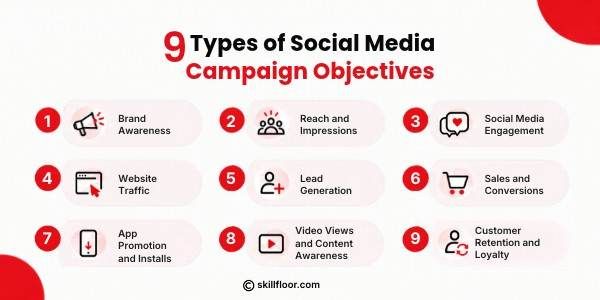
9 Types of Social Media Campaign Objectives
1. Brand Awareness
Brand awareness focuses on helping people become familiar with a business, product, or service. It is particularly useful for new businesses, product launches, and brands entering unfamiliar markets.
Example: A newly opened café shares short videos of its signature dishes, customer experiences, and preparation process to introduce itself to local audiences.
Useful KPIs:
-
Reach and impressions
-
Video views
-
Brand recall, where measurable
-
Profile visits



Brand awareness continues to receive attention from marketers. HubSpot’s 2026 Social Media Marketing Report found that 59% of surveyed social media teams identified increasing brand awareness as their top goal.
Practical tip: Focus on content that communicates what makes the brand distinctive. Repeatedly publishing generic promotional messages may not give audiences a strong reason to remember it.
2. Reach and Impressions
Reach and impressions help marketers understand how widely their content is being distributed.
Although these terms are often used together, they measure different things:
-
Reach: The number of unique people or accounts exposed to content, according to the platform's reporting method.
-
Impressions: The total number of times content is displayed, including multiple displays to the same person.
Example: A clothing store promotes its festive collection to audiences across selected locations to introduce its latest designs to more potential shoppers.
Useful KPIs: Reach, impressions, frequency, and cost per thousand impressions (CPM).
Practical tip: High reach does not automatically mean high sales. Use these metrics when visibility is the main goal, and assess other outcomes separately when necessary.
3. Social Media Engagement
Engagement is about encouraging people to interact with a brand rather than simply scroll past its content.
Interactions may include likes, comments, shares, saves, poll responses, and conversations. The most useful interactions depend on the content and the business goal. In social media marketing, strong engagement helps brands build relationships with their audience, understand customer interests, and create a more active online community.
Example: A digital marketing institute publishes a short SEO quiz and invites followers to answer it in the comments.
Useful KPIs: Engagement rate, comments, shares, saves, profile visits, and relevant follower growth.
Practical tip: Do not judge a campaign only by its like count. A smaller number of meaningful comments, shares, or enquiries may be more valuable than a large number of passive reactions.
4. Website Traffic
Sometimes, the goal of social media content is to bring interested users to a website. Traffic campaigns encourage people to explore a blog post, product page, landing page, or service page.
Example: A training institute shares a useful article about keyword research and directs interested readers to its course page for more information.
Useful KPIs:
-
Link clicks
-
Click-through rate (CTR)
-
Landing-page views
-
Cost per click (CPC)
-
Website engagement
Practical tip: Make sure the destination page delivers what the social media post promises. A slow website, confusing layout, or unclear next step can cause visitors to leave without taking action.
5. Lead Generation
Lead generation aims to collect enquiries from people who may be interested in a product or service. Depending on the business, a lead might be someone who submits a form, requests a brochure, books a consultation, or asks for a quotation.
Example: A digital marketing institute offers a course brochure and asks interested learners to complete an enquiry form.
Useful KPIs: Number of leads, cost per lead (CPL), qualified leads, form completion rate, and lead-to-customer rate.
Practical tip: More leads do not always mean better results. A campaign that attracts fewer but more relevant enquiries may deliver greater business value. Explain how personal information will be used and follow applicable privacy requirements.
According to Meta’s February 2026 announcement, based on research conducted with the Retailers Association of India, 77% of retail brand and product discovery in India happens on social media. This highlights the importance of brand awareness and product discovery campaigns in helping retail businesses reach potential customers and encourage further actions, such as website visits, enquiries, and purchases.
6. Sales and Conversions
Conversion campaigns encourage people to complete a specific action. This could be purchasing a product, booking an appointment, registering for a course, or subscribing to a service.
Example: An online skincare store promotes selected products and tracks completed purchases using a suitable conversion-tracking setup.
Useful KPIs: Purchases, conversion rate, cost per acquisition (CPA), return on ad spend (ROAS), and attributed revenue.
Practical tip: Set up conversion tracking before launching the campaign. Without reliable tracking, it becomes difficult to determine whether the advertisements are contributing to the intended outcome.
7. App Promotion and Installs
Businesses with mobile applications may use social media campaigns to encourage downloads or motivate existing users to complete important actions within the app.
Example: A fitness application promotes a free workout planner to people who have shown an interest in exercise and healthy routines.
Useful KPIs: App installs, cost per install (CPI), registrations, activated users, and retention.
Practical tip: Downloads are only one part of the picture. Check whether users complete registration, explore the app, and continue using it after installation.
8. Video Views and Content Awareness
Video campaigns help businesses distribute visual content to audiences who may be interested in watching it. They are useful for tutorials, product demonstrations, educational videos, and brand storytelling.
Example: A digital marketing institute shares a short video explaining how keyword research helps businesses attract relevant website visitors.
Useful KPIs: Video views, average watch time, completion rate, and audience retention.
Practical tip: Compare video performance carefully because platforms may use different definitions for a view. A large view count is not necessarily evidence that people watched the full video or understood its message.
9. Customer Retention and Loyalty
Not every campaign needs to attract new customers. Businesses can also use social media to maintain relationships with existing customers, encourage repeat purchases, and keep their communities active.
Example: A beauty brand shares skincare advice, answers customer questions, and introduces relevant products to people who have purchased from it before.
Useful KPIs: Repeat purchase rate, returning customer revenue, renewal rate, and customer lifetime value.
Practical tip: Give existing customers reasons to remain connected to the brand. Helpful content, responsive customer service, and relevant updates are generally more useful than repeatedly posting sales messages.
How to Choose the Right Social Media Campaign Objective
Choosing an objective becomes easier when you start with the result the business actually needs.
Follow these steps before launching a campaign:
-
Identify the business goal. Decide whether the priority is awareness, engagement, traffic, enquiries, sales, or retention.
-
Understand your audience. Consider their interests, needs, location, and stage in the buying process.
-
Choose the right platform. Match the platform to your audience and the type of content you want to share.
-
Plan your budget. Account for advertising spend, creative production, and campaign duration.
-
Select suitable KPIs. Decide how you will measure progress before the campaign begins.
-
Review and improve. Use performance data to identify what should be continued, adjusted, or tested.
For example, a new business may benefit from building awareness before concentrating on sales. An established business with a steady flow of visitors might instead focus on converting interested users into customers.
The right objective depends on the business's current needs, available resources, and marketing priorities.
Practical Example: An Online Clothing Store
Imagine an online clothing store preparing to launch its festive collection. Instead of expecting one advertisement to achieve every marketing goal, the business can plan separate activities for different outcomes.
|
Campaign objective |
Example activity |
KPIs to monitor |
|
Brand awareness |
Publish a collection-launch reel. |
Reach and impressions |
|
Website traffic |
Promote the collection page. |
Link clicks and landing-page views |
|
Sales |
Run product advertisements. |
Purchases, CPA, and ROAS |
|
Customer retention |
Share relevant new arrivals with existing customers. |
Repeat purchases and returning revenue |
Each activity serves a different purpose. Reviewing the results separately helps the marketing team understand which parts of the campaign are performing well and where changes may be needed.
Organic vs Paid Social Media Campaign Objectives
Businesses can use both organic content and paid advertising to reach their audiences, but each approach has different characteristics.
|
Factor |
Organic social media |
Paid social media |
|
Distribution |
Depends on followers, recommendations, and audience response. |
Uses paid advertising delivery |
|
Cost |
Publishing does not require media spend, but content takes time and resources |
Requires an advertising budget |
|
Common uses |
Community building, engagement, and regular communication |
Targeted reach, traffic, lead generation, and conversions |
|
Measurement |
Platform insights and website analytics |
Advertising reports and conversion analytics |
Which approach should you use?
-
Choose organic content to share helpful information, build relationships, and maintain a consistent brand presence.
-
Consider paid advertising when you need targeted distribution or want to encourage a specific action.
-
Combine the two when they support the same broader marketing strategy.
Neither approach guarantees success. Results depend on factors such as audience relevance, content quality, budget, competition, and campaign execution.
How to Set SMART Social Media Campaign Objectives
A campaign goal becomes more useful when it is specific and measurable. The SMART framework provides a simple way to structure objectives.
-
Specific: Clearly state what you want to achieve.
-
Measurable: Choose a metric that shows progress.
-
Achievable: Set a target that matches your resources and previous results.
-
Relevant: Connect the goal to a genuine business priority.
-
Time-bound: Decide when the result will be reviewed.
Examples of SMART Social Media Goals
|
Objective |
Illustrative target |
KPI |
|
Awareness |
Reach a defined audience within four weeks |
Reach and impressions |
|
Engagement |
Improve meaningful interactions over one month |
Engagement rate |
|
Website traffic |
Generate 1,000 landing-page visits in 30 days |
Landing-page views |
|
Lead generation |
Generate 50 qualified enquiries in 30 days within the agreed CPL target |
Qualified leads and CPL |
|
Sales |
Generate 30 attributed purchases in 30 days within the agreed acquisition-cost target |
Purchases and CPA |
These figures are examples, not guaranteed outcomes. Businesses should set targets using their actual budget, historical performance, and available resources.
How AI Can Help Optimise Social Media Campaigns
AI tools are becoming useful assistants for marketers who need to research audiences, develop content ideas, and review campaign performance.
Here are some practical applications:
-
Content planning: Generate initial caption ideas, video concepts, and content-calendar suggestions.
-
Audience insights: Examine interaction patterns and identify topics that attract attention.
-
Creative testing: Develop alternative headlines, messages, and calls to action for testing.
-
Reporting: Summarise performance data and highlight changes that deserve attention.
-
Campaign optimisation: Support selected advertising automation and bidding features.
For example, a retailer could test two different product headlines and compare their click-through rates and purchases to see which message works better.
However, AI output should not be accepted without review. Marketers need to verify facts, protect customer information, check tracking accuracy, and use real performance data when making decisions.
Common Social Media Campaign Mistakes to Avoid
Even a well-designed campaign can underperform when its objective and execution do not match.
Watch out for these common mistakes:
-
Launching a campaign without defining its purpose.
-
Treating likes and views as the only signs of success.
-
Targeting people who are unlikely to be interested in the offer.
-
Ignoring performance reports after the campaign starts.
-
Expecting awareness campaigns to generate immediate sales.
-
Sending visitors to a slow or irrelevant landing page.
-
Failing to check conversion tracking and attribution.
-
Changing several campaign elements at once without a structured testing plan.
A regular review of campaign performance helps marketers identify problems early and make better-informed decisions.
Frequently Asked Questions
1. What are the main objectives of social media marketing?
Common objectives include brand awareness, reach, engagement, website traffic, lead generation, sales, app promotion, video views, and customer retention. The appropriate choice depends on the result a business wants to achieve.
2. Which social media campaign objective is suitable for beginners?
Start with a goal that matches your business needs. Brand awareness may suit a new business, while a service provider looking for enquiries may benefit from a lead-generation campaign.
3. How can I measure the success of a social media campaign?
Choose KPIs that reflect the campaign objective. Reach and impressions help measure visibility, engagement rate tracks interactions, qualified leads measure enquiry quality, and purchases or ROAS help evaluate sales campaigns.
4. What is the difference between reach and impressions?
Reach measures the number of unique people or accounts exposed to content, while impressions measure the total number of times that content is displayed.
5. Can AI improve social media campaign performance?
AI can assist with content planning, audience analysis, reporting, and selected optimisation tasks. Its usefulness depends on the quality of the data, the campaign strategy, and human oversight.
A successful social media campaign starts with a clear understanding of what the business wants to achieve. Whether the priority is reaching new audiences, encouraging engagement, attracting website visitors, generating leads, increasing sales, or retaining customers, the objective should guide the entire campaign. Learn to match each goal with relevant content and meaningful KPIs. Review the results, understand what the data reveals, and make improvements based on evidence rather than assumptions. For students and aspiring digital marketers, this approach builds a strong foundation for planning campaigns that connect social media activity with business outcomes.
Digital Marketing Courses in Other Locations in India
Ahmedabad | Aurangabad | Bangalore | Bhilai | Bhopal | Bhubaneshwar | Chandigarh | Chennai | Cochin | Coimbatore | Dehra Dun | Delhi | Faridabad | Ghaziabad | Gorakhpur | Guntur | Gurgaon | Guwahati | Hyderabad | Jaipur | Kanpur | Khammam | Kolkata | Lucknow | Madurai | Mumbai | Mysore | Nagpur | Noida | Patna | Pondicherry | Pune | Ranchi | Shimoga | Surat | Thane | Thiruvananthapuram | Tiruchirappalli | Tirupati | Vadodara | Visakhapatnam | Warangal | Jalandhar | Jodhpur | Indore | Durgapur | Jamshedpur | Dhanbad | Kota | Karnal | Udaipur | Amritsar | calicut | Nashik | Ludhiana | varanasi | thrissur | Mangalore | Raipur |