













































What Are SEO Backlinks?
Find out why SEO backlinks are important and how they improve website visibility and search rankings. See simple methods to build strong and quality backlinks.

Have you ever wondered why, although having equal content, some websites manage to rank on Google's first page while others struggle?
Backlinks, a potent search engine optimization component, are frequently the solution.
One of the best ranking proofs that search engines like Google use is SEO backlinks. They help in assessing a website's credibility, relevance, and authority. Backlinks function as "votes of confidence" from one website to another.
SEO backlinks are links from one website to another. They are like references from other sites pointing back to your site.


But not all backlinks are created alike; some might greatly raise your rankings, while others might have little to no effect or even be detrimental.
You will discover what SEO backlinks are, why they are important, the different kinds of backlinks, and how to successfully create high-quality backlinks in this guide.
What Are SEO Backlinks?
Links from one website to another that serve as references or votes of confidence are known as SEO backlinks, and they help search engines in determining the relevancy, authority, and trustworthiness of various webpages.
Search engines are informed by backlinks that your content is significant and deserving of a rating. Links from reputable websites greatly increase your visibility, credibility, and organic search engine results.
Search engines like Google use these backlinks as signals to understand:
-
How reliable a website is
-
How relevant its content is
-
How popular it is across the internet
So, backlinks play a major role in deciding how high a website ranks in search engine results by showing search engines that your content is trusted, relevant, and authoritative.
Types of SEO Backlinks
-
Natural Backlinks: When other websites connect to your material because they think it's useful or worthwhile, these links are automatically generated. They are very trusted in digital marketing since they demonstrate actual authority and sincere user interest in your website.
-
Manual Backlinks: By contacting website owners, publishing guest articles, or submitting your website to directories, you can get these backlinks. Planning is necessary, but if they are constructed from reliable and pertinent websites, they can significantly boost SEO.
-
Self-Created Backlinks: Through comments, forums, social media profiles, and other public platforms, you create these links. In digital marketing, although they are simple to make, they often have little SEO benefit and should be utilized with caution to prevent spam signals.
-
Editorial Backlinks: Other websites automatically include these backlinks in their content because they think your content is helpful. Since they originate from genuine suggestions and reliable, pertinent web sources, they are the most valuable kind.
DoFollow vs NoFollow Backlinks
-
DoFollow Backlinks: DoFollow backlinks transfer SEO value from one website to another. Through the transfer of authority and trust, they aid in raising search engine results. These links are crucial to SEO since they have a direct impact on a website's visibility, domain strength, and overall organic performance.
-
NoFollow Backlinks: Backlinks that don't directly transfer authority or SEO value to another website are known as no-follow backlinks. They are still helpful for natural link profiles, traffic, and brand visibility, though. They assist in keeping things balanced and appear more natural to search engines without directly impacting rankings in SEO.
Why Backlinks Are Important for SEO
Backlinks have a significant impact on a website's performance in search results as well as its general exposure, credibility, and ranking potential.
-
Improve Search Rankings: Web pages score higher in competitive search engine results when they have high-quality backlinks that suggest authority to search engines.
-
Increase Website Authority: Credibility is increased by backlinks from reputable websites, which indicate to search engines that your information is trustworthy, valuable, and deserving of ranking.
-
Drive Referral Traffic: Backlinks increase targeted traffic and possible engagement with your content or services by bringing in direct visitors from other websites.
-
Boost Brand Visibility: Your brand gains more exposure, recognition, and awareness across various internet platforms and audiences when it appears on several websites.
-
Signal to Google’s Algorithm: As ranking signals, backlinks assist Google in assessing the overall reliability, relevancy, and quality of content for search results.
How Do Backlinks Work in SEO?
In search engine optimization, backlinks link websites and signal search engines that your content is reliable, pertinent, and useful for those looking for information online.
-
Trust Signals: Your website's authority and ranking in search results can be greatly enhanced by backlinks, which serve as trust signals to search engines by indicating that other websites suggest your content.
-
Improve Visibility: Search engines recognize the value of your content when high-quality websites link to your pages, increasing visibility and automatically drawing in additional organic visitors.
-
Faster Indexing: By following links from one website to another, backlinks increase indexing speed and overall website crawl efficiency and aid search engines in finding new pages more quickly.
-
Better Rankings: Over time, higher rankings and increased online trust result from having more authoritative and pertinent backlinks to your website.

-
Referral Traffic: When consumers click on links from other websites, backlinks also increase referral traffic by bringing in targeted people who are already interested in your offerings.


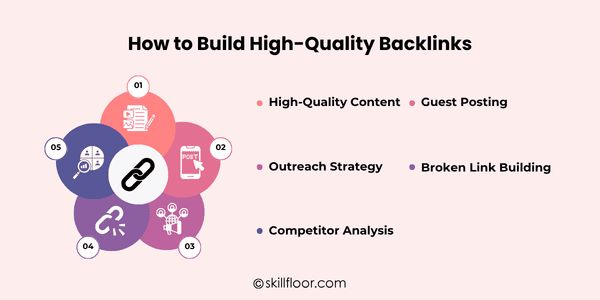
How to Build High-Quality Backlinks
Building backlinks requires consistency and strategy. Here are the most effective methods:
-
Create High-Quality Content: The foundation of link building creates original and useful content. In terms of SEO strategy, informative articles enhance content optimization and naturally draw backlinks, making your pages more relevant, useful, and simpler to rank in search results.
-
Guest Posting: Writing articles for other websites in your niche and including backlinks is known as guest posting. This technique aids in SEO optimization by increasing visibility, establishing authority, and attracting relevant traffic from reliable external websites.
-
Outreach Strategy: Requesting backlinks from bloggers, influencers, and website owners is known as outreach. This aids in the development of connections and the acquisition of high-quality links that enhance the authority and search engine ranking of websites.
-
Broken Link Building: This technique entails identifying broken links on other websites and proposing your material as a substitute. In terms of SEO strategies, it enhances user experience and generates solid, pertinent backlinks for higher ranks.
-
Competitor Analysis: Analyzing your competition entails researching their backlink sources and focusing on similar ones. This tactic helps in finding link opportunities and developing a more robust backlink profile for higher search engine rankings in SEO research.
Tools and Resources for Backlink Analysis and Monitoring
|
Tools/Resources |
Description |
|
SEMrush |
SEMrush provides comprehensive backlink analysis, including competitor research, backlink audits, and monitoring of new and lost backlinks. It offers insights into anchor text distribution, domain authority, and referring domains. |
|
Moz's Link Explorer |
Moz's Link Explorer offers insights into a website's backlink profile, including domain authority, spam score, and top-linked pages. It provides competitive analysis and helps track link growth and quality over time. |
|
Ahrefs |
Ahrefs is a powerful tool for backlink analysis, offering features such as backlink monitoring, competitor analysis, and link intersection. It provides detailed insights into referring domains, anchor text distribution, and new/lost backlinks. |
|
Google Search Console |
Google Search Console offers basic backlink data, including information about external links pointing to your site. It provides insights into top linking sites, linking pages, and anchor text used by external sites. |
|
Majestic SEO |
Majestic SEO offers in-depth backlink analysis, including historic and fresh index data. It provides metrics like Trust Flow and Citation Flow to assess the quality of backlinks. Majestic also offers competitor analysis and link context visualization. |
Common Backlink Mistakes to Avoid
Errors with backlinks might lower your website's rating and negatively impact your SEO performance. A solid, organic backlink profile that effectively increases authority, trust, and search engine exposure can be built by avoiding bad methods.
-
Low-Quality Links: Because search engines may identify spam links, purchasing inexpensive or low-quality backlinks can harm your SEO strategy. Over time, this results in fines, poorer ranks, and diminished website reputation.
-
Spam Techniques: By generating artificial links, spammy link-building techniques damage your SEO optimization. These methods erode trust, perplex search engines, and may cause your website to be deindexed or have its rating lowered.
-
Self-Created Links: Your SEO performance may suffer if you have too many self-made backlinks. They can be viewed as artificial by search engines, which would diminish their worth and severely damage your backlink profile and website authority.
-
Irrelevant Websites: Your SEO ranking signals are impacted when you disregard link relevancy. Backlinks from unrelated websites are worthless and can erode trust, which makes it more difficult for your pages to appear in search results.
-
No Monitoring: Ignoring your backlink profile can be detrimental to your SEO. Rankings may be impacted by toxic or broken connections that go unreported. Maintaining robust, hygienic, and efficient backlink performance overall is facilitated by routine monitoring.
The Future of Backlinks in SEO
As search engines become more intelligent and focused on user intent, content quality, and overall website trust, the function of backlinks in SEO is always changing. Backlinks will still be a crucial ranking element, but how they are assessed is changing dramatically.
-
Search engines will prioritize quality over quantity, rewarding fewer but highly authoritative and contextually relevant backlinks from trusted websites.
-
AI-powered algorithms will become more advanced in detecting unnatural, spammy, or manipulated link-building practices with higher accuracy.
-
Contextual relevance will play a bigger role, meaning backlinks from closely related topics, industries, or niches will carry stronger SEO value.
-
Unlinked brand mentions may gain importance as search engines increasingly recognize brand authority even without direct hyperlinks.
-
Backlinks will work alongside user experience signals, such as engagement, dwell time, and content usefulness, to influence rankings more holistically.
Overall, the future of backlinks is not about building more links, but about earning meaningful, relevant, and trust-driven connections across the web.
Enrolling in a structured SEO course will greatly speed up your learning process with helpful assistance if you're serious about mastering SEO and comprehending how backlinks, rankings, and Google algorithms actually function.
A professional program simplifies technical techniques like link building, on-page optimization, and keyword research, making it simpler to use difficult SEO ideas in practical tasks.
Platforms like Skillfloor offer structured SEO courses that emphasize real-world project experience, industry tools, and practical skills for both novices and professionals seeking practical training.
FAQs on SEO Backlinks
1. How long do backlinks take to show SEO results?
Backlinks usually take a few weeks to a few months to show results in SEO. Search engines need time to crawl, evaluate, and update rankings based on new link signals.
2. Do all backlinks help improve website ranking?
No, not all backlinks help improve ranking. Only high-quality, relevant, and trusted backlinks contribute positively to SEO, while low-quality links may have little or no impact.
3. Can I rank without backlinks?
It is possible but very difficult. Without backlinks, your SEO growth is slower because search engines may not see your website as highly trusted or authoritative compared to others.
4. What makes a backlink safe for SEO?
A safe backlink comes from a relevant, trusted website with good authority. It should be placed naturally within useful content and not created using spammy or forced methods.
5. How many backlinks are needed to rank?
There is no fixed number of backlinks needed to rank. SEO success depends more on backlink quality, relevance, and consistency rather than just quantity.
Building a strong online presence requires time, patience, and the right strategies. When used effectively, SEO backlinks can significantly increase your website's visibility, build trust, and boost organic traffic from search engines. They signal to these engines that your content is valuable and worthy of a high ranking. With consistent effort, SEO backlinks can help you reach your target audience and enhance your rankings. It’s essential to focus on high-quality backlinks instead of resorting to quick or spammy techniques. From the perspective of search engines, quality backlinks gradually increase your website's authority and enhance the credibility of your content. By continuing to learn, staying consistent, and prioritizing value, you will see positive results in due time.
Digital Marketing Course in Ahmedabad | Digital Marketing Course in Bangalore | Digital Marketing Course in Chennai | Digital Marketing Course in Coimbatore | Digital Marketing Course in Hyderabad | Digital Marketing Course in Pune | Digital Marketing Course in Delhi | Digital Marketing Course in Mumbai
Digital Marketing Courses in Other Locations in India
Ahmedabad | Aurangabad | Bangalore | Bhilai | Bhopal | Bhubaneshwar | Chandigarh | Chennai | Cochin | Coimbatore | Dehra Dun | Delhi | Faridabad | Ghaziabad | Gorakhpur | Guntur | Gurgaon | Guwahati | Hyderabad | Jaipur | Kanpur | Khammam | Kolkata | Lucknow | Madurai | Mumbai | Mysore | Nagpur | Noida | Patna | Pondicherry | Pune | Ranchi | Shimoga | Surat | Thane | Thiruvananthapuram | Tiruchirappalli | Tirupati | Vadodara | Visakhapatnam | Warangal | Jalandhar | Jodhpur | Indore | Durgapur | Jamshedpur | Dhanbad | Kota | Karnal | Udaipur | Amritsar | calicut | Nashik | Ludhiana | varanasi | thrissur | Mangalore | Raipur |