














































What are the Objectives of Cyber Security
Learn the core objectives of cybersecurity confidentiality, integrity, availability, authentication, authorization, and non-repudiation, explained simply for beginners.

Every security control used in modern organizations, from encryption and multi-factor authentication to backup systems and access controls, is designed to achieve a specific objective. These objectives form the foundation of cybersecurity, guiding how organizations protect data, manage access, maintain system availability, and establish accountability across digital environments.
Their importance continues to grow as cyber threats become more frequent and costly. According to industry estimates, global cybercrime costs are projected to reach $10.5 trillion annually, making cybercrime one of the fastest-growing economic threats worldwide. As organizations face increasing risks from ransomware, phishing attacks, data breaches, and system disruptions, understanding the objectives of cybersecurity has become essential for building secure and resilient systems.
From protecting sensitive information to ensuring business continuity during attacks, these principles influence every aspect of modern cybersecurity strategy and serve as the foundation for effective security controls.
Why Cybersecurity Objectives Matter
Cybersecurity objectives are important because they define the core information security principles that every secure system must follow, and this is closely related to the importance of cybersecurity in modern organizations. These principles support a broader cybersecurity framework, helping organizations protect sensitive information, manage risks, and maintain reliable operations.


In practice, every security control is designed to support one or more of these objectives. Together, they provide a structured approach to securing systems, data, and digital resources while ensuring that security efforts align with business and operational requirements.
These objectives also help organizations make better security decisions. Instead of reacting to threats in isolation, security teams evaluate risks based on which Cyber Security objective is affected and then select the most appropriate control or mitigation strategy. This structured approach enables modern systems to remain secure, reliable, and scalable despite evolving cyber threats.
In simple terms, Cyber Security objectives serve as the decision-making foundation of cybersecurity, helping organizations build systems that are not only protected from attacks but also trustworthy, resilient, and operationally stable.
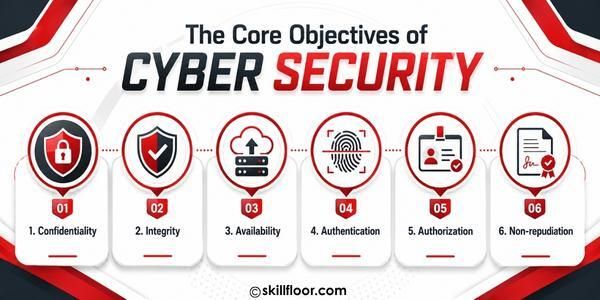
What Are the Core Objectives of Cyber Security?
1. Confidentiality
Confidentiality ensures that information is accessible only to authorized users. This is the objective most people associate with “privacy.” It prevents unauthorized access to data such as personal details, financial records, and login credentials.
In practice, confidentiality is maintained through encryption, access controls, and secure authentication methods. For example, a hospital restricts patient records so only doctors and authorized staff can view them.
A common beginner mistake is assuming confidentiality only applies to “secret” information. In reality, it applies to any data that shouldn’t be visible to unauthorized users — including everyday business documents, employee records, and customer details.
2. Integrity
Integrity ensures that data remains accurate, complete, and unaltered unless changed through an authorized process. If someone tampers with a file, a transaction record, or a database entry without permission, that’s an integrity violation — even if no data was stolen.
For example, if a bank transaction amount is altered during processing, it leads to incorrect financial records. Integrity is maintained using hashing techniques, digital signatures, and data validation systems.
3. Availability
Availability means systems, applications, and data should be accessible to authorized users whenever they need them. Even a highly secure system becomes useless if it isn’t available when required — a website that crashes during a sale, or a hospital system that goes down during an emergency, represents an availability failure.
Threats like DDoS attacks specifically target availability by overwhelming systems with traffic. Organizations maintain availability through cloud infrastructure, backups, redundant servers, and disaster recovery plans — not just to prevent attacks, but to make sure operations don’t stop if something goes wrong.
4. Authentication
Authentication verifies that a user, device, or system is actually who or what it claims to be. Passwords, OTP verification, biometrics, and multi-factor authentication are all authentication methods. Without authentication, confidentiality and integrity controls don’t mean much — anyone could claim to be an authorized user and bypass them.
5. Authorization
Authorization defines what an authenticated user is allowed to access or do once they’re inside a system. Logging in is only the first step — access beyond that point is restricted based on roles. For example, a user might be able to view data but not change system settings. This keeps sensitive resources under strict, role-based control.
6. Non-repudiation
Non-repudiation ensures that an action — like sending a message, approving a transaction, or accessing a file — can be traced back to the person who performed it, and they can’t credibly deny doing it. This is especially important in banking, legal communications, and financial operations, where organizations need proof of who did what and when. Digital signatures and audit logs are common ways to enforce this.
Where These Objectives Show Up in Real Life
These principles aren’t just theory — they're applied in nearly every digital system you interact with daily, including:
- Banking and financial platforms
- Healthcare systems
- E-commerce websites
- Government portals
- Corporate IT systems
In each case, these objectives work together to keep sensitive data protected while allowing smooth, secure operations. These concepts become much easier to understand when combined with structured learning, such as Skillfloor. It is training that focuses on practical understanding along with theory.
Common Mistakes Beginners Make When Learning These Concepts
A few patterns come up often when people start studying cybersecurity:
-
Treating confidentiality and security as the same thing (security is broader — it includes integrity and availability too)
-
Assuming availability is “just an IT problem” rather than a security objective
-
Overlooking non-repudiation because it sounds more like a legal term than a technical one

-
Memorizing the CIA triad without connecting it to real systems or examples


Understanding these objectives conceptually and being able to explain how they apply to real scenarios is often more valuable in interviews and on the job than memorizing definitions alone.
If you're just starting, it also helps to understand the broader career mistakes professionals wish they'd avoided early on, especially when looking at cybersecurity jobs for freshers
Why These Objectives Matter for Your Cyber Security Career
If you're exploring a career in Cyber Security, these objectives are among the first concepts you'll encounter. Whether you're preparing for an entry-level role such as a Security Analyst or SOC Analyst, studying for a cybersecurity certification, or transitioning from another IT field, understanding these principles is essential for building a strong security foundation.
Employers and hiring managers often expect candidates to understand not only what these objectives are but also how they apply to real-world security practices. Concepts such as Confidentiality, Integrity, Availability, Authentication, Authorization, and Non-repudiation influence everything from security policies and risk assessments to access management and incident response processes, and this becomes clearer when understanding how these concepts are applied in entry-level cybersecurity roles.
A strong understanding of these objectives also makes it easier to learn more advanced cybersecurity topics. Areas such as network security, ethical hacking, identity and access management (IAM), security operations, cloud security, and incident response all build upon these foundational principles.
As cybersecurity threats continue to evolve, organizations rely on professionals who can apply these concepts to strengthen security practices, reduce risks, and support secure business operations. Developing a solid understanding of Cyber Security objectives early in your learning journey can help you better understand security technologies, make informed decisions, and build the practical knowledge required for long-term career growth.
Understanding Cyber Security Objectives Through Examples
The following examples illustrate how each Cyber Security objective helps address specific security challenges and contributes to secure, reliable, and accountable digital operations.
|
Objective |
Protects Against |
Example |
|
Confidentiality |
Unauthorized access |
Encrypting sensitive customer data during transmission |
|
Integrity |
Data tampering |
Using hashes to detect unauthorized file |
|
Availability |
System downtime |
Maintaining backup servers during outages |
|
Authentication |
Fake identity access |
Verifying user identity through multi-factor authentication (MFA) |
|
Authorization |
Unauthorized actions |
Restricting administrative access using role-based access control (RBAC) |
|
Non-repudiation |
Denial of actions |
Recording transactions using digital signatures and audit logs |
FAQs
-
What are the main objectives of Cyber Security?
The main objectives are confidentiality, integrity, and availability (CIA triad), along with authentication, authorization, and non-repudiation. -
What is the CIA triad in Cyber Security?
It refers to confidentiality, integrity, and availability — the core principles that ensure data is secure, accurate, and accessible when needed. -
Why is confidentiality important in Cyber Security?
Confidentiality ensures that sensitive information is accessed only by authorized users, preventing data leaks and unauthorized access. -
What is the difference between authentication and authorization?
Authentication verifies a user’s identity, while authorization controls what that user is allowed to access or perform in a system. -
Why is availability considered a Cyber Security objective?
Because systems must remain accessible to authorized users, even during attacks or failures, to ensure smooth business operations. -
What is non-repudiation in Cyber Security?
Non-repudiation ensures that actions can be traced back to a user and cannot be denied, using methods like digital signatures and audit logs.
The objectives of Cyber Security—Confidentiality, Integrity, Availability, Authentication, Authorization, and Non-repudiation—work together to ensure that information remains secure, accurate, accessible, and accountable across digital systems. These principles form the foundation of modern cybersecurity and guide how secure systems are designed, implemented, and maintained. As cyber threats continue to grow in scale and complexity, understanding these objectives is essential. They help protect sensitive data, reduce security risks, and ensure trust in every digital interaction. From individual users to large organizations, they play a critical role in building secure and reliable digital environments. A clear understanding of these fundamentals also strengthens the ability to identify risks, respond to security challenges, and adapt to evolving cyber threats effectively.
Sources & references:
Digital Marketing Courses in Other Locations in India
Ahmedabad | Aurangabad | Bangalore | Bhilai | Bhopal | Bhubaneshwar | Chandigarh | Chennai | Cochin | Coimbatore | Dehra Dun | Delhi | Faridabad | Ghaziabad | Gorakhpur | Guntur | Gurgaon | Guwahati | Hyderabad | Jaipur | Kanpur | Khammam | Kolkata | Lucknow | Madurai | Mumbai | Mysore | Nagpur | Noida | Patna | Pondicherry | Pune | Ranchi | Shimoga | Surat | Thane | Thiruvananthapuram | Tiruchirappalli | Tirupati | Vadodara | Visakhapatnam | Warangal | Jalandhar | Jodhpur | Indore | Durgapur | Jamshedpur | Dhanbad | Kota | Karnal | Udaipur | Amritsar | calicut | Nashik | Ludhiana | varanasi | thrissur | Mangalore | Raipur |